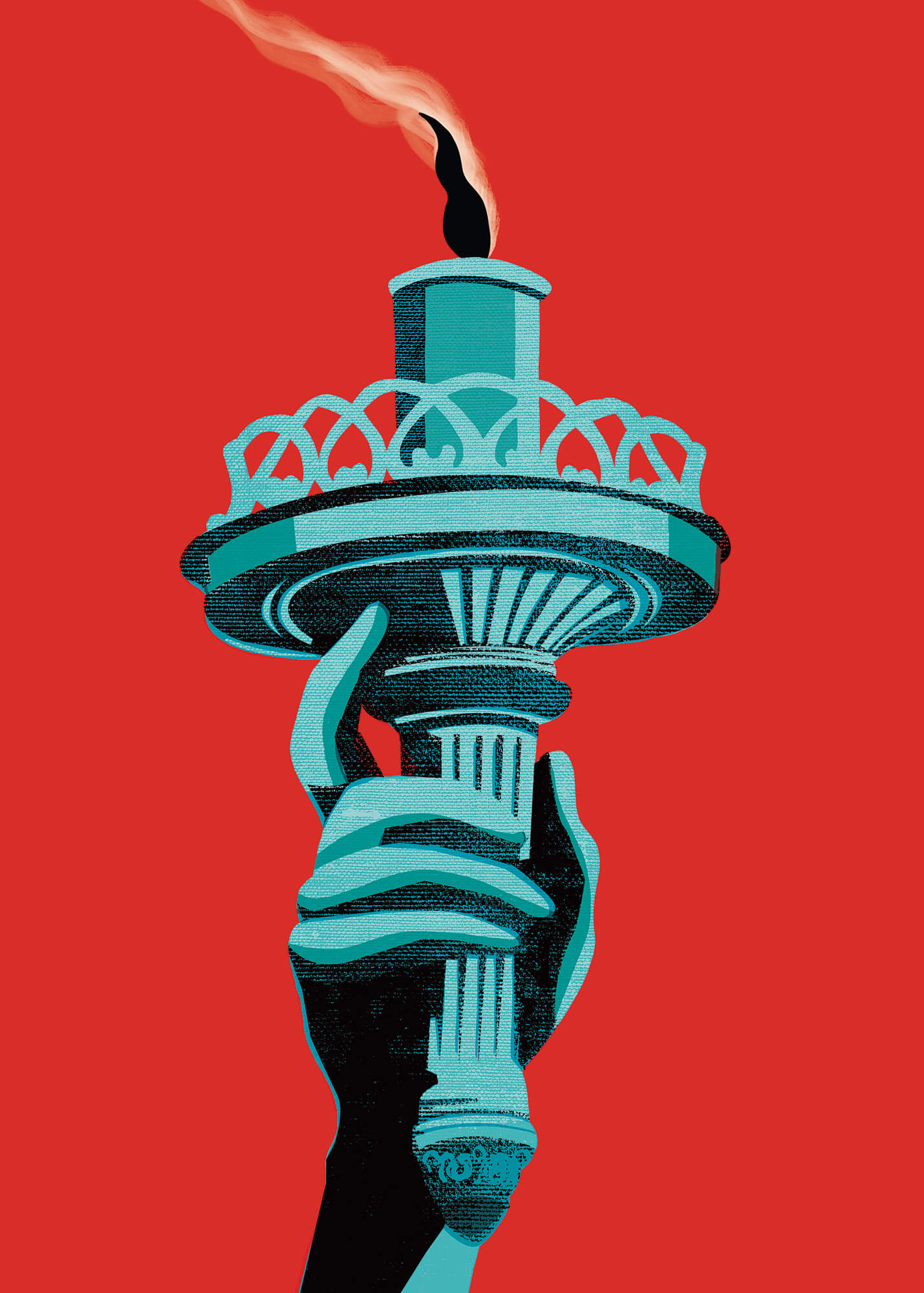
Liberty Weekend, 1986: the national celebration of the Statue of Liberty’s 100th birthday. I was nearly 13 then, so what I recollect now is how brilliantly on that Fourth of July the largest fireworks display in American history lit up New York Harbor and Operation Sail, the grandest international assemblage of wooden sailing vessels ever known.
It was, for me, a moment of awe and wonder simply watching it on television.
The opening ceremonies on July 3 were something, too. The French president dropped in to check on his country’s colossal gift. Hollywood royalty spoke. José Feliciano sang, and Mikhail Baryshnikov danced to Gershwin after being sworn in as a U.S. citizen. Neil Diamond belted out the money-line chorus to his immigration anthem — “they’re coming to America!” — over and over again.
It was a celebration of immigrants and immigration by a nation formed from the very same. During his well-received remarks, President Ronald Reagan spoke of the statue as “Miss Liberty,” as “the mother of exiles” in homage to poet Emma Lazarus, as “everybody’s gal.” His portrait of the United States elided Native Americans, as it often did — apart from mentioning those who had worked on the statue’s five-year restoration alongside French craftspeople and Americans of African and European descent — but his core question struck no less resonant a chord: “Which of us does not think of . . . grandfathers and grandmothers, from so many places around the globe, for whom this statue was the first glimpse of America?”
Welcoming the stranger is one of three great American traditions regarding the immigrant that are as old as America itself. Of course, welcomes are fraught with peril before trust is established — a lesson cruelly learned by those Taino Indians who, in the words of a recent Smithsonian magazine piece, so “impressed Columbus with their generosity.”
Columbus represented a civilization that at least paid lip service to hospitality and xenophilia as among the greatest virtues. God’s injunction to take care of the foreigner, the traveler, the exile who appears at your door is repeated dozens of times in the Pentateuch. Abraham and Sarah are rewarded for doing it; the Israelites are admonished not to do unto others as the Egyptians had done unto them. Christ, that divine self-exile among humans, identifies himself with the stranger in Matthew 25, and lists the manner of the stranger’s welcome as a leading criterion in the judgment of nations.
By then, displays and failures of such welcome could be said to drive much of the action — and the tragedy — of Greek and Roman plays and epic poetry. In the classical world, wisdom generally lay in cautious welcome, with strong emphasis on both words, lest one incur either the treachery of the wayfarer or the ire of the gods.
A pious man, George Washington understood such wisdom, even if as a slaveowner he practiced it in the breach. “I had always hoped that this land might become a safe & agreeable Asylum to the virtuous & persecuted part of mankind, to whatever nation they might belong,” he wrote to a Dutch political exile in 1788, the year the United States ratified the Constitution and held its first presidential election.
The two main waves of European immigration delivered more than 30 million people to our shores in the 19th and early 20th centuries, and one way or another, it might be said of their descendants that they “made it.” So, if welcome is one time-honored American custom, being the stranger is another. The botanist and author Robin Wall Kimmerer offers this humbling contemplation of a creation myth from her Potawatomi tradition in Braiding Sweetgrass.
“It is good to remember that the original woman was herself an immigrant,” she begins.
She fell a long way from her home in the Skyworld, leaving behind all who knew her and who held her dear. She could never go back. Since 1492, most here are immigrants as well, perhaps arriving on Ellis Island without even knowing that Turtle Island rested beneath their feet. Some of my ancestors are Skywoman’s people, and I belong to them. Some of my ancestors were the newer kind of immigrants, too. . . . And here we all are, on Turtle Island, trying to make a home. Their stories, of arrivals with empty pockets and nothing but hope, resonate with Skywoman’s. She came here with nothing but a handful of seeds and the slimmest of instructions to “use your gifts and dreams for good,” the same instructions we all carry.
The third great American tradition of immigration — and here the adjective indicates magnitude, not laudability — is rejection. Fear. Closed doors. Exclusion. The reception afforded the 400,000 unwilling Africans transported to what is now the U.S. during the 330-year span of the transatlantic slave trade could not be called a welcome in any humane sense of that word: centuries of enslavement followed by social segregation and economic and political oppression for their descendants.
Hardly anyone escaped what would come to be called, ironically, “nativism,” which could be defined as simply as the aggressive resentment of the foreign-born, or as specifically as the fearful gatekeeping of the rights and privileges of citizenship against those who must not be entrusted with it. Before 1776, when colonists along North America’s Atlantic seaboard were subjects of the English king, legal repression, animosity and vigilante violence were all-too-frequently visited upon Jews and Catholics, Quakers and Anabaptists. Benjamin Franklin, for one, expressed misgivings about the alienness and incompatibility of the Pennsylvania Dutch.
During the largely anti-Irish, anti-Catholic nativist hysteria of the 1850s, Americans who viewed themselves as “old stock” formed the Native American Party, more readily remembered as the Know-Nothings for their official policy of keeping their politics secret. Less discreet were urban street gangs like Baltimore’s Plug Uglies, who played leading roles in a series of election riots in the city in 1856 that involved open gun battles and left dozens dead and scores injured. The following year, chanting about “a foreign band” led by a “servile priesthood” that would pollute “this Eden-land,” the Uglies disrupted local elections in Washington, D.C., with a bloody street melee quelled only when President James Buchanan deployed two companies of U.S. Marines to intervene.
Nothing, it seems, is new under the American sun. Historian Jill Lepore dedicates her illuminating 2019 book-length essay, This America: The Case for the Nation, to her father, “whose immigrant parents named him Amerigo in 1924, the year Congress passed a law banning immigrants like them.” During a 1920 House of Representatives debate that yielded an earlier round of such restrictions, one Oklahoma Democrat recounted his visit to Ellis Island, where he could see only reasons to “protect” American citizens from these new arrivals, who were, to a man, woman and child, “weak, small of stature, poorly clad, emaciated, and in a condition which showed that the environments surrounding them in their European homes were indeed very bad . . . not the kind of people we want as citizens in this country.”
These efforts were so successful at all but locking the U.S. immigration door that in 1939 the U.S. Coast Guard prevented the German ocean liner St. Louis from making land with more than 900 Jewish refugees aboard. The first concentration camps were then six years old. Nazi Germany invaded Poland three months later.
Ellis Island finally shuttered as an immigration portal in 1954, by which time officials stationed at international airports were performing most of the comparatively light work of the U.S. Immigration and Naturalization Service.
The dark chapters of U.S. immigration history seemed forgotten in 1986. That November, Reagan signed what by most measures is the last major piece of immigration legislation U.S. lawmakers have fashioned. It targeted employers who hired undocumented, foreign-born workers and offered amnesty to nearly 3 million undocumented immigrants who had lived in the country at least since 1982 — or had been working seasonally in agriculture through May 1986. Strangers were welcomed.
Soon, however, those who hoped to enter our borders would have a much harder time of it. American amnesia shifted to block out our immigrant past wholesale.
Since then, calls to overhaul the U.S. immigration system have fallen deep down the political cracks. Our rhetoric about immigration has sunk deeper still.

“We are saddened by the state of contemporary debate and the vilification of immigrants,” the U.S. Catholic bishops, speaking with near-unanimity, said in an official statement last fall. Cataloging grievances that had risen to their ears, and acknowledging the nation’s responsibility to regulate its borders, they spoke of the “enormous contributions to the well-being of our nation” that contemporary immigrants make, whatever papers they do or don’t hold. “Human dignity and national security are not in conflict,” they said. “Both are possible if people of good will work together.”
Asked his opinion, Pope Leo XIV deplored the “extremely disrespectful” treatment of America’s undocumented immigrants and affirmed the bishops’ appraisal of the “climate of fear and anxiety around questions of profiling and immigration enforcement.” He added: “No one has said that the United States should have open borders.” Instead he called for due process and recognition that people aren’t the problem; rather, the broken system is.
I paid my own visit to New York’s Castle Garden and Ellis Island three years ago, the fulfillment of a lifelong yearning to discover something of my family’s — mostly opaque, I’m sorry to say — immigrant past: the Brits who arrived in the first-wave 1850s and the Hungarians and Dutch at the turn of the 20th century.
I found that America in 1900 had an exacting and remarkably well-organized system for welcoming strangers and putting them on the long path toward citizenship. It put travel-weary people through what were typically a few scrutinous, anxious hours or days, but on the whole it treated them fairly. In 2 percent of cases — and these stories were often heartbreaking — it sent would-be migrants back because of criminal records, questionable behavior or matters of physical or mental health. I read about bad attitudes and bad days and stern treatment, but also about kindness, humanity, patience and steadfastness. The country needed a self-replenishing workforce for agriculture, manufacturing and service jobs, and the system worked.
Great hardships pushed those migrants to pack their trunks and board ships in Bremen and Liverpool, Naples and Rotterdam, Antwerp and Le Havre, ceding control of their lives to sea captains and the open ocean. It strikes me as no different than what pushes people today to take their chances on makeshift rafts, the Mexican desert and U.S. law enforcement. Their first glimpse of America? Not the Statue of Liberty or even Neil Diamond in black sequins, but angry faces, detention centers, family separations, beatings in the streets, arrests.
Yet they’re still coming. Despite our fears and the failure of American ingenuity to come up with a smart, sensible system of welcome, we still have something here the world wants to be part of.
“What has made us a nation is our love of liberty and our realization that we’re part of a great historic venture, an experiment in freedom to test the ability of people to live together in freedom, respecting the rights of others and expecting that their rights, in turn, will be respected.” Ronald Reagan spoke those words when he announced the formation of the Statue of Liberty — Ellis Island Centennial Commission in 1982, one year after a fellow American citizen tried to kill him at close range in violation of those high-minded ideals.
Like their nativist forebears, many today question the capacity of this generation of newcomers to understand that “great historic venture,” to embrace that “experiment in freedom” and live out that mutual respect. Perhaps it’s time Americans ask whether we still believe in those values and habits ourselves.
John Nagy is managing editor of this magazine.