
Stained and stiffened by the berry juice of previous summers, the cloth foraging bag was strapped to my waist. I bypassed the family cemetery on the hillside behind my house, its seven gravestones hidden in weeds and shaded by a broad maple, and leaned forward against the slant of the sunlight as if it could keep me on my feet until I reached the elderberry copse I sought. My mother had preferred elderberry over all other varieties of pie, which is probably why she followed me and pantomimed my movements as I twisted off parasol-like clusters of the fruit to drop into the bag. Whenever she joins my foraging, she tells stories about the life she inhabited before her current life as a ghost. She enters hibernation each autumn when the first snowfall of the year has wilted the asters, and she reemerges in spring to resume her storytelling while I gather wild strawberries, each smaller than a pea, from June meadows of clover and timothy. Her winters underground go unmentioned. Probably because that story would always be the same old story.
The knuckled region where I will be buried close to my mother is in a way like an anthology of ghost stories with a number of pages missing: She dwells in a community of apparitions. My town and the creek it straddles share the placename Ischua, the pronunciation of which resembles the haunting and yet rejuvenating sound of swift water — ish-ooo-way — and according to a published history of the town, the name might be an anglicized rendition of a Native American word that means “fast water.” But any reliable story of the christening is missing. Many of the other placenames in the Alleghenies are likewise thought to be variants of misunderstood Native American words. The town of Ischua is located within the county named Cattaraugus, which is named for Cattaraugus Creek — kat-are-aw-gus — supposedly a version of a Seneca-Haudenosaunee word or phrase that means “smelly banks.” Why the Seneca or an earlier people found the banks of the creek to be smelly seems to have been forgotten by the flesh-and-blood living, but our local ghosts have good memories. When they haunt us, it is to remind us of all we have lost and will lose.
In his book The Dominion of the Dead, Robert Pogue Harrison notes that human languages emanate from netherworlds: “Regardless of our dialect, we speak with the words of the dead.” Some of us would rather believe the words are our own. White settlers quickly forgot many of the Native American stories that explained the ancient meanings of places, if they had ever cared to know the stories to begin with. The precise origin and meaning of the Native placename Ischua is missing from the collective memory, but it’s known that the adjacent town of Franklinville is named after Benjamin Franklin. Most histories of Cattaraugus County and its towns say little to nothing about the people who dwelled here before whites, and whose descendants still do; and yet occasionally I see white people walking freshly plowed fields along Ischua Creek, heads bowed, searching for knapped arrowheads to be pocketed. Do the searchers seek on some unconscious level to disarm Native ghosts? Asema Larson, a Native American character in Louise Erdrich’s novel The Sentence, protests that when whites “believe their houses or yards or scenic overlooks are haunted by Indians,” it is actually “the opposite. We’re haunted by settlers and their descendants.”
Yet the names of the white settlers are vanishing almost as quickly as the Native meanings of places. Many of their gravestones have been worn blank by the weather, toppled by the heave of frost, or shattered by vandals like the one who, in the early 1970s, burned down the well-preserved log cabin of the first permanent white settler in the area now known as Ischua. A cynic might say that the arson was an example of what can pass as “progress.”
Written and oral histories have managed to preserve a relatively small number of stories about the labor that “tamed” and “improved” the wilderness. These include lore about Abram Farwell’s damming of Ischua Creek to power the sawmill he would build; Charles Hatch’s felling of a million board-feet of immense white pine on a hill near the road that now bears his surname; and other efforts to remake the entire confiscated region. I should have realized that I was having oblique prophecies when, woodstove fires popping, sleet scratching at windows, I spent winter evenings of my youth in the parlors of storytelling neighbors whose ancestors had settled in 19th-century Ischua, neighbors now buried along with many of the stories they knew. Why do I sometimes hear them speak my name when I am cutting, splitting and stacking my firewood?
By 1910, the great majority of land in Ischua had been deforested for the timber or to make room for pasture and cropland. Yet because much of the soil is poor for farming — acidic, shallow and underlaid by hardpan — family farms here have been unable to compete with the corporate agriculture of other regions, and forest has reclaimed about 70 percent of the land. The ghosts of the early white farmers must be disappointed that their cleared lands have become habitat for the formerly extirpated black bear, bobcat and fisher, though perhaps, by reminiscing about the old days, the settler-ghosts drift between this transformed world and the older one of their corporeal existence. Actually, I am sure they do. One night when I couldn’t sleep, I went for a moonlit hike and trespassed into an abandoned, ramshackle barn, and saw, on the gravel floor beyond a musty row of wooden stanchions, shadows square-dancing to the screeches and purrs of a barn owl. The ghost of my late wife, even though Margaret had never lived on a farm, was whirling about and trading partners with the older ghosts. She had always loved to dance and switch partners.
Ischua once had blacksmith and cobbler shops, creameries, cheese factories, hardware stores, a hotel and a tavern, but when I was in my early 30s, only one substantial business remained — a small corner store where I occasionally purchased milk and bread, drank 25-cent cups of coffee, savored local gossip and swapped hunting and fishing yarns. It went out of business when I was middle-aged, and eventually the building was torn down to make room for the construction of a fire hall and parking lot. An abandoned building that was once a hardware store lists atop a crumbling foundation across from the fire hall; birds and bats and ghosts flutter through the opening in its broken second-floor window.
Decades ago, after the hardware store had closed permanently, an owner of the building was converting the upper floor into a residence for himself and found in the attic an old wooden casket that he moved into his living area to serve as a conversation piece. He jerry-rigged an elevator, which transported him between floors until the day the cable snapped with him in the carriage. The fall injured him so severely that after his hospitalization he spent the remainder of his life in a nursing home. His son now keeps the antique casket in his own home, or so I have been told, where perhaps it still inspires conversation between the dead and the living.
I sometimes drove to Ischua Creek in the company of a superb fisherman and fly-tier who lived near my home. He had never been a doctor of any sort as far as I knew but was known by the moniker “Doc.” He was in his 70s and had a bad heart and preferred company when he fished, “just in case” — and although his fatal heart attack didn’t occur at the creek, I occasionally see his ghost there. I recently parked my truck along Dutch Hill Road near a bend that had been one of Doc’s favorite fishing spots. The sun was sinking and trout were rising to feed on crystalline-winged, yellow mayflies — commonly known as pale evening duns — that were wriggling from nymphal casings adrift on the swirling film of the water. The trout were feeding also on living and dead coffin flies, the elongated black and white mayflies into which pale evening duns metamorphose before eventually depositing their eggs on water and dying. When the light had become too faint for me to see my fishing leader and artificial flies, I put aside reel and rod and sat on the damp, soft ground among maiden ferns and beneath the skirt of a black willow and listened to the shish of the creek. Ish-ooo-way. Doc’s ghost continued to fish.
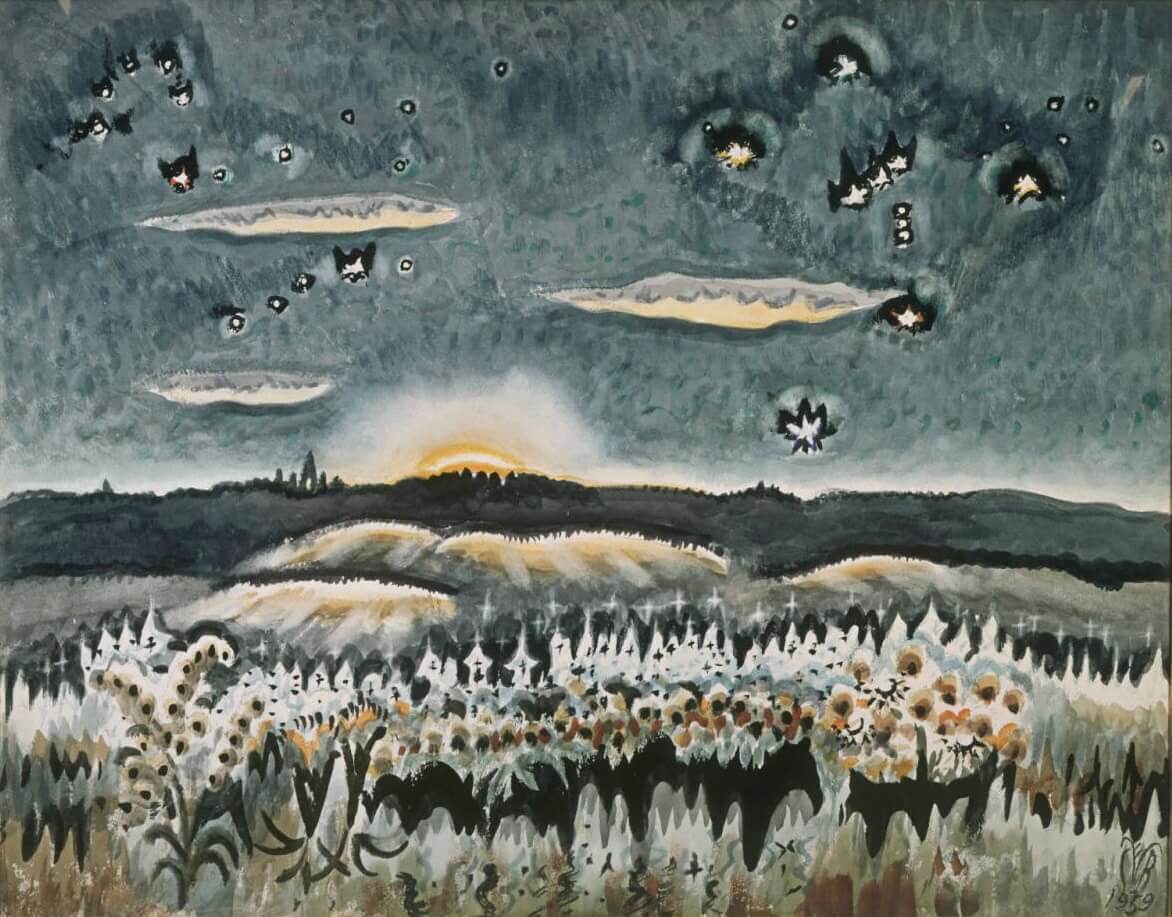
My parents never lived full time in Ischua, even though, in 1966, they purchased the acreage on which I now reside. Their property was abandoned farmland, nearly naked, bearing little resemblance to how it must have appeared when covered by old-growth forest. I sometimes see the ghosts of the doomed trees and of Horace Guild — the first white person to settle on what is now my land — as he swings his double-bit ax, tree after tree groaning in the moments before it whomps the ground. His wife died from an illness when fairly young, and two of their sons would die during the Civil War, one at the Battle of Chancellorsville and the other in Andersonville Prison. Guild migrated to California and lived there for a few years but returned to the Alleghenies and never again left his homestead in Ischua. I suppose the ghosts of his wife and sons insisted he stay. My parents, eldest sister, wife, two uncles and an aunt, their ashes buried in the cemetery behind my house, are among the reasons why I’ll never willingly move away.
On his and my mother’s land in Ischua, my father built a 20-by-25-foot cabin. He yearned for a rural hideaway distant from the sweltering and deafening and coal-dark power plant that employed him as a maintenance welder near Buffalo, 60 miles north of Ischua, and refused to connect the cabin to the grid. The property was graced by a freshwater spring that supplied our family with drinking water whenever we vacationed there. He died from cancer when he was 45, before he could realize his dream of planting thousands of trees on the land. I inherited the land — or it did me — and Margaret and I moved into the cabin some years later. We lived there a long time without phone, electricity or indoor plumbing, until we could afford to expand and modernize the building.
On my 40 acres, Margaret, my mother and I planted 3,000 spruce and pine seedlings in April 1979, and I would plant 4,000 more during subsequent springs. I walked or snowshoed through the young plantations almost daily, the bristly tips of them poking above the weeds or snow, and wished the trees would grow faster, imagining them as forest. When I hike my land now in my old age, my father often accompanies me, ethereal among the shadows cast by the tall trees I had dreamt. I ask him, “Can you believe this was open land when you died?” I add, “I wish I could plant them all over again.” He nods in response but says nothing — leaving me unsure whether he is sympathetic or considers me foolish for wishing away anything I have accomplished in my life, which has lasted far longer than did his.
The lowest branches in the mature plantations are skeletal, deprived of light by the layers of living boughs above them. Short grass, sallow needles, fallen limbs, squirrel middens and small wigs of moss cover the ground. Breeze surfs the crowns. The air temperature there is noticeably lower than it is outside the plantations. Some of the Norway spruce are two feet thick and 80 feet tall, but should I stand motionless in their shade for long, they will dissipate until the land looks as it had when I felt it was mine. An open meadow. An endless lifetime to fill.
I sometimes see three ghosts in the meadow. One is mine. He bends to insert tangled, bare roots into gashed sod, stomps the wound closed, pulls another seedling from a bundle, strides thrice, places his right foot on the step of a drain spade, shifts his weight forward and again gashes the sod. Clipped to his belt, an aluminum canteen gurgles and glints; the front of his shirt is splotched with spilled water, the back clinging and paisley with sweat that I smell even at my distance. I envy him when he doesn’t press a hand to his lower back or groan as he straightens.
The two other ghosts are Margaret’s and my mother’s. They converse as they plant parallel rows, and in response to something Margaret has said, my mother laughs, high-pitched like the creaking of a windblown bole. And then — in an instant — the mature trees, the middens and the moss return.
On the first day of spring three years ago, the flesh and blood Margaret died, but I still encounter her. Her ghost is seldom runic or frightening like those in the Henry James novelette The Turn of a Screw. She likes to dance in our parlor, transfiguring a void — with the fluid febrility of the guitar riffs in Eric Clapton’s “Layla” — into gratitude. She both prolongs and distracts me from my lasting grief. And whenever I hear “Layla,” which was her favorite dance song, I am haunted by my memory of a September night when we were in our 30s and drinking beer in a mowed hayfield near our home, and she danced there. I’ve already written about that night, and I shouldn’t again, but the memory of her in the field is insistent. Let me dance again. And so Margaret, or the memory or ghost or story, finds a rhythm she likes on the radio, turns up the volume, climbs down from the pickup, commences dancing on the stubble and says, “Come on.” Transfixed by my young wife in the fluid light and dark under the moon and stars, I remain seated. She is gradually moving away from me. “Come on. Come on, old man.”
I returned to the field last summer, in my 70s, and hoped she would appear and this time say, “Go on. Go on, old man.” Instead, fireflies bobbed and drifted in constellations of evanescent green over a land that has become its own ghost.
My children have their own stories about Margaret and me, some quite unflattering, but I persist in telling them the stories by which I hope their parents will at least partially be remembered. I also repeat the sagas my elders told me about themselves and our ancestors in hope that I would remember, and the stories my neighbors told me about their ancestors who hoped to be remembered, life stories that mingle like vapors.
When she was young, I overheard my daughter dismiss my heirloom tales as “Dad’s ghosts,” a description more apt than she knew. Yet now that their hair is beginning to gray, she and her brother have become more interested in these and other stories and legends that aim to circumvent the graveyard for a while, although, of course, it waits, confident of our arrival — as even Scheherazade of The Arabian Nights must have eventually discovered. I like to think that Scheherazade hoped her stories would not only lengthen her life but outlast it.
I was middle-aged before I understood my compulsion to seek and tell stories. The German-Jewish writer Walter Benjamin provided me with a partial explanation in his essay “The Storyteller” by noting that a truthful storyteller “has borrowed his authority from death,” but I was uncertain exactly what Benjamin meant until an evening when I happened to lean over my bathroom sink while the mirrors of the vanity were open on my right and left. I then saw in the opposing mirrors my face and the back of my head repeatedly superimposed on each other, the reflections gradually diminishing in size and fading into ghostly blurs before they disappeared like overlapping lives forgotten forever.
Mark Phillips lives in southwestern New York and is a regular contributor to this magazine. His essays have been published in The American Scholar, Commonweal, The Sun, The New York Times Magazine, Salon and other journals. He is the author of the memoir My Father’s Cabin.