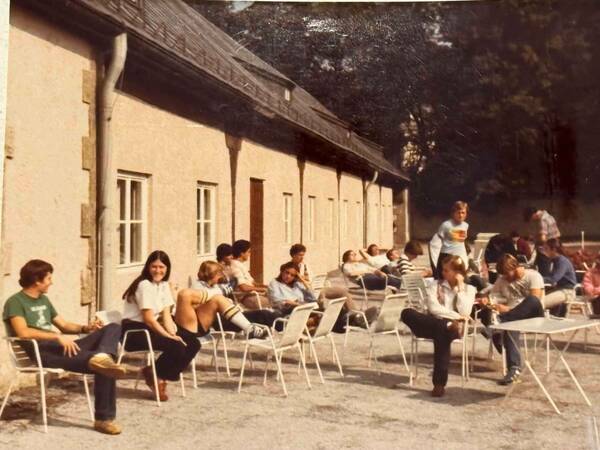
It was the end of summer, 1979. The Iranian Revolution had begun. The United States was still grappling with the implications of a partial meltdown of the nuclear reactor core at Three Mile Island. The Sony Walkman had just freed people to listen to music on the go. And then, more than 40 Notre Dame and Saint Mary’s students embarked on what promised to be a magical year abroad in the enchanting city of Innsbruck, Austria.
Bob Clement ’82 and I were assigned a room with a family with three children still at home in a high-rise building in Innsbruck’s Olympic Village, or O-Dorf, at the city’s extremes. Granted, it was a half-hour bus ride or an hour’s walk to our classes. But what a fortune to be walking in the footsteps of Dorothy Hamill, who just three years prior had mesmerized the world with her figure skating as she won gold.
Our small room was right inside the apartment door from the ground-floor lobby. Each morning, our host family served us the traditional Austrian breakfast. Lunch was on our own. Dinner was with the other 40 classmates at a brewery restaurant each night.
At first, there was nothing overly problematic in our living arrangement. Per custom, there was a lock on the phone. The key to the basement mailbox was kept hidden. Our host family was distant, but Bob and I were there mostly to study at night and sleep. There was some yelling and screaming, and the younger daughter, about 10, was obnoxious and loud. Keeping our door shut (also the Austrian custom), we could largely tune out the distractions.
Soon, though, it seemed to Bob and me that there was more at play than cultural differences. Our host father was yelling more and more. Before long, we became one of his targets. Throughout the week, we would often read at night before falling asleep. He burst into our room one night, flicked the light off and on several times, and began screaming repeatedly, “Ganzen Tag schlafen, ganze Nacht lesen!” — “You sleep all day and read all night!” The lights were costing him money. He slammed the door, then repeated the scene. Over and over.
At times, when we went to the kitchen for breakfast, he would sit drinking at the small table, which was already littered with empty beer bottles. His wife brushed it off by repeating the same banter every day, pointing out the window, reciting, “The mountains are beautiful, aren’t they? Such beautiful mountains! Just beautiful!”
I joined the choir at the Jesuit church in town. It happened that a lady named Angelika from the high-rise next to ours was also a choir member. Hearing my broken German, she inquired about the family I lived with. As soon as I said their name, Angelika recoiled in horror. “Oh my,” she exclaimed. “And that girl. Isn’t she repulsive?”

There were other challenges. In the days before instant worldwide communication, mail from home was a lifeline, but our host family only occasionally gave us our letters. Finally, one day, with everyone else coincidentally gone, we searched every drawer and found the key. It unlocked an overstuffed mailbox, which also had multiple letters for us.
Often, Bob and I found ourselves locked out of the apartment — a key left in the lock from the inside made it impossible to open from the lobby. We could ring the bell and pound on the door as much as we wanted, but sometimes the family couldn’t hear us — mostly for the TV, sometimes for the shouting.
Then, sometime that winter, our host father disappeared for weeks. He came back for a short time, during which he would be up to his usual antics. One evening, I walked into the kitchen, where he was surrounded by his tableful of empties. For the first time ever, he invited me to sit with him. He talked of his World War II military service, when he was stationed in Norway on behalf of the Third Reich. In some incident there, he sustained a serious head injury. To this day, he explained, he suffered intense headaches as a result.
Before long, he was mysteriously away for weeks at a time, only to return for short stays. During one such episode, he explained to me that he was secretly leaving his wife and family for a new life in Italy. Each time he came home, he brought an empty suitcase to refill. Soon, he said, he would have enough belongings in Italy and would never return.
So there we were, Bob and I, living with an unemployed alcoholic secretly trying to leave his wife. Who slammed doors and screamed at us (when he was home) for reading at night. In an apartment we sometimes couldn’t unlock. With a family that only rarely gave us our mail. And whom the neighborhood reviled. I can’t speak for Bob, but boy, did I feel sorry for myself. Little, though, did we foresee what would happen next.
One early morning, about a week after Easter, there was a loud knock on our door, to shouts of “Aufmachen!” We opened, and two plainclothed detectives barged in to search our room. They assured us it had nothing to do with us, but gave no further explanation. So, after our morning classes, Bob and I walked to police headquarters and insisted on a clearer explanation. The head of detectives said that the older boy in our host family had been involved in a major robbery on Holy Saturday night. They suspected that he may have hidden some of the loot in our room.
Off and on through the year, Bob and I had tried to persuade our program director, the late and dear Herr Albert Wimmer, that he should find a new placement for us. His answer had been consistent: Be patient; try to understand the cultural differences; there’s nothing egregious that would merit breaking our contract. This day, upon leaving the police headquarters, we went straight to Herr Wimmer’s office and told the latest tale.
He was silent for a moment, struggling to take it all in. Finally, he spoke: “This is an altogether different matter. I don’t yet know where you can go, but I’ll figure that out.” Within a couple days, he found a new room for us and devised a plan. The next morning, at six o’clock sharp, he pulled up in his van, and we ran out with all our belongings so that we wouldn’t have to confront our host family directly.
The new place turned out to be the apartment of an elderly lady. This setting came with its own idiosyncrasies. She fed wild birds at the kitchen table, insisted that we always be back to the apartment and silent by 8 p.m., and warned that a single hair left in the sink or tub would cause her to break out in hives. Yet in this home, we felt welcome, and a burden was lifted for our final two months in Innsbruck.

Toward the end of my Innsbruck year, I went past the Olympic ski jump and up to the grounds of Schloss Ambras, a castle several hundred feet above the city in the mountains to the south. There, one is away from the sounds and bustle of the busy city. From that height, one can look down at a full vista of Innsbruck. As I sat in silence in the Ambras gardens in contemplation of the majestic Nordkette mountains opposite and the seemingly serene city in the valley below, I realized I could make out our old high-rise building at the city’s extremes in the O-Dorf.
Suddenly, I was overtaken by the contrast between the observed tranquility of that home from such a distance and the daily turmoil and anguish I knew to exist there within. I realized that both — the horror and the beauty — were equally true. In an instant, an unsolicited wave of compassion and love washed away all of the anger, resentment and disdain I had felt toward my host family. Whatever pain I may have carried from my time with them, it was inexplicably healed. More importantly, my animosity towards them vanished.
Instead of wanting distance from the mean old drunk, I now felt connected to a man irreparably scarred by the ravages of war. In place of disdain for his clueless wife, I felt tenderness toward a woman who was doing her best to raise a family in distress and on the brink of poverty. It was no wonder he drank. It was no wonder she acted oblivious. Nor that their younger daughter lacked social skills or their older son was mixed up. And, while getting letters was my lifeline to loved ones, to them, the overflowing box brought bills they might not be able to pay. They weren’t keeping our mail from us; they were keeping themselves from their own mail.
I had merely looked at them from a stance of entitlement, of what they should be doing for me, never looking at them as full, complex human beings trying to make sense of life’s mysteries, just like I was. It dawned on me then — how had it not before? — that the daughter living at home had slept in their bed and their sons in the living room throughout our stay because we had occupied what would have been their bedroom.
In his podcast Turning to the Mystics, spiritual writer and trauma therapist Jim Finley dedicates a season to reflection on T.S. Eliot’s poem “Four Seasons.” In one episode, host Kirsten Oates reiterates a theme Finley often identifies in the poem: “I’m just an infinitely loved broken person. And, of course, so are the people who’ve made my life such a hell.”

On one of our few remaining days in the city, Bob and I ventured out on a crazy endeavor — trying to visit our former host family. Following the robbery incident, our host father had returned to his family from his Italian exploits. After losing our rental income, they had moved to a different O-Dorf building and a smaller apartment.
Bob and I went to their new door and nervously rang the bell. I shuddered to think of the many ways the encounter could go wrong. So I was greatly relieved that no one appeared to be home. We turned to leave, but just then, our former host mother opened the door. We reluctantly turned around. To my astonishment, she was smiling, looking at us with joy. She invited us in to visit over coffee and cake. I started to say I had just come by to say farewell, but she eagerly insisted I come in to visit. She fixed coffee and set out treats. Her grown daughter was there, and the three of us sat together for the longest time laughing and telling stories. Before I left, I was able to say thank you. That happy afternoon was, to this day, one of my life’s most intense experiences of reconciliation.
These days, I often drive down the street and realize that, inside the walls of each house, people are living lives as important as my own, suffering, rejoicing, laughing, crying, trying to make their way in life, trying to find purpose and meaning, floundering and — every now and then — making progress, just like me. That moment in the Ambras gardens has also, at times, given me the capacity to extend a modicum of grace to those whom I judge not to deserve it. They might just be the ones to call to me someday when I’ve turned my back — and smile at me with joy.
Matthew Scheiber is a retired educator in Toledo, Ohio now working on climate, hunger and immigrant education concerns.