On a warm July evening, four participant families from Notre Dame’s William J. Shaw Center for Children and Families gather inside a classroom in the new Veldman Family Psychology Clinic.
The room has been prepared for making art: Plastic sheets cover the walls and tables, and each workstation has a sketchbook and drawing pencils. Paint and cups of water surround the sink, ready to be passed around. In the center of the room sits an arrangement of plants and flowers gathered from nearby backyards in South Bend’s Northeast Neighborhood. Hydrangeas and Japanese maple branches poke out from the vases, ready to inspire.
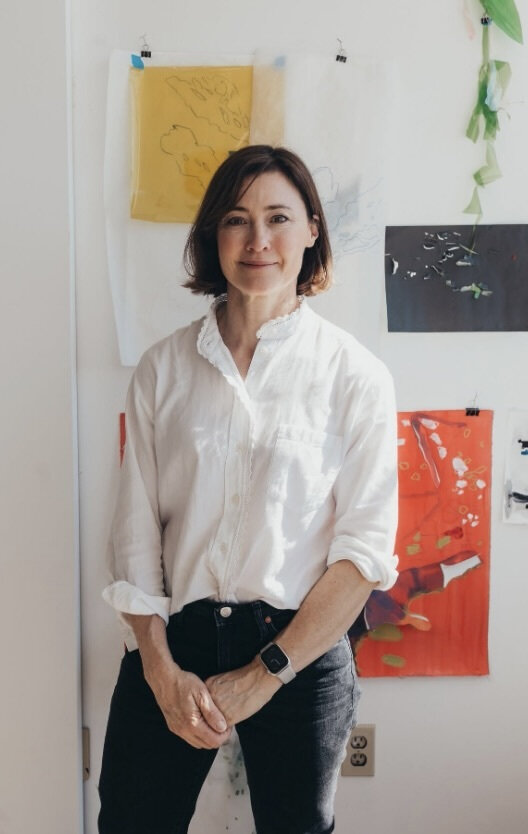
Annie Kammerer Butrus ’99MFA, a Birmingham, Alabama-based landscape painter, greets everyone who enters. But this is not a traditional still-life art class; Butrus is applying a philosophy of wellness rooted in the idea that creativity can be a tool for healing.
Housed within the clinic, the Shaw Center provides clinical services designed to advance the well-being of children and families. Research increasingly suggests that engaging with art, observing nature and participating in creative activities can reduce stress and support emotional health. Those findings reinforce Butrus’ own conviction: Creativity offers us a way to process experiences and discover something within ourselves.
Butrus has spent much of her career exploring the relationship between art, nature and human experience. She originally came to Notre Dame to earn a Master of Fine Arts degree with a focus in painting and printmaking.
Even as a student, Butrus was interested in moving beyond traditional studio practice and exploring how art could communicate human experiences. Much of her early work involved interviewing farmers and creating art inspired by their stories.
Preserving fleeting moments in nature is central to her vision. She makes abstract pieces that capture the passage of time through a process called shadow tracing. She’ll find a favorite spot, place 18-by-30-inch boards on the ground and trace shadows cast by plants, returning to those same places across seasons and years. She must work fast while the sun’s movement changes the shadows. She marks down geographical coordinates to ensure return visits are as similar as possible. The moments she sketches become the foundation for larger pieces made with layers of opaque and translucent acrylic paint.
Now, Butrus is bringing her passion for nature into a new painting series created specifically for the Veldman Clinic, whose mission — supporting children and families through mental health care — aligns with her belief that seeing art and being creative can be healing.
The inaugural painting was installed at the clinic in July. Butrus captured plant shadows along the city’s Link Trail — an urban path connecting Notre Dame, the Northeast Neighborhood and downtown South Bend — during the spring. She incorporated brain scans produced by a functional magnetic resonance imaging machine to signify “the interaction between the landscape and our mind,” she says.
The series will follow the changing landscape throughout the year and further explore the connection between nature, art and mental health. Butrus, who maintains her studio practice in Alabama, plans to return to campus with additional pieces representing summer, autumn and winter after each season. She teaches the workshops during these quarterly visits.
Rather than appearing in the clinic’s lobby or main hallway, the artwork will hang in clinic rooms where clients and their families may experience moments of uncertainty and stress.

“I am really interested in the therapeutic power of art,” Butrus says. She sees “huge potential impact” in putting art in places where people might especially need it.
Butrus is also crafting a larger community artwork for the clinic: a collective “quilt” made from 5-by-5-inch watercolor paintings created during workshops with Veldman clients. Participants are encouraged to paint several pieces per workshop — one to take home, one to trade with another workshop artist and one to contribute to the installation — crafting a shared work of art out of individual experiences and perspectives.
The workshops are designed for people connected to the clinic’s and center’s community partnerships, which include South Bend’s Center for the Homeless and a group for survivors of gun violence.
At the end of each class, the participants leave with their new sketchbooks. Butrus hopes they’ll keep drawing, especially outdoors.
“It’s more than just rewarding,” she says. “It feels like it’s the reason why I’m supposed to be painting.”
Michelle Cuneo is an associate editor of this magazine.