The letters we publish here are edited for space and are representative of those we receive. We print only those letters referring to an article in the most recent edition of the magazine, not those responding to letters or commenting on issues not addressed in the recent edition.

Leafing through autumn
I was fascinated by the information in “Winds of Change” — I had no idea! This tax scheme is not about revenue generation; it’s nothing but a thinly disguised attack on higher education in America. Very disturbing — very sad.
I hope to learn something about Professor MacIntyre, who came after my time (“What MacIntyre Meant”). But I must say you paid him no compliment by that godawful portrait on the cover. From what I can tell, he deserves better.
In my year at Trinity College in Dublin, I had several occasions to worship in the Newman Chapel (“A Doctor of Hope”). Very interesting architecture — it is a remarkable place. A refined display of the art of trompe l’oeil. I trust things fare well there under the Holy Cross Fathers.
Finally, I always turn to “The Classes” to find out whether I have passed away since the last edition or won a Nobel Prize or something. I rarely know anyone mentioned there. Perhaps that is just a reflection of my limited relationships while I was a student. I thought then that I traveled in a fairly wide circle of classmates: fellow residents of Carroll and Fisher halls, fellow provocateurs in Pangborn, fellows active in ROTC, fellows who were history majors, etc. I even had some good friends at Saint Mary’s. Apparently my circle was too small. My loss. Just an observation.
William T. Little ’73
Waxahachie, Texas
Congratulations on an excellent Autumn 2025 issue. The breadth of the topics covered is a tribute to the University, from the top-tier philosophizing (“What McIntyre Meant”) to piano repair (“Having Coffee with . . . Norman Vesprini”) and the undermined financial infrastructure of higher education (“Winds of Change”).
Darragh Hannan’s essay (“Making Sense of Identity”) gave me a new perspective on international adoption and the complex nature of belonging. But my favorite pieces were the Ratboys profile (I was lucky enough to see them at the Salt Shed in Chicago) and Michelle Cuneo’s story about Gage Goods (“The Gatherer”). I admire that sense of community, even as I mostly hang with my family of four these days.
James Seidler ’02
Munster, Indiana
‘Why’ indeed
As we watch the science-illiterate president and his party devastate science, “The ‘Why’ Axis” states, “There are those with the power of the purse on Capitol Hill who consider robust federal research funding essential to maintaining the nation’s global leadership. Indiana Senator Todd Young cowrote a Washington Post op-ed in March outlining why ‘sustained investment in fundamental and transformative science is consistent with the president’s stated vision of a new Golden Age.’”
Seriously? Your choice of quotes and your comment normalize a party that has massively undermined science in the United States, has made this country less competitive and less secure. I am astonished by the picture you decided to paint. I do hope you show greater journalistic integrity going forward, on behalf of a country sliding away from its democracy.
Julie Peller ’03Ph.D.
Chesterton, Indiana
Just so your staff knows that creativity does not go unappreciated: The graphic for “The ‘Why’ Axis” was quite clever. Not only did the wordplay catch my notice, but the skyward shot of the library in what would be the “Y” direction on a graph was an extra touch of craftsmanship. Keep up the good graphics.
Don Barkman ’69
Oak Ridge, Tennessee

Evan’s gifts
We all bring different gifts to the table. I couldn’t help but recall that sentiment while reading about Evan Gage (“The Gatherer”). In his case, it’s literally true.
One summer after my retirement, the theology department asked me to teach German Graduate Reading. I can’t imagine that course making anyone’s list of favorite offerings. Nevertheless, that intense summer experience evolved into one of the most gratifying intellectual endeavors. It was just plain fun. Evan was a student in that class.
Within a short time, he suggested that anyone so inclined attend his Friday evening poetry readings. At best I considered his offer fanciful. I tried not to show any skepticism and attended several sessions.
They mirrored his effervescence and innate generosity and conviviality. To paraphrase Gabrielle Schulte’s words from the article: It’s debatable whether South Bend needs another rug emporium, but it does need more folks like Evan.
Vera B. Profit
Professor emerita of German and comparative literature
Granger, Indiana
Where the band began
“Ratboys, Plural” was the best article I’ve had the pleasure of reading in Notre Dame Magazine for a long time. Julia Steiner and Dave Sagan represent true dedication and commitment to their craft. And they make indie rock, one of my favorite genres.
While I will always love my alma mater, the conformity of the student body bothered me. There wasn’t much room for authentic creative activity. So I am pleasantly surprised to discover that Ratboys gestated as a band right there on campus. Amazing!
Mike Murray ’83
Las Vegas
Restoring our resting place
“Part of Something Grander” reminded me that my wife and I are destined for a columbarium at Cedar Grove Cemetery.
When the University opened Cedar Grove to alumni, my wife and I sat down and talked about where our remains would be located. We are both from the Chicago-Milwaukee area and nearly all our close relatives have passed away. Our children, grandchildren and a great-grandchild live on the West Coast and in Maine, and we decided the University would make an ideal and memorable middle ground.
So, we sent a deposit in 2008 to hold a dual niche for us and paid over a two-year period after we selected a space. We went to a football game shortly after that decision, and we visited our eternal resting place with a staff member of Cedar Grove. It was a rare and memorable moment, and as we toured the cemetery the staffer noted that Father Hesburgh had left money in his will to update the small chapel at Cedar Grove in his mother’s name. That was 17 years ago, and we have never wavered in our decision to be buried at Notre Dame.
Stephen Dragos ’61
Southport, North Carolina

Seminary memories
So many happy memories flooded while reading about the renovations at Moreau Seminary (“Notebook”). In the 1970s and ’80s, the Congregation of Holy Cross, in addition to their own seminarians, welcomed students from dioceses and other religious communities. I was one of those seminarians known as the “non-CSC” team under the direction of Monsignor Jack Egan.
The hospitality of Holy Cross and Notre Dame was a crucial part of my formation for ministry some 50 years ago. Four seminarians from the Diocese of Wheeling-Charleston in West Virginia lived and studied at Moreau and were ordained for our diocese. Though the CSC community members sometimes referred to us as “lonely commandos” who would work largely alone as diocesan priests, their friendship and support never failed. I am still touched remembering our day of departure from Moreau for home in West Virginia. The whole community gathered on the front steps and in second- and third-story windows to send us off with a soaring rendition of “Take Me Home, Country Roads.”
Rev. Larry W. Dorsch ’74 M.A.
Weirton, West Virginia
Quote, unquote
Regarding the quote of Stephen Dedalus referenced in Paul Elie’s essay (“Among the Modernists in Rome”), that “history is a nightmare from which I am trying to awake,” interpretations of what the character meant can vary. But a review of my often-read paperback edition of Ulysses, used in Edward Cronin’s and Seán Golden’s classes on the book in the mid-1970s, confirms that the quote appears in Ulysses on page 34, not in A Portrait of the Artist as a Young Man.
Mark Szaflarski ’79
Oak Park, Illinois
The approachable president
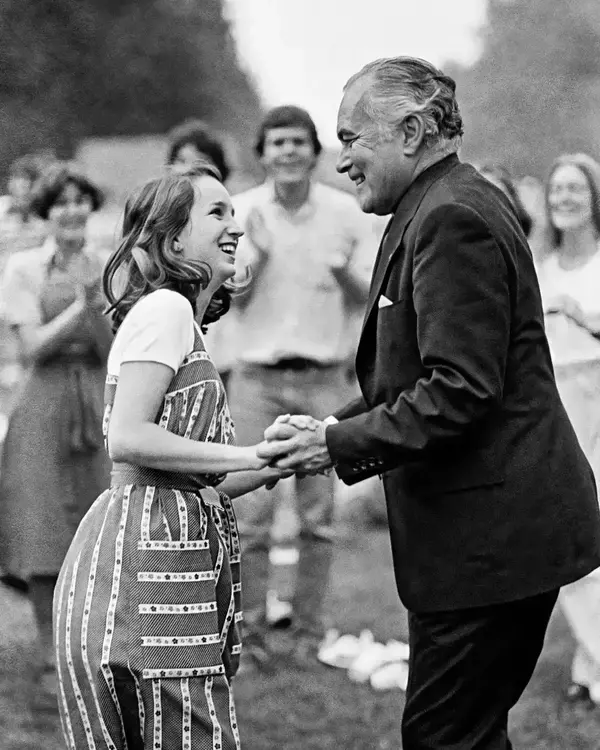
That picture of Mary Blazek Buckingham dancing with Father Hesburgh (“A Step Back in Time”) brought back so many memories and emotions. I was at that picnic. Hesburgh was always so accessible to students. That is one of the things that made Notre Dame so special.
Paul Coppola ’78
Washington, D.C.