The last time I drove away from my parents’ house — which had also been my boyhood home — I saw them standing at the top of the driveway as they always did, bodies close, each with an arm around the other’s waist, the opposite hand raised in a wave goodbye. The image brought the threat of tears.
That is where I spent hours alone shooting hoops: at the top of the sloping driveway where I once left a car in neutral — apparently — finding it later across the street in the neighbor’s yard. The driveway where I once hurled a push broom downhill in anger, snapping it in two, prompting my father to say, “Well, it looks like you’ll need to go buy a new broom before you finish sweeping.”
I saw them standing there, yet I didn’t. They were long gone from there — partly apparition, partly my imagination, all memory now.
The last time I pulled out of that driveway my sister and I had cleaned out the house. This was more than 15 years ago. My memory works mostly in visuals: a random smattering of mental pictures.
I can still see the broken broom and the car crumpled against the neighbor’s tree. I can still see the whorls in our home’s wood-grain walls, the ones that looked like the face of an owl and an alligator standing on its tail. The crank pencil sharpener on the wall in the hallway closet, near the marks on the door frame that measured children growing. The white-faced clock whose circulating hands directed early morning traffic in the kitchen. The crucifix on my bedroom wall, next to the ivory cow skull, next to the 2-by-3-foot poster of my basketball hero Bill Russell, a poster that caused consternation because of the veneration given a Black man.
The back room of the house — we called it “the caboose” — with its bookshelves and wood-paneled walls, was where we watched television and argued about Vatican II and Vietnam, integration and Watergate. Where an eighth-grade baseball team pulled an all-nighter after losing the Catholic league championship, a bitter defeat that my parents softened by hosting a sleepover. Where we played body-slam basketball till dawn on one of those miniature hoops hung above the sliding glass doors, the same doors that my boyhood dog, Scamp — outside and thrilled to see me home — ran smack into, his poor head banging into the invisible barrier. Where my son — unannounced and unbidden, during a visit from Indiana to Louisiana — launched his first stiff-legged steps, crossing the room as we all looked on in silent surprise.
The same room where, in suits and dresses, we watched Cash Cab in the hour before all were ready to leave for my father’s funeral Mass. And where, only a month earlier, he and I had talked over, around and through his progressing dementia.
I ran across this Frederick Buechner quote many years back. “You can kiss your family and friends goodbye and put miles between you, but at the same time you carry them with you in your heart, your mind, your stomach, because you do not just live in a world but a world lives in you.” It is even truer now that I am older. So much that I have seen and known, lived and caressed now exists only in the secret frontiers of my brain. Seven decades of people, places and experiences that constitute the person I am are now vapors in the mists of my mind.
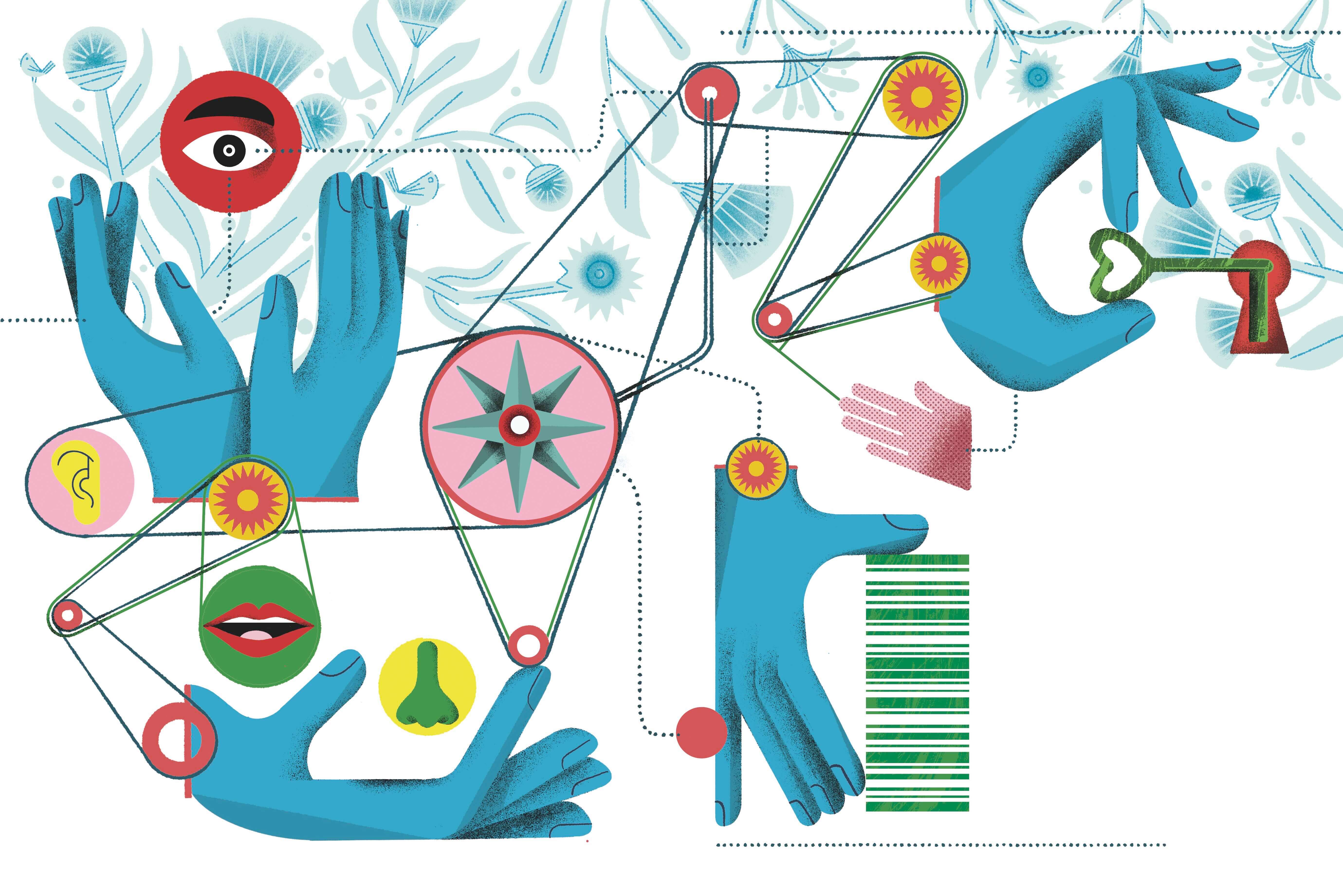
I was wrong about memory: I had conceived of it as a filing cabinet or photo album. Pieces of the past would be stored away in some corner of the brain that could be accessed through neural wiring, little cellular packets of memories shelved until sparked by some electrical missile, with each memory lighting up the next.
Like this: My sister texts from Tennessee to explain she was up late last night watching lightning bugs. So I remember the season’s first flicker in my own yard last night, over by the honeysuckle bush. And I remember driving through Missouri when the lightning bugs twinkled in the darkness like electric starlight. And how some people say “firefly.” And how Mark Twain said the difference between the right word and the almost-right word is like the difference between lightning and a lightning bug. And then I see that night when I was little, chasing lightning bugs, collecting them into the glass jar with the metal lid with holes poked in it — to give them air. I can still see that jar and inside the pulsing, neon-green tails, as vivid in my mind’s eye now as then, it seems.
Why is that? Why can I see the jar, the flashing bugs, my sister’s silhouette in the summer darkness, the porch light behind her, and nothing of the days before or after? Days that surely contained more important events and happenings.
And why is my memory so clear of our sitting in that back room watching Cash Cab while I have almost no recall of my father’s funeral Mass? Nothing else of that day comes to mind. Why? Where did all that go? These are thoughts I have driving back to Indiana from Louisiana, all those hours alone in the car with so much time to revisit my past, one memory igniting the next — and certainly not on a linear course as I had thought but streaming out in innumerable directions, like a web of roadways vining over the countryside.
Buechner was right: My brain contains a multitude; whole worlds live inside of me. But memory is not what I thought. It is more astounding than I had imagined.
Some people — about 100 worldwide — remember everything. They have hyperthymesia, also known as highly superior autobiographical memory (HSAM). They possess an extraordinary ability to replay mundane events in vivid detail. Give them a random date and they can accurately recall what they ate and wore that day, what the weather was like. They are mental time-travelers who score no better on memory tests than an average person. They do not have photographic memory, the knack for precise recall after a brief exposure to a picture, scene or text (the existence of which aptitude is not supported scientifically).
For those with HSAM, the cinematic storehouse is autobiographical. Their brain scans exhibit greater activity and strength in those areas linked to memory as it relates to their personal narrative — because “memory” is not one thing. It is a stunningly complex network and the collaboration of various parts of a person’s brain and body.
It is no surprise that memories begin with the senses — with what we hear, taste, touch, smell and see. A lightning bug, for example, flaring in the darkness. Vision provides a good example of the brain’s agility, an illuminating pathway into the circuitry of remembrance.
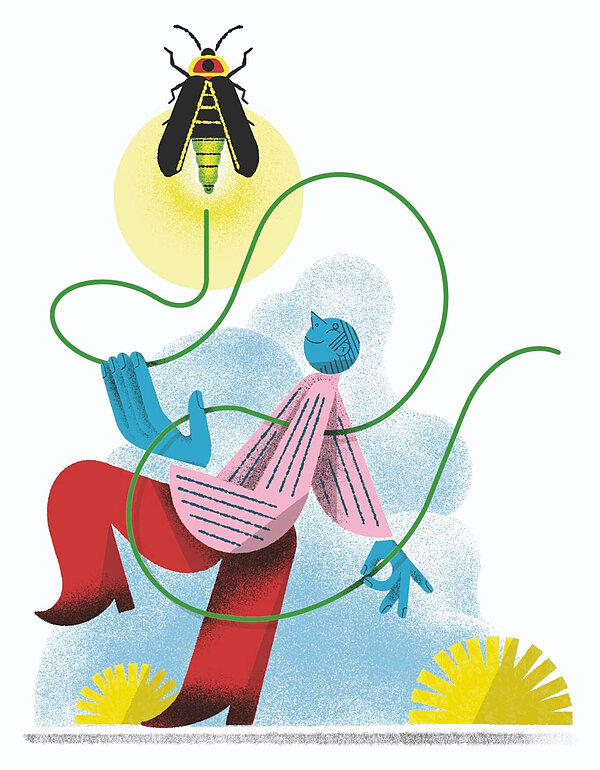
The world thrums with an energy we call electromagnetic waves, oscillating at different wavelengths, different frequencies. They are all around us. They are known to us as cosmic rays, radio waves and X-rays, as ultraviolet, infrared and gamma rays. We see some waves as color — visible light — which ranges from 380 to 750 nanometers on the wavelength spectrum. Each color has a specific wavelength. That lightning-bug green, for example, ranges from 530 to 630 nanometers.
Photoreceptors in our eyes are shaped like rods and cones. The human eye has millions of them, and they enable us to see about a million colors. These receptors send signals to the visual cortex at the back of the brain. There an image begins to form as it recognizes and analyzes color, shape, movement, location and all to create a perception of what we see as we look around, scan our surroundings and take it all in. Darkening yard, lightning bug, glass jar, sister’s silhouette, porch light and myriad other visual cues — to say nothing of already embedded memories that provide the context and rationale for chasing those bioluminescent beetles and stashing them in a glass jar with a perforated lid.
Sensory memory relies on our sensory organs — eyes, ears, nose and others — that gather input from the world around us and assist the brain as it automatically processes all that information unconsciously and often in fractions of a second (for visual cues), and in no more than a few seconds (for auditory data). Sensory memory is a kind of first impression, a detailed picture, sending some information to short-term memory storage while discarding information deemed unimportant. The brain’s constant filtering serves as a buffer to prevent cognitive overload. We simply cannot absorb everything the senses deliver. Extraneous detail (someone’s name, for example) may be instantaneously jettisoned.
Each sense follows a unique pathway. Sound — a voice, chainsaw, honking horn — converts into electrical signals that nerve fibers send to the brain, through the brainstem, through the thalamus where it is directed to the auditory cortex in the temporal lobe. Touch goes to the somatosensory cortex in the parietal lobe, sight to the primary visual cortex in the occipital lobe.
Some such memories linger, can be evocative. The melody of a favorite song, the sound of rain on a rooftop or the aroma of chocolate chip cookies. Or that day last week when, before I knew what was happening, water steaming on a hot sidewalk took me back to a childhood pool.
The human nose has hundreds of types of odor receptors, each seeking specific odor molecules. Once paired, brain cells called olfactory sensory neurons shoot electrical signals down axons to different parts of the brain linked to learning, emotion and memory — to the olfactory bulb at the bottom of the brain, then to the piriform cortex that identifies smells, to the amygdala that processes emotion and to the hippocampus which stores and organizes new memories. Those smells identified by the hippocampus as important — if, say, they are connected to some emotion — can be stored indefinitely, tapping into feelings decades later. Cookies baking. Steamy water on hot concrete. The piney aroma of a campfire.
For some people, smell can trigger more emotion and reach deeper into the past than other senses. One theory is that sights, sounds and other sensory information travel through the thalamus before reaching the amygdala and hippocampus. The olfactory system, in contrast, is physically adjacent to these structures deep within the brain’s temporal lobe. That proximity may enrich the experience — and the memory.
Memory is bounteous, faulty, a blessing and a guide. It can be episodic — the reliving of joyous and heartbreaking scenarios, big games won or lost, that embarrassment in front of class, the act of kindness no one saw. It recalls the color and shape of our first car, our first child, the sun setting over Lake Michigan. It records, without our realizing it, flavors and faces and words. It may deliver — before our consciousness knows what hit it — a surge of anxiety, the sting of pain; it can also trigger, from the bank of our subconscious, the chemicals that bring a sense of pleasure and well-being. It can save about a million billion bits of information and at the same speed forget as many others.
Memory helps us solve problems, answer questions on a test and recall what we need at the grocery store. It helps us find our way in familiar places as well as new ones. It helps us build relationships, keep our fingers out of a flame and sing along with “Sweet Caroline.” It helps us anticipate and plan for the future. It fosters decisions, shapes who we are, gives us a sense of self and helps us navigate life.
Procedural memory, a kind of implicit memory, enables us to complete tasks without remembering how they were learned. Tying a shoe, riding a bike, putting toast in the toaster. Information is stored and applied without our conscious control through automated neural circuits. Eventually, with much practice, playing a piano may become procedural, or more specifically a type of memory known well by dancers, musicians and athletes: muscle memory, the body’s ability to perform difficult feats after practice and repetition without conscious intervention.
Another type, semantic memory, relates to facts, general knowledge and the meaning of words and concepts: the capital of Denmark, for example, or the number of eggs in a dozen or what a tree is. Such data is logged in our consciousness and, usually, is readily accessible — or teases us by lingering “on the tip of our tongue.”
Working memory enables us temporarily to retain a telephone number while dialing it or to calculate a server’s gratuity. It is closely related to short-term memory because it can store only four to six units of data at a time — and for a mere 20 to 30 seconds. After that — after the flood of instantaneous, often unconscious transactions made by the brain as it processes a constant avalanche of incoming calls — the information either disappears or gets forwarded to long-term memory storage.
All these memory systems rely on different but interrelated regions of the brain. Working memory, for example, mainly uses the prefrontal cortex, which is located in the forehead and also plays a role in decision-making and processing information as it arrives. Semantic memory uses the parietal lobes near the crown of the skull and the temporal lobes at each temple, which are tasked with storing language and general knowledge. Procedural memory involves regions deep in the brain.
So, memory isn’t just memory. It is more like “memories,” and is not just a mixed bag of images retrieved from a house I once lived in, but is rather the different ways those memories reside in me: currents of information flowing along a complicated, dispersed network of routes and ports, pausing, staying, signaling and singing to each other with lightning speed, separate but intimately interrelated. So much is happening — the brain whirring, firing, humming, sparking — and so much is going on beyond our conscious awareness, that it leaves one to wonder, where am I in all this — except as the amalgam of memories that have added up to make me who I am, what I know, what I do and why and how.
Adding to the wonderment is the discovery that much of memory’s action takes place not in nerve cells but in the synapses between them.
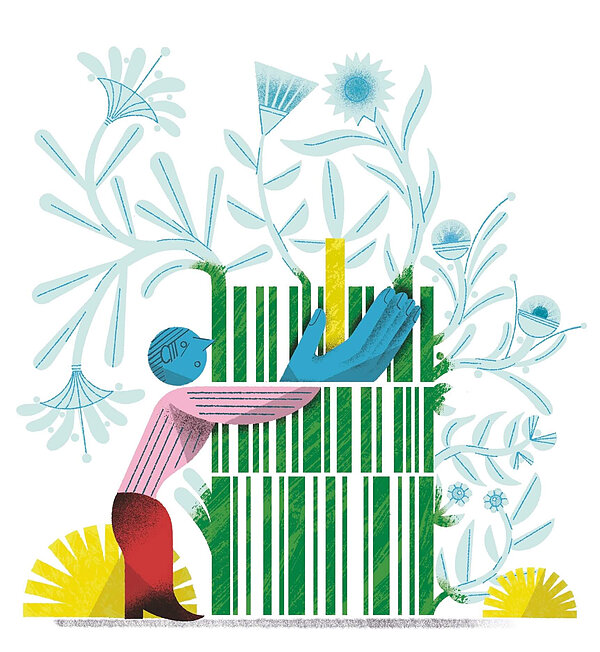
Fifty years ago, when computers were revolutionizing the way we communicate, I said I could not grasp how they did all that, especially operating under the binary code of 1s and 0s. A colleague asked if I understood how television worked, and I admitted that I had no idea how all those sounds and pictures came through the cord plugged into the wall. He laughed and said growing up with TV had dulled my curiosity; I took it for granted. Computers were new, and that’s why I wanted to figure them out. “Stop trying,” he counseled, and so I did. I do not try to understand how the little phone/camera/computer in my hand does what it does.
There is much beyond my comprehension — the universe, quantum physics, the GPS voice telling me where to turn, God, animal instinct and a whole lot more. But some concepts tantalize me, and so I try to learn what I can about them.
For example: One of the brain’s key maneuvers in filing a memory is converting the information gathered by the senses into a storable mode. Through a series of physical and chemical processes known as encoding, sensory perceptions are integrated, altered and ultimately translated into a format that can be managed and retained, enabling nerve cells to communicate. The hippocampus serves as a key processing hub, binding together various sensory threads into a single, coherent episode that is distributed across millions of nerve cells in different regions of the brain. A memory, then, is not a single folder, but a dynamic strand traced across complex neural networks.
Because of this, recalling a memory doesn’t just pull up and replay a video. The brain reconstructs the experience, reactivating the same neural pathways that fired during the original event. In fact, when an intense experience is recalled, the hippocampus and the amygdala — the brain’s emotional center — are activated, releasing stress or pleasure hormones that revive the body’s initial reaction.
However, the initial experience is not replayed perfectly. It is reconstituted — incorporating new information and different perspectives with subsequent versions. The brain is in perpetual flux, adding, adapting, deleting, splicing, storing, retrieving, holding onto, letting go. This is the brain’s plasticity.
Scientists now estimate that the human brain contains about 86 billion neurons, or nerve cells. Each neuron will connect with as many 10,000 other cells through neuronal extensions — outgrowths from the cell body which are essential to sending information throughout the nervous system. The gap between nerve cells is called a synapse. It is within these spaces — an estimated 100 trillion or more of them — that memory does its thing.
The chemical messengers traveling along the synapses and between all these neurons are called neurotransmitters, and they are composed mainly of amino acids. At the receiving end are dendrites — tiny spines protruding from a neuron suspected to be integral to learning and memory storage. Studies show that repeated signaling across synapses bolsters the connections between neurons, and that electrical stimulation results in the strengthening of dendritic spines as well as the creation of new spines. The process of building synaptic circuits that synthesize memory makes storage — and retrieval — easier and stronger. Some call this “consolidation,” the transferal of temporary information into a long-term trace. To do this, the brain produces new proteins and alters the structure of brain cells.
On the other hand, pathways in the neural network that are not used weaken, diminish and in time disappear. Some memories live on; others are forgotten and lost.
And some lay tracks in the psyche that haunt for decades.
When I was in graduate school, I rented a room from a woman whose son, a Vietnam veteran, lived on the other side of the wall from me. I could hear him at night, the nightmarish torment in his cries. She blamed the LSD; he said it was the carnage he had witnessed, images of atrocities that he could not get out of his head. I’ve known victims of sexual abuse who were emotionally broken from harrowing experiences that also impacted spouses and rippled through succeeding generations. We all have painful memories, and those that make us cringe with guilt or regret. Or strike a surge of anxiety, even fear, when we anticipate “the next time.” Memory is not always kind.
Researchers at Johns Hopkins University have done some interesting investigations into the bonds between emotion and memory by delving into the relationships between brain chemicals like glutamate and the receptors critical to communication between brain cells. Subjecting mice to traumatic events results in an increase in the level of receptors for glutamate at synapses in the amygdala, the brain’s emotion hub, where fear associated with memory is encoded. Removing these receptors decreases the strength of those connections — and the fear element — without erasing the memory.
Those who study the brain commonly describe memory in four phases — gathering, encoding, storage and retrieval. If something goes awry in any facet of these complex mental operations, memories lapse, holes appear, malfunctions occur. Stress, sleep deprivation and depression can affect memory. So can thyroid conditions, strokes, tumors and traumatic brain injuries. As we age, neurons get smaller, synaptic connections weaken and the brain’s communication circuitry slows down. We’re just not as sharp.
More severe losses to nerve cells and their connections may lead to dementia. Alzheimer’s, the most common form of dementia, results from the amyloid plaques (sticky clumps of proteins and protein fragments) that build up around neurons and the neurofibrillary tangles (knots of tau proteins) that form within neurons, eventually killing brain cells and causing the brain to shrink.
Those who have watched loved ones wrestle with memory loss also witness the fading away of the person they have known for decades. Our memories are so integral to who we are and how we act, and so powerful in shaping our identity, that their departure leaves behind only a semblance of what used to be.
My sister and I see each other about once a year. When we do, we trade stories from our childhood. We remember different things, of course, and we remember the same things differently. Sometimes, her recollections spark in me the retrieval of memories I would never have recalled without her reminding me. “Oh yeah,” I will say, “I remember that now,” and once-lost images and memories will suddenly reappear. I have thought about this over the years; I have thought about forgotten times lost forever if no one else is there to rekindle them.
I no longer have access to my parents’ memories, or to those of high school friends who may recall the escapades that made us laugh or run away. A friend and I backpacked together for 10 years, usually just the two of us. He is gone now, so no one is there to “remember when,” no one to remind me of exploits I can no longer retrieve alone. When my sister is gone, so much of my childhood will evaporate, too.
I have a wooden file cabinet in my basement and a few cardboard boxes that contain the flotsam and jetsam of a lifetime. Some rocks and prayer feathers, baseball cards and old photos — school pictures of little me and of my father in uniform and of my First Communion class. Things my kids made for me, some birthday cards with little-kid expressions of love. Copies of stories, letters from writer-friends, letters from my mother, high school varsity letters and ticket stubs and a piece of driftwood and a baseball signed by teammates from a charmed summer long ago.
I do not expect anyone to spend much time with these things when I am gone. I do not expect to wow my grandchildren. I am not leaving a legacy as much as providing myself a lane into my past. They are reminders, they trigger memories, they make me smile. I will let others do the discarding. In the meantime, I occasionally linger in the sunny glades of a lifetime as I try to find the thing I am looking for.
I still do not know for sure why I remember some things and not others. Why commonplace details are imprinted forever in my psyche. Why some offhand and otherwise inconsequential remark persists and not some profound truth stated in earnest, even when I tell myself, “Remember this.”
The professionals say we remember best those experiences laced with emotion. We remember better those events that we replay in our heads, strengthening the connections there. Associations build; bad times may get suppressed. Some say we have moments when our senses are most alert, most acute, and our heightened curiosity stimulates the circuits. Some say our ancestral DNA has us tuned to scout out the unexpected, the unpredictable, and that surprising discoveries reward instinctive vigilance with bursts of illumination that we hold onto. Beyond that, the brain does a lot of deciding on its own what to keep and what to release.
Much of what I remember feels like a grab bag of seemingly insignificant moments — a yellow kite against a blue sky. I still see it way up there, and my father is asking, “Want to hold the string? Do you think you can hold onto the string?” And the string feels heavy somehow, pulling steady and strong, as it connects me to that canary-yellow diamond of a dot so high up in the blue summer sky.
At least that’s how I remember it.
Kerry Temple retired as editor of this magazine in 2024.