
Cleaning out the 64 square feet that Moses Bunn called home, we didn’t find much to flesh out an obituary: a bartender’s license, an ID badge from a stint as a security guard, but nothing in the way of family photos or personal letters. He’d just gotten a copy of his birth certificate. He was exactly as old as we’d guessed: 50. He was born in Orange, California, in 1974 to Larry and Myralene Shields Bunn.
It’s hard to imagine him living in this small space, a modular structure designed to address homelessness and natural disasters. People called him the “Gentle Giant,” as Bunn was well over six feet tall and generously filled out. Yet we found two ID cards listing him as 5-foot-11. The world never could see Bunn’s full measure.
Despite his size, or maybe because of it, he was a peacemaker in the community. He sidestepped arguments, spoke softly, smiled often. He was “Bunn” to nearly everyone, as far as we can tell, though to older women he would introduce himself as “Moses.”
What events brought Moses Bunn from the West Coast to New Haven, Connecticut, where he briefly lived and then died in Rosette Neighborhood Village?
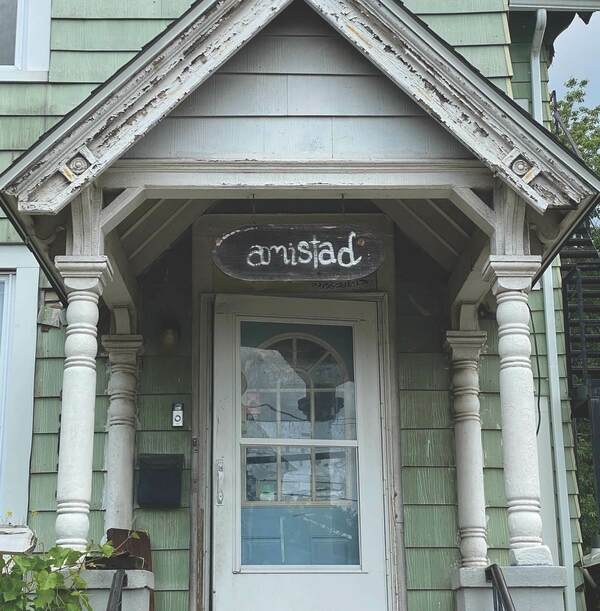
Rosette is a community of formerly unhoused people who live in the village’s tiny modular shelters and tents. From the instant it was established in the backyard of the Amistad Catholic Worker House in New Haven, it has received a constant stream of camera crews and city inspectors.
The city views Rosette as an annoyance. The public tends to see it as inspirational and, frankly, puzzling: Religious nuts inviting unhoused people to live with them, without asking permission from anyone but the surrounding neighbors. What a story! And what an affront to municipal authority! Whether one lives or, like me, volunteers at Rosette, we are interviewed. But not Bunn. Though amiable, he had definite boundaries. He always ducked into his house when journalists visited.
Like many people who are unhoused, Bunn was uncomfortable being identified as such. He tried hard to find employment, even as an hourly laborer for local contractors, and was saddened that in his last months of his life he could find nothing. He wanted to work. He wanted to be independent.
One winter evening, looking perfectly himself and complaining of nothing, he took a plate of food into his home, sat on his bed and died before he could touch a bite. His front door was closed, so the world went on as if nothing had happened.
I threw out a lot of food the day I cleaned out Bunn’s tiny home with Nicole Brown, who volunteers almost daily to keep the village running. The drawers of Bunn’s plastic organizer were crammed full of half-packages of instant oatmeal and saltines, the kind of long-shelf-life food given out by social service agencies.
One thing we can conclude about Bunn is that he planned on surviving, not on having a fatal heart attack. His passing is tragic, but not surprising. Black Americans like Bunn are 54 percent more likely to die of heart disease than are white Americans. Unhoused people are 40 to 50 percent more likely to die of a heart attack than are their housed neighbors. People come to Rosette with all sorts of chronic illnesses aggravated by living without shelter — asthma and high blood pressure being the standouts.
Our dear friend Mother Sylvia Mundle, 73, arrived with a cast on her foot and using a walker. After Mother Sylvia had been struck by a truck, a hospital-discharge planner recommended she call Amistad House and ask if there was room at Rosette. The village is guided by the aims and means of the Catholic Worker movement, in which people dedicate themselves to the corporal and spiritual works of mercy: feeding the hungry, caring for the sick, et cetera. Burying the dead is also a work of mercy, and we realize we will be called upon to do it again and again, because poverty is so often a fatal disease.
Thirty years ago, Mark Colville and Luz Catarineau-Colville moved into a home on New Haven’s Rosette Street given to them by a Maryknoll priest. They opened a “house of hospitality,” where people in need could get food and often a roof over their head, and it came to be called Amistad House. The Colvilles adjusted their ministry to meet their neighbors’ needs. It started with coffee and day-old bagels for moms who had just dropped their kids off at school. It continued into community organizing to resist the drug trade that was making the neighborhood unsafe. Donors started bringing things: food, clothing, furniture. The Colvilles distributed it all where it was most needed while raising their own children.
One of the defining characteristics of the Catholic Worker is personalism. They don’t have clients: they have friends and neighbors. Luz and Mark have strings of text messages from Bunn. Often it was just a smile emoji and an inquiry about their youngest child, who was seriously ill.
Rosette Street is in The Hill, a neighborhood that remains the poorest section of New Haven. Even so, it is hard for someone working a low-wage job — or two low-wage jobs — to find an affordable apartment there. Luxury apartments are now being built at the neighborhood’s edge. Meanwhile, the rate of homelessness in Connecticut has risen about 14 percent annually since 2021. The scale of the housing crisis is too vast to hide, as people lay their heads wherever they can: the train station, the city green, doorways, alleys. As one unhoused friend told me, “If you’re visible, you’re criminal.”
The day Nicole and I cleaned out Bunn’s house was icy. Lugging some boxes, I slipped and came down hard on my bottom.
“I’m sorry you fell,” said Sean Gargamelli-McCreight, a volunteer who was doing yeoman’s work clearing out Amistad’s cellar that day. “But you know, it’s a message. Everybody’s important.” Bunn had been the one who always salted the pathways when the weather turned slick. There was a hole in the community without him.
Sean and his family live about 20 miles away at the Benincasa farm, a community influenced by Dominican spirituality, the Catholic Worker movement, a deep care for the Earth and the reform of the Roman Catholic Church. Benincasa has been instrumental in the creation of Rosette Neighborhood Village. Sean is also the person who found Bunn’s body.
On a Monday morning in January 2024, he knocked on Bunn’s door to check the smoke detector. The fire marshal was paying Rosette yet another visit that morning, and Sean was crossing his T’s. When Bunn didn’t answer, Sean peeked in. Bunn had been sitting on the bed with his head against the wall when the heart attack struck.
The police came and did their thing, which everyone found too brusque for the situation. “This is an active investigation,” they would say when anyone objected to the way Bunn’s body was moved or the place was scrutinized. Afterward Sean reflected that they might have had to cultivate a certain degree of desensitization to do their work. “It’s not their defined job to ensure that this person’s humanity and dignity is preserved,” he said.
But it is ours. Nicole and Luz opened the windows so that Bunn’s spirit could leave. Sean blessed water and sprinkled it around the home. Mother Sylvia led a prayer.
Bunn’s body went to the morgue. State law required the police to find his family within 24 hours or file a report saying why this had not happened. Nicole kept calling the probate court to see if the family had been found. Absent a family to claim Bunn’s body, the community at Rosette intended to claim him. We wanted to give him a send-off that underlined the truth Bunn had lived in the last months of his life — that he was made in the image and likeness of God, that he was loved.
Signs at every entrance to Rosette Neighborhood Village declare: “You Are Entering A Human Rights Zone.” In 2013, the United Nations Committees on Human Rights and Racial Discrimination published an extensive study of municipalities across the United States, evaluating compliance with the U.N. Universal Declaration on Human Rights, particularly around service delivery and the provision of affordable housing. The U.S. failed miserably.
Mark Colville always cites that report when talking about the genesis of Rosette. “We have to examine the water we’re swimming in as people committed to gospel-based hospitality,” he says.
The shelters that form the official response to homelessness in the city fall far short of gospel-based hospitality. Mark calls them “carceral.” People are denied their personal belongings, cannot have visitors, and must be out on the street at dawn, regardless of the weather.
During the summer of 2014, the Amistad community decided to change that. With the help of two excellent student organizers from Yale Divinity School, Greg Williams and Sarah Raven, Mark and his friends began to set up tents on nearby parcels of unused land. With consent, cooperation and even hospitality from some Hill neighbors, these “takeovers” quickly became communities of mutual aid.
Unfortunately, as soon as city officials took notice, they would quickly disband these tent communities, and Amistad had not yet amassed enough people-power to prevent that from happening.
Bunn had lived in some of those encampments and liked being part of a community. But he eventually moved to a motel the city was using for shelter when the weather turned cold. At one point, the Colvilles found a donor to buy Bunn a heavy winter coat, size 6XL. They worried because they knew they would never get another coat that size donated, and they thought the risk of Bunn giving his coat away to someone without one was high. “That’s just the kind of person he was,” Mark says.
Amistad House brought hot meals to the encampments springing up in the city and protested when police arrested people for loitering, trespass and other offenses that amount to the crime of being homeless. In 2023, the City of New Haven, with 70 armed police officers in attendance, bulldozed a tent city just around the corner from Amistad. So, the Colvilles invited displaced people to put up tents in Amistad’s backyard — their own private property. From the start, they called these folks “backyard neighbors,” making it clear that this was not some social-service enterprise: This was neighbors helping neighbors. Rosette, as it would come to be called, wouldn’t have a laundry list of rules, other than those that the people living in this new community made and enforced themselves.
Then something beautiful began happening. Anyone who wandered into the backyard would be warmly greeted and often offered a cup of coffee by a backyard neighbor. Residents and others were always raking mulch to keep the areas around the tents clean and dry.
But a tent is no place to spend a New England winter. A group of supporters, eventually called the Rosette Neighborhood Village Collective, formed after the tent city demolition. The collective decided to buy modular tiny houses for the backyard community. Fundraising began in earnest, almost all of it happening at brunches cooked by volunteers.
Even before the tiny homes went up, the city started sending letters making it clear that such projects required permitting. The zoning code, written a century ago, made no provision for structures like these. It also did not foresee the housing crisis of the 21st century.
Once we had cash in hand, we put up the houses with a volunteer crew on a joyful, gray Saturday. We figured we could house our neighbors now or put our time and money into a legal battle with the city, a process that would likely drag on for years. It was not a hard decision. People started moving into the homes in October 2023.
A cease-and-desist letter from the city promptly followed.
Rosette consists of six small structures, two of which are double occupancy, and tents. Bunn was not one of the first eight tiny-home residents because he was away from New Haven when we opened. He’d gotten a video production job in New York City but kept in touch by text. One of the tiny homes became vacant around the time that job wrapped up, and he planned on coming back to New Haven. Inviting him to live in Rosette was a no-brainer.
Amistad charges no rent for these homes, but people staying there agree to participate in the culture of hospitality. That means preparing hot meals once a week for people on the New Haven Green, doing chores to keep the village neat, offering a hot breakfast to anyone who comes to the door. Bunn was all about that. A big, jovial guy always ready to share anything he had — people loved him. He was sometimes a puzzle. For example, he liked to set up a lawn chair in the middle of the street to “take the sun.” But that just made everyone smile. Bunn was an original.
From October to January, Rosette did battle with the city over permitting issues. The city would not allow the power to be turned on in the units, rendering the heating system useless. We tried everything we could to keep people warm — including giving everyone hot water bottles to keep in their beds. During the coldest nights, Bunn would get up several times each night to put fresh hot water in Mother Sylvia’s bottle. She loved him. She always comments that one of her sons is named Moses, too.
About a week after we cleaned out Bunn’s house, a woman named Kathleen “Gypsy” McKenzie moved in. She’d been living in a tent in the village, which was not doing her arthritis any good. Like the previous occupant of her home, she has a literary bent. (“I am a man of words and books,” Bunn would say when asked to do heavy chores.) A former teacher, a writer and a lover of the arts, Gypsy was pleased that her tiny home had a bookshelf where she could keep a few volumes. Within months, she moved on to a permanent apartment. Her new place is in a basement, but it’s surprisingly bright with a lot of natural woodwork that she’s polished to a shine.
The legal stuff just never ends. We had a public hearing before the city’s Board of Zoning Appeals. Jacob Miller, not a lawyer but the member of the collective who is shouldering much of the bureaucratic complications of our endeavor, argued for our right to exist. Bolstered by moving testimony from backyard neighbors and people living in the immediate community, Jake laid out a masterful case: Far from posing a threat to the neighborhood, the village is an asset. Jake stressed that the police had never needed to be called to the community.
A New Haven police sergeant countered him, saying she wanted to set the record straight. They’d been called about a dead body and answered numerous other calls at the address, she said.
The “numerous other calls” were backyard neighbors calling 911 because of health crises, which, again, are always going to be common in this community. But implying something sinister because Bunn died in his bed in a place where he was welcomed and respected — that was just too much.
It’s what set me off on a mission to find Bunn’s family. By then, he had been dead more than a month. Nicole’s frequent inquiries to the probate court revealed that the authorities had made no progress finding them. My background in journalism made me pretty good at tracking down information, but anyone could have done it. It took me only an afternoon to find a Larry Bunn in the vicinity where Moses was born. I also located a Myralene Shields in South Carolina. I probably expended more energy praying for help in breaking the news compassionately than I did in locating the family. Had the police, with access to far more information than I could find on Google, even tried?
I called Larry Bunn and told him I was looking for the family of a Moses Alexander Bunn. Larry said he was Moses’ father, and I conveyed the news that his son had passed away.
“Moses,” he said, with more pain than you could imagine two syllables could hold.
Larry informed his former brother-in-law, who told Myral, who called me to confirm the news, because she could not quite believe it.
Thank God I had the stories about his tender care of Mother Sylvia, about that old fishing hat he wore, about his courtly good manners. It allowed me to convey that Moses was part of something. That he did not die alone under a bridge.
We exchanged a lot of phone calls as they tried to understand what had happened. It is amazing how many times in a day you can say, “I’m so sorry,” because absolutely no other words are appropriate. Myral called the probate court and claimed her son’s remains. He had already been cremated, she was told, and would soon have been “buried at sea.”
In July, I flew south for Bunn’s memorial service. His ashes were interred along with those of his brother, C. Eugene Bunn, who had died of COVID. Myral had found a plot near her church in the North Carolina foothills. A white and red floral cross marked the spot. A headstone would come later. The priest talked about the resurrection and the hope beyond the grave promised to all God’s children. The words and the idea are always beautiful. Under that hot summer sun, they were doubly so, because Bunn was finally getting the home he deserved.
Myral looks a bit like her Moses. She smiled through her tears and thanked me effusively for coming. “I had to come,” I said. “Thank you for letting me.”
Four days after Moses’ memorial service the City of New Haven sent an eviction notice to the residents of Rosette Neighborhood Village, though no shelter beds were available in the city. Where Rosette’s residents were supposed to “vacate” to we cannot guess. Another three days later, the power company cut off the electricity to the backyard community at the city’s instruction. Thankfully, Amistad House still has power to cook meals and provide hot showers. But the tiny homes’ air conditioning is essential for people with chronic health conditions, especially during a midsummer heat wave. Joel Nieves, the latest resident in the house that was once Bunn’s, uses an electrically powered CPAP machine to manage his sleep apnea.
As of this writing, the eviction notice has not been enforced. The Rosette residents are still in their beloved community, though less comfortably and less safely than they would be if the power were on. We continued legal appeals through the fall in hopes of getting the heat turned on before winter. It angers me that we’ve had to devote energy to raising funds to pay our lawyers, instead of taking on projects to promote the health and independence of the backyard neighbors or to expand this kind of people-centric community to other sites.

The day after the memorial service, Myral had kindly invited me to her home, where the family was looking through oversized scrapbooks. It was going the way these gatherings tend to go. Laughter and tears.
“Intelligence” was the word spoken most often at first. As a youngster, Bunn could figure out complex math problems in his head but frustrated teachers because he would never use the method they taught to solve the problem. Left-handed, maybe a sign of his creativity, Moses always wanted to do things a little differently. He was in the “gifted and talented” program. As children, he and his sister had acted in a production that starred Buddy Ebsen, whose long movie career was eclipsed by his television success in The Beverly Hillbillies and Barnaby Jones, and who was a booster for children’s community theater.
Six feet tall in the sixth grade, Bunn was a natural athlete. His uncle, Ronny Shields, once believed his nephew had a bright future as a running back, because he was big, tough and oh-so-smart. But — Ronny laughed as he remembered it — his nephew had a way of not running the play the coach had called. He got yards, though.
Myral found her youngest son harder to control when he hit adolescence. She believes he fell in with a bad crowd. But she doesn’t fully understand why Moses never found his niche. Nobody seems to. Offered a full scholarship to California State University, Fullerton, he never showed up to claim it.
When I started looking for Bunn’s family, several people told me he probably didn’t have one. That was far from true. Ronny and Patricia Shields never got rid of their landline because Moses remembered that number and, every once in a while, would call. He texted frequently with his parents — but there were also long periods when Myral heard nothing from him, and so worried no end.
One time he joined her where she lives now to attend a community college program in video production. He did well, was admitted to Phi Theta Kappa and kept three copies of that certificate in his home. Myral encouraged him to stay on with her, but something in his nature refused to be stationary.
In Bunn’s final home, I found many letters he had sent off to film production companies looking for work. His files contained no replies. Once a person becomes unhoused, it can be enormously difficult to reestablish an address, and that leads to difficulty getting employment. One letter from the City of New York terminated his employment doing maintenance for the fire department because he could not offer proof of residence. Another from a housing program gave him the brush off because he couldn’t produce proof of employment. We do know, from text exchanges with the Colvilles, that he was employed for much of the time he was in New York. But the pay was never enough for him to afford an apartment.
Bunn’s care for Mother Sylvia resonated with his family. They all have memories of him surrounded by his younger cousins, reading them stories. “He was more of a surrogate big brother,” his cousin Sam said. Everyone nodded their head at that. He was endlessly patient with the younger children in the family.
The little kid photographs in Myral’s scrapbook hit everybody hard. It was so strange to picture him small, yet those laughing eyes were unmistakable. Myral turned to a page with a pale blue handprint he’d made in nursery school. She started to read the poem attached to it: “I’ve left some little fingerprints on just about every wall. . . .” She asked me to finish reading it.

Ronny Shields, a retired police officer, was distressed that the New Haven authorities had not tried harder to find Bunn’s family. “He would have been a John Doe,” he said, “if you people had not loved our Moses.”
We did love him. And that is why burying the dead is a work of mercy, because it involves fiercely asserting a person’s worthiness of love. As with any work of mercy, it requires seeing the person you are helping as infinitely precious in dignity.
In a consumer society, lives can be reduced to what we have packed away in boxes. At Rosette, we barely see the boxes. We come to know people on a different level. Even after I spent time with Moses Bunn’s family, I know so little of his particulars. Going through records, I can pick up his story in this state or that, in a new program, at a new job. But I do know that this man would set an alarm to get up and comfort the elderly woman shivering in her bed next door. That is a lot to know, and an enormity to mourn.
Rest in peace, friend. We’ll see you in a place where there’s room for everyone.
Colleen Shaddox is a journalist, fiction writer, playwright, activist and co-author, with Joanne Samuel Goldblum, of Broke in America: Seeing, Understanding and Ending U.S. Poverty. She left daily newspapers to work in a soup kitchen when her editor reprimanded her for writing ‘too many stories about poor people.’