
Here is something else in the news today. Nineteen Buddhist monks are on day 96 of their 120-day, 2,300-mile Walk for Peace from Fort Worth, Texas, to Washington, D.C. They are now in Lawrenceville, Virginia, walking along a slushy two-lane highway in cold temperatures under grey skies. I follow them on Facebook.
I have been following their journey for a few months now, having stumbled onto the videos of them walking the pine-tree hills of Alabama, a support vehicle following behind. I have seen clips of them walking along, single file, wrapped in their robes, with knit caps pulled onto their heads.
They begin each day with prayers and chants before sunrise. They often end the day in darkness. Another 30 miles complete. Because of those posting videos on social media, I have seen them walk through sunshine and rain and, lately, snow. They often stay in tents. Sometimes, along the way, they are given shelter by local residents — a school gym or church, for example. Supporters sometimes provide the pilgrim hikers food at various stops.
When I first started watching the videos, a scattering of people along the roadside offered flowers and said “thank you” and recorded the monks who would stop and sometimes tie a blessing cord or peace bracelet onto the wrist of those greeting them. The colorful strings represent mindfulness, compassion and unity. As days went by, I noticed more people lining the roadsides and then crowds in small towns, dozens, if not hundreds of onlookers in towns I had never heard of.
The monks were joined by hundreds when they crossed the historic Edmund Pettus Bridge in Selma, Alabama, and stopped to pray at the site of the famous Civil Rights march in 1965. The crowds grew larger in Atlanta, then Columbia, South Carolina, and Charlotte and Raleigh. The videos became more numerous. In little towns and on rural roadways the monks encountered people in wheelchairs and people in tears, people bowing and praying, people handing them food and water and flowers, people of all ages and races and walks of life.


The venerable monks now have more than 2 million followers on Facebook. They are accompanied on foot by thousands in larger cities. The videos and postings are extravagant in their gratitude — for their rare and steadfast demonstration of loving kindness, compassion and hope. Their Walk for Peace has, as the saying goes, “touched a nerve” at a crucial time in our nation’s well-being. “You know things must be bad,” one observer noted, “when Buddhist monks are walking to bring peace to America.”
At the outset, 20 monks embarked from Huong Dao Vipassana Bhavana Center on October 26, 2025, but a month into the walk, one of the monks, Phra Ajarnh Maha Dam Phomassan, lost his leg in a traffic accident. His brief reunion with his fellow monks later in Atlanta served to illustrate the potent spirituality the monks represent. The Walk for Peace now has a police escort, which also helps serve as crowd control.
For many of those marking the monk’s journey, Aloka, the stray dog that joined them as they made a 100-mile walk across India, is the star of the pilgrimage, with his own Facebook page (850,000 followers) and wagging tail of joy and peace.

Always at the head of the line is Bhikkhu Pannakara, walking staff in hand, his cloak now covered with badges and pins given to him by police officers en route. At stops along the way, he shares reflections with local residents and others who have traveled miles to witness what has become a kind of phenomenon.
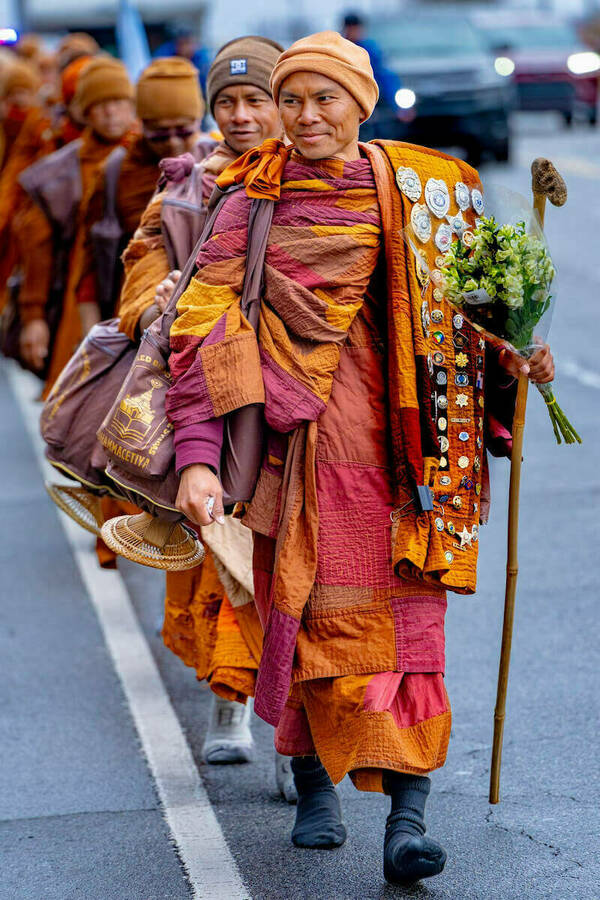
This is not about conversion, he says. It is about unity and love, empathy and finding peace within our own hearts. He talks about the difficulty of the journey, the blisters and sore feet, as well as the importance of paying close attention, mindful of their breathing, how each step is a prayer. He thanks the police and supporters, thanks those who have joined their walk in spirit, says they are buoyed in the cold, snowy weather by the warm faces lining the route. He talks about finding peace in one’s own heart, how important it is to say to others — even those troubling us — to wish them well, to bless them with peace. That he is grateful to all who have come, but that he hopes they carry peace away with them, that they have come not only for the excitement of this moment, but to carry peace back into their lives and to share it with others, and how that is the way to spread peace to the world, each step at a time.
But it is not the message that has inspired me as much as the response of the people — those lining the roads, those gathering on street corners, sitting in unity as he talks, the voices posted on Facebook, the crowds so moved by what is going on, and by a band of quiet, humble Buddhist monks. It conveys a sense of contagious goodness, and maybe a spirit moving. And right now goodness — simple goodness — is much needed.
During one of the first talks Bhikkhu Pannakara asked those listening to write each morning on a piece of paper, “Today will be my peaceful day,” and then to return to it as the day goes on — because, he said, our sense of peace will only get “messed up if we let others mess us up.”
Ever since then, I have started each day telling myself that today will be my peaceful day. I have not yet mastered the practice. But tuning in to the monks walking for peace has surely helped.
Kerry Temple retired as editor of this magazine in February 2024.