Ensign George A. Wolf Jr., 24, was the first Notre Dame man lost. He was serving on the battleship USS Arizona when Japanese aircraft launched the December 7, 1941, surprise attack on the Pearl Harbor naval base in Hawaii. Suddenly, the United States was drawn into World War II.
Wolf was reported missing when the ship went down and was later declared presumed dead. He had attended Notre Dame for a year in the 1930s, then transferred and earned a degree at Georgetown University. In 1940, he became a midshipman in the U.S. Naval Reserve. One of more than 2,330 U.S. military personnel killed in the Pearl Harbor attack, Wolf was posthumously awarded a Purple Heart.
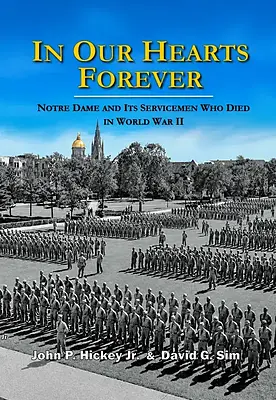
His is one life story told in a new book, In Our Hearts Forever: Notre Dame and Its Servicemen Who Died in World War II, which memorializes the 331 known Notre Dame men who died while serving in the armed forces during that conflict. Published in August, the book was researched and written by John P. Hickey Jr. ’69 and David G. Sim ’69. It is available for purchase at hickorystickpress.com and at the Hammes Notre Dame Bookstore.
Hickey and Sim will sign copies of the book at the campus bookstore from 3:30 to 5 p.m. Friday, September 18.
The tally of the dead includes graduates and former students, some who died in battle and others who lost their lives to accidents or illness while in the military. Of those profiled, most were officers — including three Catholic priests serving as military chaplains — and about one-third were enlisted men.
The book details acts of great valor.
While serving in Italy in July 1943, Ensign John J. Parle prevented the detonation of explosives that would have destroyed his ship. He died a week later, at age 22, of injuries from his actions and was posthumously awarded the Medal of Honor. Parle graduated from the Midshipmen training program at Notre Dame and was commissioned in January 1943.


Army 1st Lt. Hershel G. Horton, 29, who attended Notre Dame as part of the Class of 1943, received the Purple Heart posthumously. He was one of 367 American soldiers who were surrounded for three weeks by Japanese troops in New Guinea, and he was killed in action. A letter he wrote to his parents while dying was recovered from his prayer book and published in newspapers across the country.
Rev. Richard E. Carberry, a diocesan priest who had attended Notre Dame summer school as a graduate student in 1931, was a U.S. Army captain and chaplain. He survived the Imperial Japanese Army’s infamous Bataan Death March in 1942, which killed more than 3,000 Filipino and American prisoners of war, but he died in 1945, at age 40, from wounds he suffered as a POW on an enemy transport in the South China Sea. Carberry earned the Purple Heart, two Silver Stars, two Bronze Stars and a Prisoner of War Medal.
A total of 329 names were included in an honor roll of the war dead printed in the University’s 1947 commencement program, but Hickey and Sim discovered the list wasn’t complete. They conducted most of their research in the digitized Notre Dame Alumnus magazine and through the University Archives.
During World War II, the U.S. Navy helped keep Notre Dame financially afloat by transforming the University into a military training site. When enlistments and the military draft caused civilian enrollment to plummet, the Navy established a V-7 midshipmen’s training school on campus in 1942 and a V-12 officers college training program in 1943. Nearly 12,000 naval officers trained at Notre Dame by 1946.
The sacrifices of servicemen hold special significance for Hickey and Sim, who each had close relatives in the war. Sim himself is a retired U.S. Army veteran.
Additional Notre Dame-affiliated World War II dead may yet be identified. Some Navy trainees attended the University only briefly, and if their families didn’t notify the administration of their deaths, the news of their deaths and their connections to campus might not have been reported.
The World War I memorial door at the Basilica of the Sacred Heart’s east entrance lists the names of most of the Notre Dame men who died in that conflict. Some senior alumni would like to see a campus memorial listing the names of all the University’s known war dead from the 1898 Spanish-American War through the U.S. war in Afghanistan in this century. (Records are sparse regarding Notre Dame men who died in the Civil War.) Hickey and Sim plan to donate all proceeds from the sale of their book to such an effort.
Nine former Fighting Irish varsity football players died in World War II, including Marine 1st Lt. John “Jack” Chevigny ’31, who scored a comeback touchdown in the 1928 game against Army after Coach Knute Rockne gave his famous “win one for the Gipper” speech. Chevigny, 38, was killed in action on Iwo Jima in February 1945. He earned a Purple Heart.
At least one University employee died from his World War II service. A veteran of the Great War,
Robert B. Riordan ’24, ’33M.A., was the University registrar and an associate professor of economics from 1929 until his recall to active duty in 1941. His tour included time in the Pacific theater.
After the war, Riordan returned to work at the University but soon was stricken with a tropical illness he had acquired overseas during his military service. He died on December 4, 1946, at age 50, leaving a widow and nine children, including two sons then attending Notre Dame.
Margaret Fosmoe is an associate editor of this magazine.