
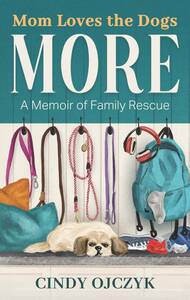
Cindy Ojczyk ’85 adopted a stray dog, Snuka, that she found outside South Dining Hall at the end of her senior year. Forty years and over 25 foster dogs later, Ojczyk published Mom Loves the Dogs More, a memoir detailing her family’s experience with fostering dogs and the mental health challenges of her two daughters, Anna and Mia. When adolescence brought diagnoses of ADHD and anxiety, and life began to feel unsteady, caring for the dogs became a lifeline, and Ojczyk realized she could learn from her daughters and their foster pets.
When did you decide to write your book?
When my family came along, and we started fostering dogs, one of the things that people said to me all the time was, “I could never foster; I could never give them up.” And I thought if I could write an inspiring how-to book, everybody would line up to foster. So I wrote that manuscript. I’d never written a book in my life. What I got back from my beta readers was that they loved the dog stories, but they weren’t inspired as much as I wanted about fostering. They all felt it would have legs if there was a way to turn the how-to book into a more general-focused story. They wanted the meat of what was happening while we were fostering. They wanted to have an arc that would carry from start to end, rather than singular chapters on steps in fostering and the dog stories that came with them. I knew what the arc was, but the question was how I was going to frame that arc to write this story.
What did you decide the arc would be?
The arc has to do with my family’s journey through the teen years that were not just chaotic from being the teen years, but also complicated by mental health challenges with my kids. How the book starts is that our family dog died unexpectedly when the kids were just entering their teens, and it sent us into this tsunami of emotions and grief. I was totally unprepared to handle my grief, let alone their grief. It was also a time when we couldn’t agree on what kind of dog to get, so we ended up with the idea of fostering again. With fostering, you have this parade of dogs in your home. You take in the dog that needs your help, not just the dog that you want to help. And along the way, we lived this life, and that was the story that I needed to include.
Writing about your own family can be risky. How did you maintain boundaries?
I wrote the story, told the kids what I was doing, and said, “You’re going to have the opportunity to give me the red light or the green light. If it’s too uncomfortable and you don’t like how you come across, we’re going to just scrap it or go with another plan.” Both of them had a really hard time reading it the first time, but the second time through, they realized that they were now beyond those years; they’re no longer teenagers, and their stories could possibly help other families and other teens find a way back to each other.
How did fostering dogs help?
As much work as it was to foster dogs, we were getting this continuous feedback loop that overlapped with what the therapists were teaching us about our daughters. You could see the successes — that the reward of putting in effort showed up in the dogs. In the same way, we knew it would just take longer with us and the kids, constantly implementing strategies and trying to figure out what would work for one child versus the other, or one dog versus the other. Some things work, and some things don’t. You have to find the thing that helps that individual creature thrive.
What is the central message of your story?
The heart of the story is about a shift in my attitude. My goal was no longer just about raising kids to be successful. It shifted to raising kids that were going to be the best versions of themselves. I want people to be able to really sit down and think about why they had their family in the first place. Was it to have external gratification and accolades, or was it that, in the end, you stay connected? Because connection is about communication. It’s about safety. Are you a safe place? Is your home a safe place? Are you enjoying each other’s company? Do you respect each other? Do you value each other? And that’s what brings together connected families.
How do you hope parents will feel after reading the book?
That they will find hope. I wrote the book to share my experiences of raising teens with mental health challenges, to give parents hope and to invite people into fostering pets. Fostering pets saves an animal’s life, and it can save families, like it did ours in the end. If I have a dream for this book, it’s that it helps move the needle in a positive direction for both the teen mental health and the animal shelter crises. They seem so separate, and yet they really are problems within our communities that we can fix if we all work together.
Interview by Brigid Iannelli, a sophomore American studies major with minors in journalism and education, and this magazine’s spring intern. The interview has been edited for clarity and length.