
In the theology course, The Heart’s Desire and Social Change, the primary texts are the students’ lives. Plenty of other materials complete the syllabus, but the most challenging read comes from looking within.
Rev. Daniel Groody, CSC, ’86, Notre Dame’s vice president and associate provost for undergraduate education, developed the course around 2013 at the behest of students who wanted to dive deeper into concepts he had raised in other classes.
“We began paying attention to, ‘What are the questions the students are asking? What are the themes related to those questions?’” Says Groody, whom Pope Leo XIV named in March to the Dicastery for Promoting Integral Human Development.
Those themes revolve around his interests in spirituality and social justice: “how the deepest desires of the heart are connected to the needs and challenges of the world, which become a pathway to understand where God’s calling us,” the theology and global affairs professor says.
In the interview below, Groody explains how The Heart’s Desire and Social Change helps students hear — and heed — that call.

What led you to create this course?
This is built out of the Holy Cross and Ignatian tradition and years of going through retreats and discernment and spiritual direction and other things. I wanted to know in my own life where God was calling me when I was a student at Notre Dame, and it’s that kind of schooling of the heart that led to letting my life be its own text and letting that text be something I learned to read over time.
Some students came to me and said, these themes that you’re teaching in other courses that I was doing, we’d like to do more on that. They actually took a volunteer class, it wasn’t for credit. Eventually we began to realize that students were not studying the text of their own life, and it was probably the least studied text in their undergraduate education. They really didn’t know anything about their own inner life, and so we really started asking the question, not just what do you want to do, but who do you want to be, and how do you begin to find the flow between your inner life and your outer world?
How do you guide students toward understanding what the text of their lives is telling them?
We begin with stopping the busyness train. You’ve got to quiet it down, and this is even more intense now. We’re just not taking the time to be quiet. It has to come through prayer, discernment, but that takes silence. So, the first part of the class is stopping the constant activity, beginning to listen to what’s going on inside, and then beginning to name what’s there.
Then moving beyond the ego and the kind of polite self-understandings to really get into the deeper terrain, which is the difficult stuff, the stuff we don’t want to face, and saying that’s part of me, too. Then beginning to look at cultural values and saying, “What are the narratives that the culture has about who I am and what I grew up in? What are the narratives that come out of my foundational experiences and major moments of life?” Then you start getting into true self and false self. You say, “What’s the persona that I present to the world? What’s the deeper person, and what if the narrative of what I’m told I should be is not aligned with what I really want to be and what I’m really called to be?”
How can students distinguish what they want from what they feel like they’re supposed to want?
That’s where discernment comes in, because sometimes you don’t know, where’s this coming from? Is it actually coming from me? Is it coming from God? Is it coming from a darker place? Is this coming out of my conflict, my wounds, my needs? Sorting through that takes time.
The other breakpoint comes in two places. The first is when I ask, where do you need to be forgiven, and who do you need to forgive? The second is working through our fears. I ask them, what are your 10 biggest fears? And what are the three biggest of those 10? And how do you put those in one word?
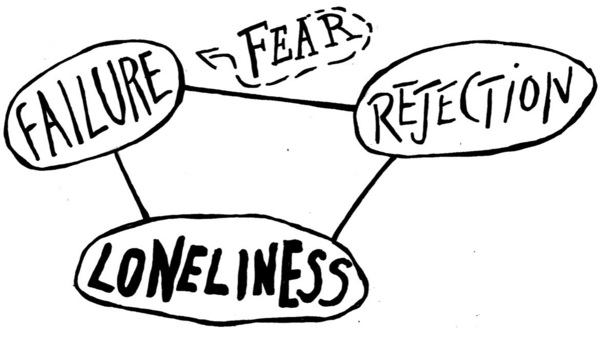
Then we’ll spend 45 minutes mind-mapping. People go up to the board and if they have the same fear, they put a circle around it; if another has same fear, they star it. If it’s connected to another fear, we draw a line, put another circle. At the end of this, you have a kind of workshop of the collective fears of the group.
Here’s where you get behind the persona of the Notre Dame student: “I’m smart, I’m bright, I’m successful.” Deep down, they’re saying, “I’m afraid that I’m not enough. I’m afraid I’m going to be alone. I’m afraid I’m going to fail, be rejected.” OK, now we’re talking.
You’re really getting into the space of vulnerability. If you’re going to get into the heart’s desire, at some point you’re going to have to deal with the vulnerability.
Then you see this humanity come forth, when they start trusting the community enough to say, “I’m afraid of failure, I’m afraid of being alone, I’m afraid of being rejected by God, I’m afraid of not being enough,” then you flip it in terms of the desire. What we want is connection, what we want is to be loved, what we want is to know that our life has meaning: we want to know that we’re forgiven and, above all, that God loves us. That can free us to say, I can actually take the entirety of the text of my life and not just edit out pieces of it.
What does it take for students to feel comfortable revealing their fears and vulnerabilities?
When you can come together as a community grounded in faith, trusting each other, you can talk about what really matters in the heart, but you have to feel safe, you have to create an environment for that. I think there’s enough support here where that could happen, but sometimes our need to achieve, accomplish, produce — I mean, look, that has its place — actually can get in the way. The magic is having meaningful conversation about things that matter, and that’s what Notre Dame should be.
This interview, by Jason Kelly ’95, the editor of this magazine, has been edited for length and clarity.