Northwoods.
A word freighted with desire and imagination for kids growing up in the Midwest.
Geographically, it’s the boreal forest encompassing portions of Canada and half a dozen states. For me and my brothers, it was a prayer promising escape from the concrete claustrophobia of Chicago’s south side to a vastness of freedom, adventure and elbow room in the outdoors.
The same ritual every summer: My father ties our suitcases to the carrier on the roof of the Pontiac station wagon using some of my mother’s clothesline. We lock the windows and doors of our brick bungalow and take our accustomed places in the car. Dad keys the ignition, makes the sign of the cross, then heads out onto the highway to a vacation cottage on a lake up north. A different resort on a different lake each year.
It is an all-day drive cut in half by a stop at a roadside picnic table along a rural two-lane highway where my mother opens the picnic basket with its dozen ham and mustard sandwiches on Silvercup bread, the chocolaty aroma of hot coffee from her thermos spiking the country air. After we’ve eaten, and while Dad rests his eyes, we visit a creek back in the trees, then hit the road once more.
Every leg of the journey like a sacrament: Hypnotized to sleep by the telephone poles darting past the Pontiac’s windows; counting the gallons by the number of times the gas pump rings; gazing with tenderness at the cows lazing in the shade of an oak.
Once arrived, how I love the vintage cabins with their slanted floors. Sleeping on the screened porch under a quilt in the era when nights are still cold in August. And that first leap off the pier into lakes of liquid silk, smelling vaguely of seaweed and the fearsome pike that swim in their depths.
Best of all is the old man in vacation mode: Charlie instead of Charles, telling stories and jokes and giving us quarters to buy Pepsi and potato chips inside a dark and cozy tavern in town. He crosses his legs at the head of the wooden table, sips foam off the top of a 50-cent draft beer, and gives us a wink to keep these “errands” a secret from Mother.
Something changed in the summer of ’62. Or maybe it was just me because I turned 13. Jimmy and Charlie, Jr., were old enough not to go, so it was my turn to lead my younger brothers, Kenneth and Patrick, along the shallows, clutching fiberglass spinning rods and looking for sandy potholes where fish might hide.
The particular lake in Wisconsin that year was a good size, and I spied a splash of color on the other side. A young girl with a blonde ponytail and a green swimsuit, walking in a parallel direction. Strolling along the beach, her tanned arms and legs in perfect syncopation, she moved slowly, deliberately, in a green two-piece. Kenneth pointed, eyes wide.
Patrick asked for help with the line tangled around his reel, and I stopped and gave him my rig so as not to lose track.
But she had stopped, too. To gaze back at us? I wasn’t sure, because of the breadth of the lake. I squinted, trying to see her face. But then she raised a sculpted arm and waved. And something shifted deep inside.
I glanced at my brothers. But they had already gone ahead and were casting to a weed bed. I turned and waved back to her, maybe too vigorously, though hoped she saw before resuming her walk.
Kenneth shouted that he had hooked a fish, and I ran to catch up. He cranked in a juvenile bass to where I could wade and slide my thumb into its mouth and hold the fish up for them — for her — to see.
But she had vanished.
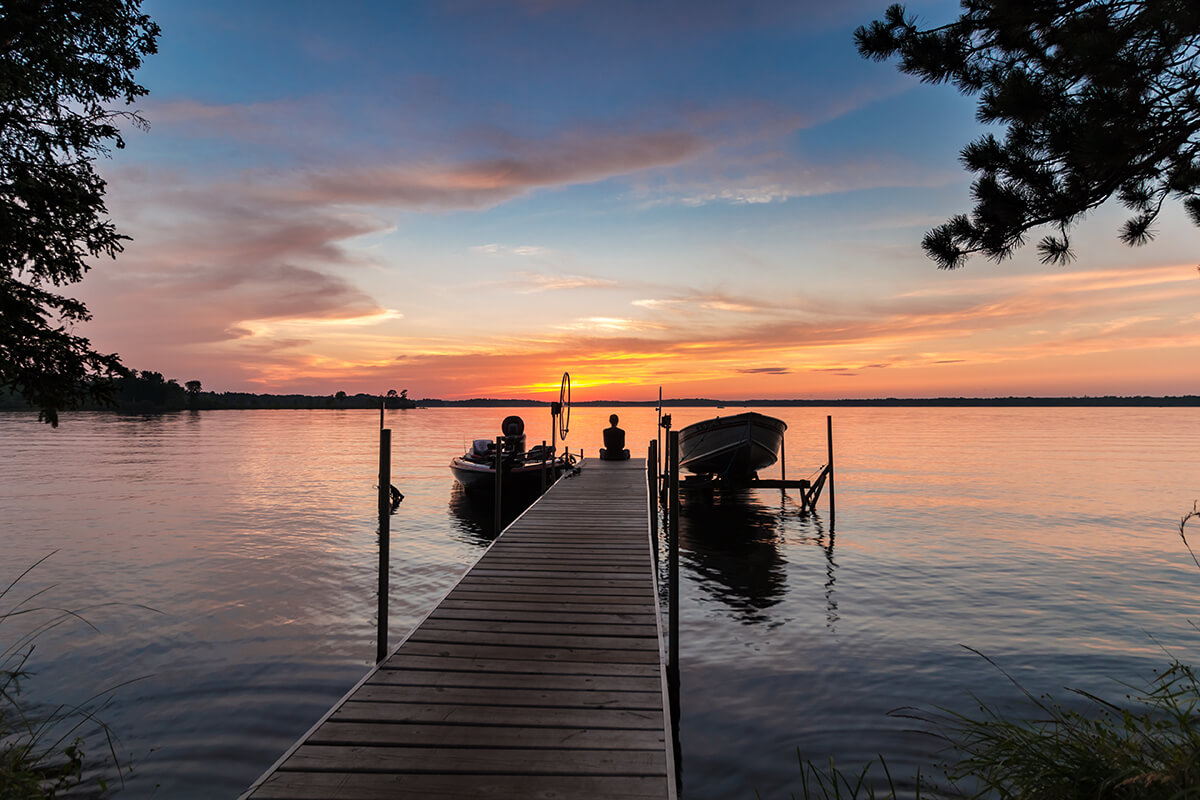
The next day, I got permission from my father to venture out alone with the boat that came with our cottage. I rowed and rowed, then up and down the opposite bank until I saw her emerge from between two cabins: Jeans and a long sleeve white shirt, but the same ponytail, the same unmistakable stride to the end of the pier.
“Say, you rowed across!” she said.
She was grinning brightly. Her teeth seemed especially large, maybe because I was beneath her in the boat. And pointy cheekbones, squinched against either side of her nose, as she was shading her eyes with her right hand.
“What’s your name?” she said, and I told her, forcing a smile. Hers was Kate.
“So, David, how was the fishing yesterday?”
I liked her voice: warm and kind. But I confess, her face was different from what I imagined. A wasted trip, to my 13-year-old eyes, not yet mature enough to see beneath the surface. Our conversation would begin to change my perspective.
“Slow” I said. “One small bass.”
“I’ve some extra Mepps spinners I can give you.” Was she an angler? “The northern are keen for the black and yellow ones. Black Furies, they’re called.” Wait till I tell my brothers.
“Sure, if you can spare them,” I said. “Let me tie off.”
And that’s how it went with Kate. She was all about fishing. An aficionado. Practically a guru.
She gave me three lures extracted from one of two tackle boxes in her garage, while talking up hotspots around the lake. When I asked where we might have a chance at a pike, she laughed and said they were stacked in the coontail in front of our rental. Laughing not at our ignorance, but at our good fortune.
When I asked how she knew, she said her family lived year-round in their two-story blue house on the lake, how her “Pops” joked that she’d probably grow gills, fishing with him since she was 4.
I envied her the secrets she must harbor about these waters, how she was part of the Northwoods. Its mystery. Its treasures.
Though older than her by perhaps a year, I felt like her junior. Her student.
But it wasn’t till the middle of my boat ride back across the lake that I felt like an ass. The wind had kicked up, and I struggled with the oars, cold spray hitting my face, even as I flushed with boiling shame. Less for rowing across and chasing after a teenaged boy’s fantasy, than for my disappointment, my shallowness when I saw she was not — my juvenile preference for superficial glamour, over a kind and wise and generous soul.
On the last day, we caught five northern pike under the bright sun. And when Patrick asked me if Kate was as “fine” in person, I shook my head slowly and said, no, she was even more beautiful than we thought.
We did not return the following summer. Dad liked trailblazing different routes, exploring different lakes.
Still, it was the same pine scented breeze, the same northern lights, the same lonely wail of a loon at night.
The Northwoods, I realized, would never change. But its pristine nature and honest beauty helped change me.
David McGrath, an emeritus English professor at College of DuPage, is the author of Far Enough Away, an essay collection. His essay ‘His Intimacies with Lake and Stream,’ published in this magazine, was cited in Best American Essays 2022. Email him at mcgrathd@dupage.edu.