
In the 1920s, young Billy Hambley liked to sit near the railroad tracks in his hometown of Pikeville, Kentucky, and observe his surroundings.
He couldn’t help noticing the coal dust that settled everywhere, blown from freight trains that moved through town. Or how every few years, the Levisa Fork of the Big Sandy River — which nearly encircled Pikeville — rose and flooded homes and businesses. Or the impoverished residents who lived in hundreds of hillside shacks, many with dirt floors and no indoor plumbing.

Even as a boy, he imagined better things for Pikeville and its people.
Years later, William Carter Hambley Jr. ’39 would earn a medical degree at Northwestern University, marry and have four children, run a successful medical practice and serve as his hometown’s mayor for nearly 30 years. But he is best remembered for spearheading an engineering feat that involved slicing through a mountain, transforming the landscape and raising Pikeville’s prospects.
Called the Pikeville Cut-Through, it was one of the largest civil engineering projects in the Western Hemisphere — its scale surpassed at the time only by the Panama Canal and the Grand Coulee Dam. The Cut-Through involved shifting nearly 18 million cubic yards of earth and rock and creating nearly 400 acres of new flat land to allow for city expansion.
Afterward, Hambley said fate had determined his place in the world, and he wanted to do all he could to improve his hometown. “And you don’t do things by just thinking about them. You see? Aspirations and ambitions without commitment — are nothing. They’re just daydreams,” he told a local author in the 1980s. “I don’t like to daydream — I like to bring all ideas I conceive into reality.”
Hambley was born in 1914 in Pikeville, then a town of about 1,300 people nestled in the coalfields of eastern Kentucky, the top coal-producing region in the state between 1912 and 2013. It’s the region where the famous Hatfield-McCoy feud played out in the late 19th century.
He was one of five children of Myrtle and William C. Hambley Sr. His father worked as a butcher, a construction foreman and a custodian. Billy attended grade school and high school at Pikeville College Academy, which was affiliated with Pikeville Junior College, a Presbyterian institution.
A late bloomer, Billy earned modest grades in high school and mostly focused on basketball. He attended the junior college for a while, still not much interested in academics. It surprised everyone when he announced that he planned to apply to Notre Dame and play football: He had never played organized football, and he wasn’t Catholic.
Nonetheless, Hambley was attracted to Notre Dame while following the Fighting Irish football team from afar. He worked washing cars at a service station to save nearly $700 for college. Once accepted at Notre Dame, he enrolled in 1935, during the Great Depression. Initially a physical education major, he had by sophomore year changed his major to science. And he logged some time on the gridiron. Notre Dame Scholastic articles listed him as a fullback on the B team, the varsity reserves.
Hambley’s family couldn’t afford to help him with college costs, so he got a part-time job working in the greenhouses at neighboring Saint Mary’s College. Each day he walked by the campus bakery on his way to his job. A Dutch immigrant at the bakery took a liking to him and regularly provided him with cinnamon rolls, although the two never exchanged names.
As a senior, Hambley was elected president of Notre Dame’s Academy of Science, an honorary scholastic society. That fall, his father died. He considered dropping out to get a job and support his family, but they urged him to finish his studies. He graduated cum laude with a bachelor of science degree.
By then, Hambley was determined to become a physician. After a summer job selling Bibles door to door in rural Wisconsin, he enrolled in medical school at Northwestern University. During his medical training, Hambley found a mentor in Dr. Loyal Davis, a prominent neurosurgeon and the adoptive father of Nancy Davis — who later married and became Nancy Reagan.
Hambley met his future wife, Alberta Heintzberger, on a blind date in Chicago in 1941. Alberta had grown up in Mishawaka, Indiana, near Notre Dame. After the couple became engaged, Alberta took her fiance home to meet her parents, and Hambley discovered his future father-in-law was Henry Heintzberger — the Dutch baker from his college days. The Hambleys would have two sons and two daughters.
After earning his medical degree, Hambley spent three years as an Army surgeon during World War II, serving at an Army hospital in Galesburg, Illinois, and six months aboard a U.S. Army hospital ship in the Pacific. After the war, he returned to Chicago, earned a master’s degree in anatomy and completed his surgical residency.
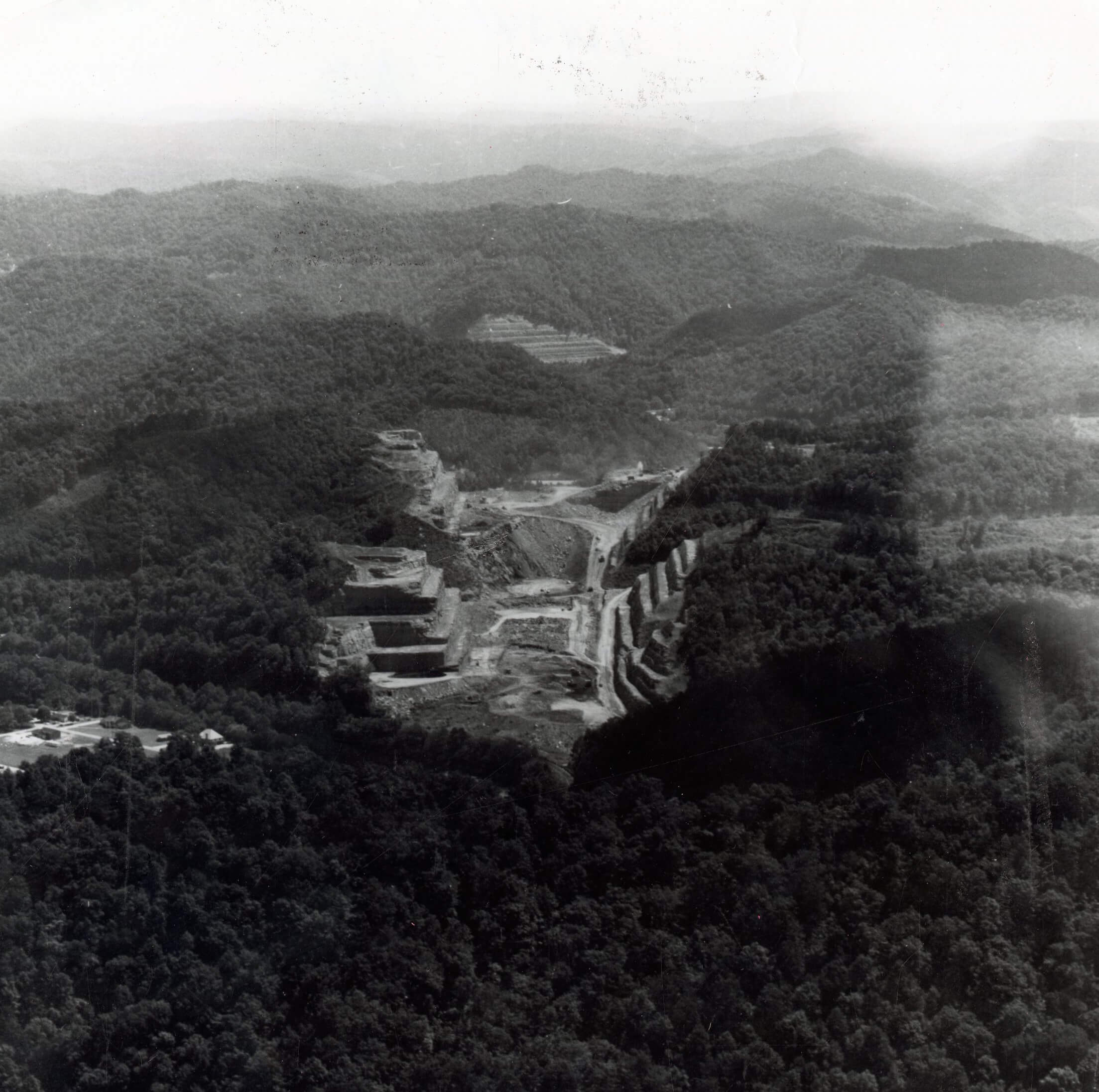
Pikeville, meanwhile, continued to experience periodic flooding. Coal dust choked the air, coal trucks choked the downtown with traffic, and the city lacked suitable land for expansion. During the 1940s, while still in Chicago, Hambley started telling friends about his idea of removing a section of Peach Orchard Mountain and rerouting the river, the railroad and four highways through the gap to make the town a more inviting place. Many people considered it a pipe dream.
The Hambley family left Chicago in 1954 and moved permanently to Pikeville. While he specialized in surgery, Hambley ran a general medical practice — treating routine illnesses and miners afflicted with black lung disease, delivering babies and staffing the local hospital’s emergency room. He often worked seven days a week.
“I couldn’t extricate myself from my universe of concern in Pikeville. I wanted to come back and serve my own people,” he said. During the 1950s, Hambley became a member of the city planning commission. He became mayor in 1960 and was reelected numerous times, serving for 29 years while continuing his medical practice.
Hambley got involved with the National League of Cities, an advocacy organization. The idea of a “cut-through” to allow for a town redesign was always in the back of his mind. Some locals were captivated by this brainstorm, while others just shook their heads in disbelief, says Barbara Hambley Keenan, the last surviving of Hambley’s children. She and her husband still live part time in Pikeville, in the same circa-1919 brick house where her father grew up and she and her siblings were raised.
Hambley Keenan recalls when the river rose above 52 feet in January 1957. At the time, it was the worst flood in the town’s history. Water filled the Hambleys’ basement and nearly reached the first floor. The cost to Pikeville homes and businesses totaled more than $8.5 million at the time — the equivalent of more than $100 million today.
At midcentury, the isolated town faced numerous challenges. During a coal-mining depression in the 1950s, Pikeville’s unemployment rose to 14 percent. The 1960 census found that 75 percent of the town’s housing was substandard.
In 1965, Pikeville was named an All-American City, an award recognizing communities for their civic engagement and efforts to address local challenges. Hambley forged relationships with regional, state and federal leaders, and became adept at applying for urban-renewal grants.
Another initiative, the Model Cities Program, provided federal funding to selected communities to address poverty and urban blight. Initiated by President Lyndon B. Johnson, the program emphasized local governance and community participation in planning and implementation. In 1968,
Pikeville won a place in the program and devoted its $58,000 planning grant to preparing applications for other federal funds. The effort would pay off.
The Cut-Through project became a certainty in 1970 after a hearing held by the Kentucky Highway Department. Of the 200 local residents who attended, none expressed opposition to the plan. Meanwhile, delegations sent by the federal agencies that would fund most of the work gave the project their public blessing.
At the time, Pikeville had 5,800 residents, about 10 percent of Pike County’s population. “A few years ago, this 147-year-old county seat was so poor that it advertised itself as a place where even the undertaker went broke,” The New York Times reported in 1970.

“The whole idea of rerouting the river was very off-putting to some people,” recalls Sara George, a former owner and editor of the Pikeville newspaper who covered the latter years of the project. Hambley, she says, “was not vain, but he was certainly self-assured and confident about this project.”
Many residents considered coal dust the city’s worst problem. Heavy trucks rumbled constantly through downtown, creating long traffic delays at the tipples where they dumped coal for rail shipment. Chesapeake & Ohio freight trains rolled along, blowing coal dust, George recalls. “There was no air conditioning. People had to keep their windows open.”
Ever the optimist, Hambley had every detail of the proposal memorized and traveled to Washington, D.C., and the state capital in Frankfort to explain his plan and advocate for funding. He succeeded. The money for the planning and the project itself came over time from a combination of federal and state aid and a 2 percent local business tax. It included millions of dollars in federal grants designed to alleviate poverty and isolation in the poorest areas of the nation.
Sometimes Hambley used a medical analogy to explain the need for the Cut-Through: “This is the heart of Appalachia, and we’re doing a surgical bypass on the mountain.”
Some residents remained skeptical, calling the proposal outlandishly expensive and dubbing it “Hambley’s Folly.” “He talks in paragraphs, and I listen in sentences. He just climbs away over people’s heads,” one resident said.
Once the project was underway, residents endured 14 years of significant disruptions and challenges — blasting to split the mountain, construction noise, dust from massive earthmoving vehicles, detours, traffic congestion.
Some residents complained about cracks forming in their foundations from the vibrations. “My mother shook her head in despair since our house was right on the riverbank within a few hundred feet of non-stop rumbling and dust,” Hambley Keenan recalled in her 2023 book, Remembrances of My Father. “People reported seeing rats who had lived for generations on the riverbank being squashed by the rocky fill, trying to scurry to safer ground. Dad said there must have been a million rats buried when the river was filled in.”
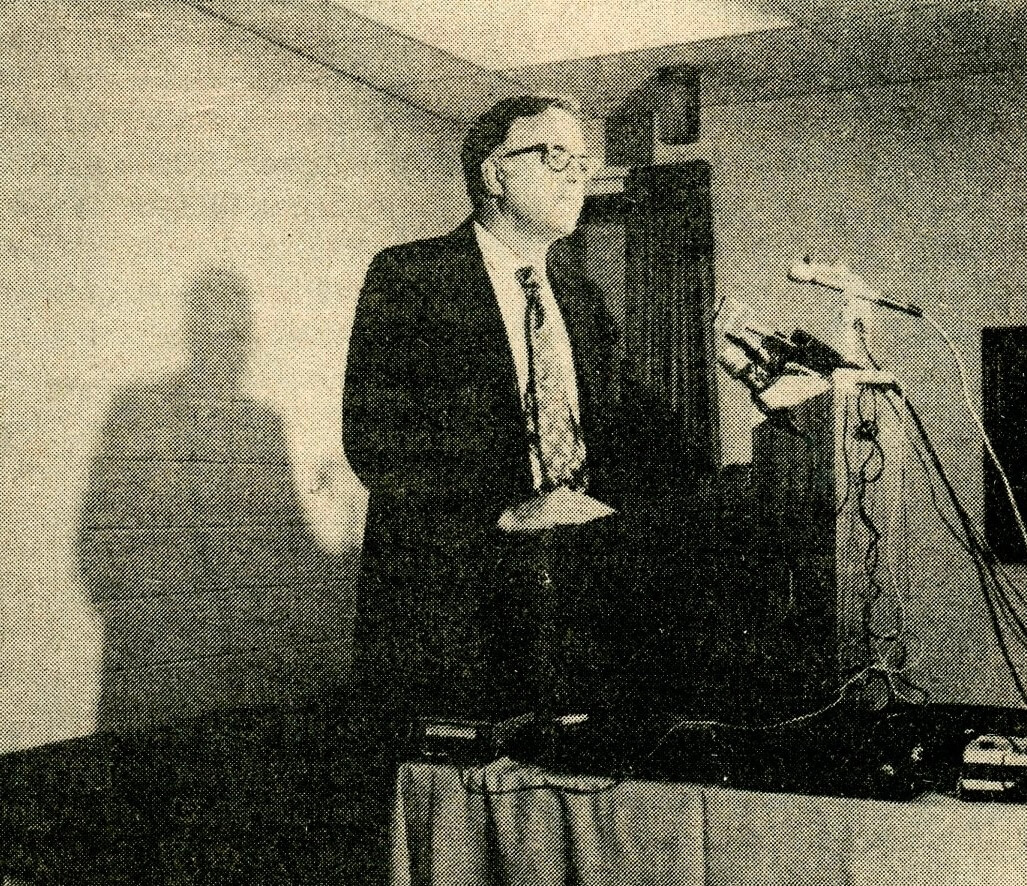


The construction and rerouting altered the layout of the city. Neighborhoods were impacted, and residents moved to new and better housing as shacks were demolished.
Work on the Pikeville Cut-Through began in 1973 and was completed in 1987 at a cost of $78 million. The work created a slice through Peach Orchard Mountain that is three-quarters of a mile long, 1,300 feet wide and 523 feet deep, providing a new path for the railroad tracks, the river and the four thoroughfares now merged into a four-lane U.S. highway.
Before the project, major floods routinely caused $10 million or more in damages to Pikeville, and floods occurred every few years. “See, it doesn’t take long to make up [$78 million],” Hambley said in a 1988 interview. Most vehicles coming through town on the highway didn’t need to stop, so moving the highway removed more than 80 percent of the traffic on the narrow downtown streets, he explained. “Economically, it was just a very sound proposition.”
Some 500 dilapidated houses were torn down and replaced with new units of public housing and modern subdivisions. Hambley considered the addition of a community child care center his proudest accomplishment, because it allowed women — including single mothers — to earn a living assured their children were safe. “If you want to improve society, then you improve the foundation,” the mayor said.
In time, venues and services built atop the former riverbed included a public arena, a 10-screen cinema, a county health department building, a senior center, a museum and a community college. A 15-acre community park was created on a newly flattened hillside, complete with playing fields, walking trails and picnic areas. A scenic overlook provides a grand view of the Cut-Through and the city below. A new regional airport opened north of the city in 1983.
Just as important, the floods, dust, traffic and other perennial coal-town problems subsided. Downtown Pikeville was even spared damage during 2022 and 2025 floods, which caused widespread damage in residential and commercial areas located outside the flood protection zone.
Meanwhile, the Cut-Through facilitated the transition of the regional economy. Coal production in eastern Kentucky peaked at 131 million tons in 1990 then declined steadily in the decades since to a mere 8.6 million tons in 2020. Today, Pikeville is a pleasant mountain community of about 7,750 people and a regional hub for banking, healthcare, education and business with a highly rated public school system. The University of Pikeville — the former junior college — has an enrollment of more than 2,100 students and includes colleges of osteopathic medicine and optometry.
“None of those things would have happened without the Cut-Through, because we wouldn’t have had the quality of life available — nor would we have seen the interest required to support those kinds of things,” says George, the former newspaper editor.
Hambley died in 1996 at age 82. Nearly three decades later, he hasn’t been forgotten. A statue of the former mayor stands in a downtown park, and an athletic center and a major city street on the former route of the railroad are named in his honor.
Shortly after the mayor’s death, Larry Webster, who served 13 years as city attorney, said Hambley was a visionary whose enthusiasm was contagious. “When you combine that will with his intellect and his character, it was a devastating force . . . a powerful force,” he told the Lexington (Ky.) Herald-Leader.
Her father instilled a lesson in his children that education was the most important choice a person could make, Barbara Hambley Keenan recalls. He spoke fondly of his student years at Notre Dame, where academics became his priority and he decided to pursue medicine. “Dad found himself, found the man he was going to be, at Notre Dame,” she says.
Margaret Fosmoe is an associate editor of this magazine.