In January 1905, a group of young people from the Philippine islands arrived in South Bend and enrolled at Notre Dame and Saint Mary’s Academy. By ship and train, they had traveled more than 8,000 miles.
“There were in the party six young men ranging in ages from 16 to 19 years, who matriculated in the university,” the South Bend Tribune reported. Five of these youths enrolled in engineering studies and the sixth in the law program. Three Filipinas matriculated at Saint Mary’s.
The young men became students under the Pensionado Act of 1903, a federal law that established and funded a scholarship program to encourage Filipinos to enroll at colleges in the United States. In the aftermath of the Spanish-American War in 1898, the Philippines had become a U.S. territory, and Filipinos were considered noncitizen U.S. nationals.
Supporters of the law said they started the program to prepare the Philippines for self-governance. Pensionado candidates took an examination, and those chosen to receive a scholarship were considered the best and the brightest of the nation, an archipelago of more than 7,000 islands located in the western Pacific Ocean between Taiwan and Indonesia. Notre Dame’s first Filipino students earned degrees in June 1906, becoming the University’s first Asian graduates.
The presence of those Asian students is a reminder that Notre Dame has long been part of a global story, says Jeremy Dela Cruz ’15, ’19M.S., the chair of the University’s Asian Pacific Alumni affinity group. Dela Cruz began researching these former students during the COVID pandemic. “Many came from prominent families in old Manila,” the capital of the Philippines, he says. “The majority were from elite backgrounds.”
Last year marked the 30th anniversary of the founding of this affinity group, but Notre Dame’s ties to the continent begin with those first Filipino students.
That legacy was born in a complicated moment in history, Dela Cruz notes. Emerging from the Spanish-American War, the Philippine-American War of 1899-1902 and the onset of U.S. colonial rule, which lasted until 1946, it’s a story shaped by pain and privilege — pain in the loss of Filipino sovereignty under the short-lived Philippine Republic, and privilege in that the pensionados were largely drawn from highly educated families being prepared for colonial leadership, he says.
By September 1905, 12 Filipino students were attending Notre Dame. In their spare time, they enjoyed baseball, track, football and swimming. “These Filipinos are very loyal to Uncle Sam and when asked regarding the American rule [in the Philippines], always express themselves in unmistakable terms that they are glad to be ‘Americans,’” the Tribune reported.
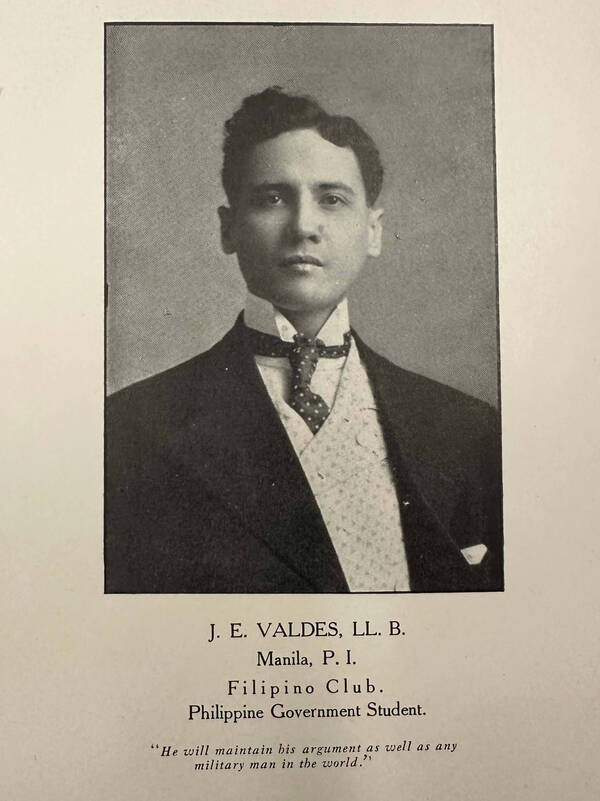
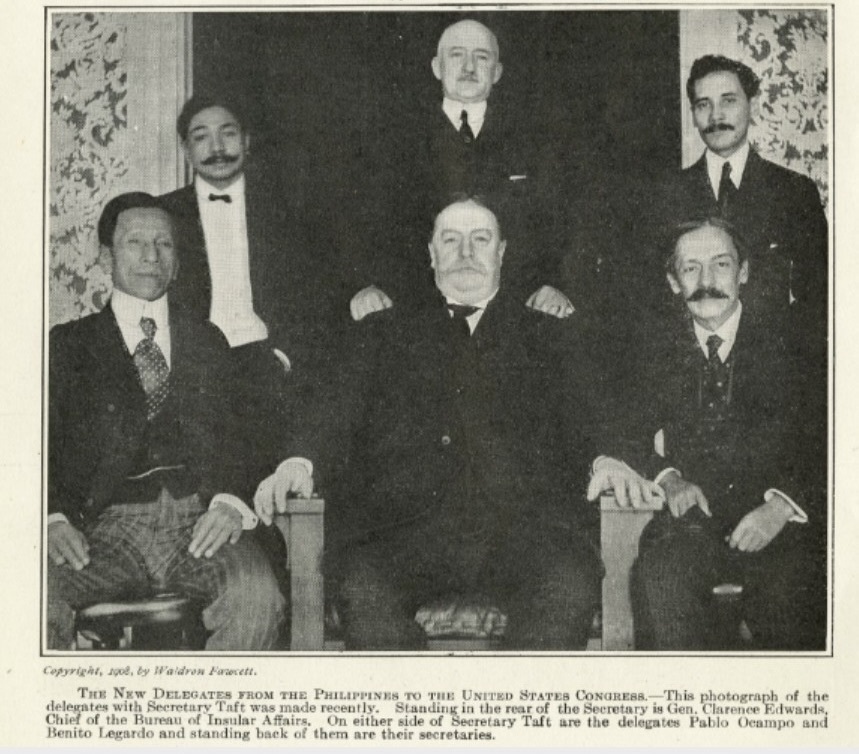
The first pensionado to earn a Notre Dame degree was José Eduardo Valdes of Manila, who received a bachelor’s degree in law with high honors in 1906. Newspapers reported that Valdes was the first pensionado to graduate from a U.S. college. He would serve in the cabinet of Benito Legarda, the first resident commissioner of the Philippines in the U.S. colonial government, and later became chief of the income tax division of the Bureau of Internal Revenue for the Philippines. His son, Gonzalo R. Valdes, graduated from Notre Dame in 1935.
The 1906 edition of the Dome yearbook devoted a page to the Philippine Government Students’ Club and its dozen members. By the 1920s the organization had become the Manila Club. Those groups were forerunners of today’s Filipino American Student Organization, a club whose events include Fiestang, an annual music and cultural showcase that culminates in a Filipino banquet.

The earliest Filipino student group was inward facing, says Sophia Labrador ’25, who traced those early students through campus publications for a research paper her senior year. “The point of the [first] club was to specifically connect with other Filipinos on campus,” she says, and to make a good impression on Americans who had little knowledge of the Philippine islands or their people.
Over the years, that club and its successors focused more on sharing Filipino culture through music, dance and traditional foods. Today students of any nationality are welcome to join, says Labrador, a former club officer.
When the first pensionados arrived, they found two students who hailed from the Philippines, a pair of brothers of Spanish heritage, Evaristo and José Batlle of Manila. They had enrolled in 1902 after their businessman father saw the University’s Spanish-language catalog and wrote to request more information, according to correspondence in the University Archives.
“We are the first Filipinos to come here, and we are treated with the kindest attention. You can not imagine the interest which our native land . . . [has] awakened here,” Evaristo Batlle told a Manila newspaper for an article that was republished in a March 1903 issue of the Notre Dame Scholastic. The Batlles earned bachelor’s degrees in architectural engineering in 1906.
Because the brothers were sons of a Spanish father who had worked in the Philippines, they considered themselves partly or mostly Spanish. Their home was listed as Barcelona, Spain, in the 1903-04 campus bulletin and in their commencement program, and they spent their summers in Europe. After college, Evaristo Batlle became editor of an import-export trade magazine based in New York City. José Batlle practiced architecture in Spain.
An estimated 500 Filipino pensionados received federal scholarships and attended U.S. colleges between 1903 and 1943. Thousands of other Filipino students were educated in the U.S. during those decades, with their studies paid for by other means. No comprehensive list records the names or number of pensionados who attended Notre Dame.
The University’s first pensionados arrived three months after then-Secretary of War William Howard Taft visited campus to give a lecture titled “The Church in the Philippines.” At the time, Catholic journalists had raised questions about why all the pensionados thus far were enrolled in public universities. Taft had led the effort to establish a civilian government in the Philippines.
In his speech, the future U.S. president highlighted how religious tolerance helped forge a settlement regarding ownership of lands occupied by the Catholic Church in the Philippines and expressed hope that American priests would continue missionary work in the islands.
Catholicism had arrived in the Philippines in 1521 with the Spanish expedition led by the Portuguese explorer Ferdinand Magellan, and the faith spread rapidly after the appearance of missionary orders. By 1900, more than 90 percent of Filipinos were Catholic.
In exchange for their scholarships, the pensionados were required to return to the Philippines and provide at least 18 months of government service to help prepare for independent rule. Depending on their training, that service might be in government, law, public health, teaching or engineering.
The Filipinos at Notre Dame “are admired both by students and professors for their studious habits and their gentlemanly behavior. I wish we had a thousand students as diligent and studious as our Filipinos,” Notre Dame President Rev. John W. Cavanaugh, CSC, wrote to a prominent Manila attorney in 1906. “One of them, Mr. Valdes, is known to you, and I look to him especially for great service to the Filipino people on his return home. I am one of those who thoroughly sympathize with the aspirations of your people for liberty, and I hope that the United States of America will adhere to her traditions when the proper time comes to allow perfect independence to your people.”
The first Filipino to earn two Notre Dame degrees was José Antonio Urquico, who earned a bachelor’s degree in 1916 and a master’s in 1917, both in law. He would serve as governor of the Philippine province of Tarlac in the 1930s.
Alfonso Ponce Enrile studied law at Notre Dame in 1905-07, and later became a prominent Filipino lawyer and politician. One of his sons, Juan Ponce Enrile, was a lawyer and politician who served as the chief architect of martial law under President Ferdinand Marcos Sr. before playing a role in toppling the Marcos regime in 1986.
Pio Montenegro was a journalism major and popular public speaker who graduated in 1923. As a student, he presented public lectures in South Bend and other American cities about the history and culture of the Philippines, arguing that the islands were ready for self-rule.
Montenegro was also one of the first students to report seeing a ghost at Washington Hall, a claim that has found its way into numerous campus publications over the past century. He said he witnessed the specter of the late Notre Dame football star George Gipp riding a white horse up the front steps and through the hall’s front doors.
Students from other Asian countries who studied at Notre Dame in the early 20th century included Yasabro Francis Sugita of Osaka, Japan, who attended 1905-07, and Wai Kyi Woo of Shanghai, China, in 1912-13. In 1921, Paul Sun Ting, of Chinese ancestry but a resident of the Philippines, graduated with a chemical engineering degree. Dominic Ching Kay Ong, Class of 1923, of Amoy, China, is considered the first graduate from mainland China. The first female graduate from the Philippines was Rebecca Nebrida of Manila, who earned a master’s degree in 1963.
On December 9, 1935, Notre Dame celebrated Philippine Day. President Franklin D. Roosevelt visited campus and delivered an address in the Fieldhouse. He and Carlos P. Romulo, a Filipino independence leader and editor and publisher of The Philippines Herald, received honorary doctor of laws degrees. The occasion honored the creation of the Philippine Commonwealth and celebrated more than 400 years of Catholicism in the Philippines. FDR was the first U.S. president to visit campus during his term in office.
The pensionado program ended in 1943, while the Philippines was under Japanese military occupation during World War II. The Philippines became an independent nation in 1946.
One Filipino who was a lasting figure at Notre Dame was Pastor Villaflor, a student from 1905 to 1910. University records don’t indicate that he earned a degree, but Villaflor returned to campus in 1926. Skilled in weaving and needlework, he became well known for his elaborate embroidery of clerical vestments. Living in a small room in Corby Hall, he made Notre Dame home until his death in 1955 at age 80.


The first Notre Dame club outside the United States was formed in Manila in 1924. Today the University still has an alumni club in the Philippines and at least 20 other clubs across Asia and the Pacific islands. More than 6,000 alumni are members of the Asian Pacific affinity group, which presents annual awards named in honor of José Eduardo Valdes.
While the University archives and old newspapers offer occasional brief mentions of the early Filipinos at Notre Dame, detailed profiles and first-person accounts of their presence are lacking. Many of these alumni returned home and lost touch with the University. Labrador was disappointed to find so few details about those students during her research. Further exploration in the Philippines may uncover the paths their lives and careers took. “I’d be curious,” she says. “What did they do with their Notre Dame education and how does that match up against other pensionados who were at other [colleges] across the U.S.?
“Maybe we could discover old letters they wrote back home. I would love to know how they felt while they were at Notre Dame.”
Margaret Fosmoe is an associate editor of this magazine. Contact her at mfosmoe@nd.edu.