
Alec Dietzel ’17 didn’t transfer to Notre Dame for football, academics or campus life; he came because he wanted to be closer to his sister. Months earlier, doctors had diagnosed their father with cancer, and although his parents urged him to stay in school, Dietzel wanted to be near family for whatever came next.
He was randomly assigned to O’Neill Hall and a roommate named Luke McVeigh ’17, another sophomore transfer student. McVeigh had come to Notre Dame to be closer to his high school sweetheart, Emily Burns ’17.
Dietzel and McVeigh soon became close and discovered they had even been on the same mission trip years earlier, though they hadn’t met.
“There were so many little signs when you look back now,” says Alec’s mother, Lois Dietzel. “We know God brought them together for a reason.”
During their first year at Notre Dame, the new friends built a small community of transfer students in O’Neill, playing flag football, staying up late talking and going to dorm Mass together.
“We could talk about anything,” Dietzel says.
He fondly remembers working with Burns and her Walsh Hall friends to form a joint intramural flag football team. They won two championships “and should have won a third had Emily not torn her ACL in the game,” he says. “We were always doing things together.”
As Dietzel’s family continued to navigate his father’s illness, that circle of friends — especially Luke McVeigh — became an important source of support.
Alec’s father, Dennis Dietzel, was known among friends as a devoted family man. In the early 2000s, he sold his electrical contracting business so he could be more present for his children. He coached their soccer teams, wrestled with them in the backyard and brought them on service trips to Haiti and Nicaragua, where he used his expertise to bring electricity to homes and churches.
Alec calls Dennis his best friend; his sister, Olivia ’15, says he was her biggest supporter.
Things with Dennis first started to feel off when Alec and Olivia came home for their winter breaks in 2013 — Alec in his freshman year at the University of Wisconsin-Madison and Olivia in her junior year at Notre Dame.
During those weeks, familiar names began to slip into vague placeholders as Dennis spoke — “you know who I mean” — and at a New Year’s Eve party, he accidentally filled a friend’s glass with hot water instead of cold.
A few days into 2014, Dennis developed flu-like symptoms that disappeared within 24 hours. But four days after recovering, he woke at 2 a.m. to vomit again.
Lois, a nurse, called Dennis’ secretary to ask whether anything had seemed off at work. The secretary recalled a letter Dennis had asked her to review. It was riddled with obvious spelling errors — so unlike him that she had assumed he was playing a joke.
Lois asked Dennis if he would consider going to the doctor. He agreed instantly.
“My husband was not one to go to the doctor, so I knew he knew something wasn’t right,” Lois says.
The nurse initially dismissed his symptoms as the flu, but Lois insisted on a CT scan. The scan revealed a “cookie-sized” brain mass pressing on the midline — so large doctors feared he could suffer seizures at any moment.
Their small city of Dickeyville, Wisconsin, had no neurosurgeons, so the Dietzels were told to drive immediately to the nearest major hospital, no time to spare. They risked a stop home to tell their children. Alec and Olivia were in the sunroom reading when their parents delivered the news.
“They wanted us to know what was going on. They weren’t trying to shield us, protect us from anything,” Alec says. “They were just very open about the reality of everything. And that gave us a lot of comfort later that we weren’t going to miss things.”
Then Lois and Dennis set out on the hour-and-45-minute drive to Iowa City, where a team of doctors and Lois’ sister would meet them on arrival.
The next morning, January 10, 2014, Dennis was in surgery. Because the tumor was in the part of his brain that controlled speech and movement, doctors warned that he might not be able to talk or move afterward. Ten hours later, he emerged, reached for Lois’ hand and spoke to her.


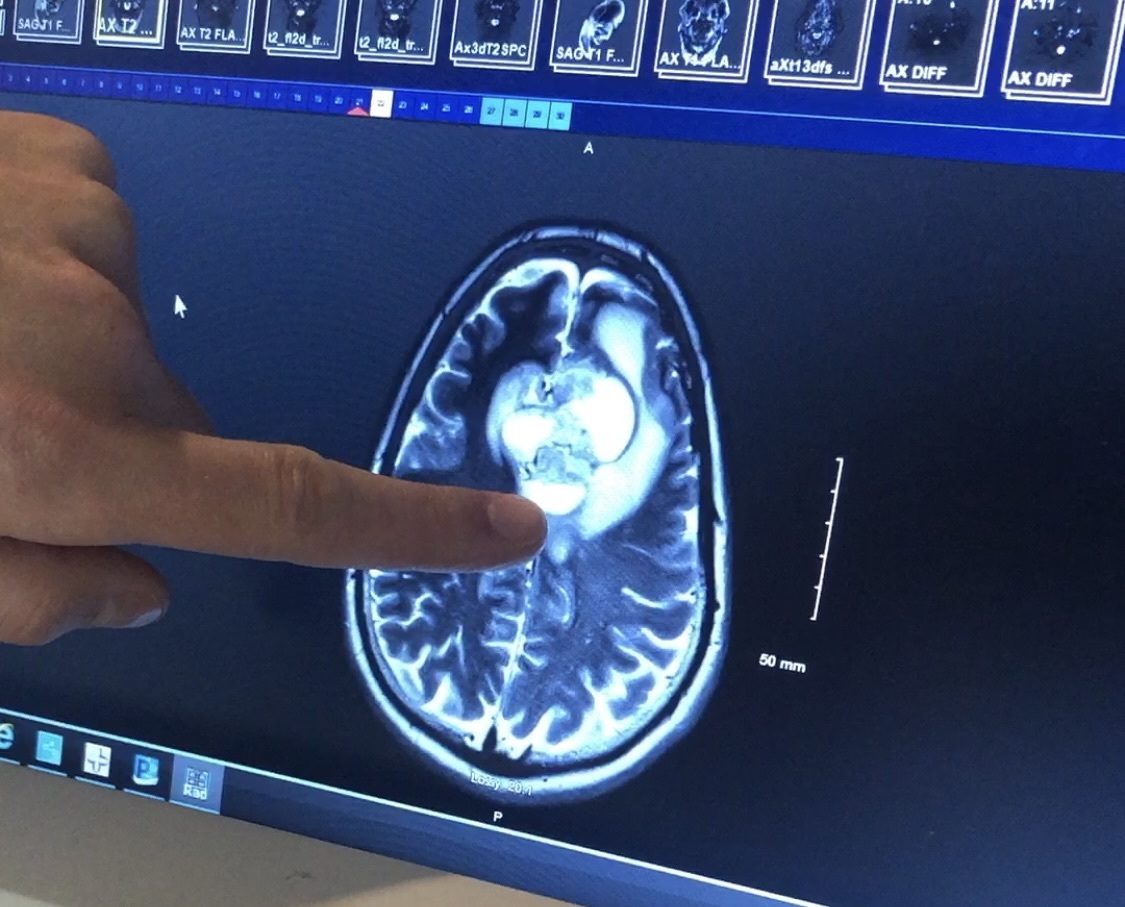

The diagnosis was glioblastoma — the most aggressive cancerous brain tumor found in adults. It is one of the rarest forms of cancer, representing fewer than 1 percent of all cancer diagnoses. It can trigger seizures, stroke-like neurological deficits and changes in speech, vision, mood and personality. Most patients survive only about a year. Roughly 1 in 20 live beyond five years.
Alec was scared. Besides the emotional toll of knowing he was to lose his father, he was worried about the logistics. Dennis handled so much household responsibility that Alec wasn’t sure what it meant, at 18, to step into the role of “man of the house.”
His parents insisted that Alec and his sister continue their education. A few days after the surgery, Alec went on a scheduled service trip to New Orleans to help rebuild houses impacted by Hurricane Katrina and then returned to Madison. Olivia went back to Notre Dame for the second half of her junior year.
“I think the worst part was that every time that I would get a phone call — from Olivia, from my mom, from my dad — that I wasn’t expecting, my mind would automatically shift to something bad that just happened. And that never went away until the day that my dad passed,” Alec says.
Knowing his father’s poor prognosis, Alec began the paperwork to transfer to Notre Dame so he would be near his sister after they lost their father, which he expected to happen within the year.
Alec spent much of his sophomore year with Olivia and her friends, as well as with Luke McVeigh and their O’Neill friends, who tried to support Alec and Olivia as best as they could.
Dennis defied his prognosis. He didn’t die that year, and he even seemed to thrive.
Olivia graduated with a degree in mechanical engineering, and she moved back in with her parents in Dickeyville to help take care of Dennis and work as a product engineer at John Deere in Dubuque, Iowa, 15 minutes away. Alec returned home in the summers to work with his father at Morse Electric in Dubuque.
Over the three years Alec and Luke were roommates, their parents also became close, visiting frequently and building a bond of their own. They went to games and tailgates together and watched their sons win the flag football championships. Dennis Dietzel and Brian McVeigh even teamed up to face their sons in a game of beer pong during Junior Parents Weekend. The fathers won in overtime.
“Everyone was laughing,” says Emily McVeigh, who married Luke in 2018. “Brian and Dennis got along super well and were just both really fun, laid-back guys. They were just two well-liked, happy, great guys with great, laid-back, happy sons.”
Life was holding steady. Not perfect — Dennis kept working, then would be picked up by Lois or another family member to head to Iowa City for daily radiation treatments, along with ascorbic acid infusions three times a week — but steady enough to feel, at times, almost normal. Dennis leaned into life. He traveled for vacations — as far as Hawaii — and went skydiving.
In 2017, the families watched their sons graduate — Alec in mechanical engineering and Luke in biochemistry. It had been three and a half years since Dennis’ diagnosis. Alec remembers his father playing pool with Brian McVeigh in O’Neill that weekend.
After graduation, Alec took a job at Bell Flight in Texas — much farther from home than he would have liked. Still, he made the effort to visit whenever he could, carving out time to be with Dennis.
On Labor Day in 2018, Dennis went into the hospital, and his health began declining fast. Alec moved back to Wisconsin for a new job as a product marketing coordinator at Milwaukee Tool so he could be closer to home. He drove the two and a half hours to see his father often, opening the door to weekend excursions in Dennis’ beloved Camaro and quiet conversations that became some of their most meaningful moments together.
“It was just me and him, and we talked about everything, and what things might look like when he’s not around,” Alec says. “I saw a different side to my dad, a little more of a vulnerable side, which I think was necessary in the process of coping with everything, of him eventually not being around.”
Olivia took up biking so she could join Dennis with his exercises.
“I didn’t really know what I was doing,” she says. “It gave him the opportunity to coach me again, and so it was really cool to have that opportunity.”
In June 2019, Olivia founded Mind Over Matter, a fundraising platform tied to her first Ironman race, which supports brain cancer research at the University of Iowa. She decided also to collect the names of 140 people affected by glioblastoma — one for each mile of the race — and dedicate each mile to a different person. When she told her mother about the plan, Lois was skeptical. She couldn’t imagine Olivia finding 140 people who had been touched by such a rare cancer.
“It took a week, which is honestly really sad,” Olivia says.
Three weeks before the race, Dennis was hospitalized again, and it seemed unlikely he would be there to watch. But he pulled through, was discharged just days before the race and, unbeknownst to Olivia, waited outside in a cold rain to see her cross the finish line and greet her with a hug. The plan had been for him to wait in a nearby hotel room, but he told his wife: “I’m not leaving this course until she crosses that finish line.”
“I started struggling pretty hard on the bike, but thinking about my dad gave me the motivation to get through the last 40 miles. I was in a lot of pain at that point,” Olivia says. “Seeing him at the finish line was a huge surprise. It was incredibly emotional.”
After the race, Dennis’ health continued to decline, and hospital stays became more frequent.
Years before that difficult summer he had quietly made one notable preparation for the possibility that he might not live much longer. Without telling anyone, he had visited his brother, who had a small sound studio in his basement, and recorded “Lullabye (Goodnight, My Angel)” by Billy Joel, a song he used to sing to his children. He wanted it to be played at Olivia’s wedding if he couldn’t be there to sing it himself.

Alec Dietzel lived with the uncertainty of his father’s glioblastoma for nearly six years — learning to cherish ordinary moments while knowing they could soon disappear. Then, in the fall of 2019, Luke McVeigh entered the same uncertainty.
After their wedding, Luke and Emily had moved to Indianapolis, where she worked remotely and he attended the Indiana University School of Medicine. Meanwhile, Kelly and Brian McVeigh had moved from Lansing, Michigan, to a high-rise in downtown Grand Rapids, where Brian had started a new role as CEO of Adventure Credit Union. Kelly had begun pursuing a master’s degree in counseling.
“Life was really, really good,” Kelly says.
Even with a new job, Brian balanced work and home life well. His former colleagues had known him as a calculated planner, a steady hand. At home, he was “the behind-the-scenes backbone of his family,” one niece says. “The calm in the craziness.”
He was also spontaneous and playful. Another niece remembers the New Year’s Eve when Brian and her father took over her new Christmas present, a karaoke machine. While her father sang, Brian performed Rockettes-style high kicks in the living room.
Signs that something was wrong emerged that October. Brian, who had always left for work by 7:30 a.m., began taking more time to get ready, heading out around 9:30. His new coworkers hadn’t known him long enough to detect any differences, but the change struck Kelly as odd.
Because Brian had epilepsy — which, in addition to seizures, can cause subtle personality shifts — she first thought his medication needed adjusting. But the unusual behavior continued. Sometimes, Kelly would ask him a direct question and get no response at all.
On October 30, with no resistance from Brian, Kelly drove him to Trinity Health Grand Rapids Hospital. The medical team couldn’t see anything obviously wrong, but after two days of testing, they ordered an MRI, which revealed a baseball-sized tumor on his brain.
Four hours away, Luke and Emily were riding an Uber to a friend’s Halloween party when they noticed missed calls from Kelly. When they reached her, Emily says, they were “shell-shocked” by the news. They turned around without entering the party and walked the two miles home in silence. They packed that night and drove to Ann Arbor first thing the next morning.
Drawing upon his medical training, Luke reviewed the MRI with the neurologist. Before they got the test results back, he knew what he was looking at: glioblastoma — the same aggressive cancer Dennis Dietzel had been living with for almost six years.
A few days later, Brian went in for surgery. Kelly, Luke, his brother, RJ, and Emily camped out in Brian’s hospital room for the next two weeks, sleeping in shifts while he recovered.

Luke called his friend Alec to share the hard news.
“I was in absolute disbelief,” Alec says. “And just immediately all the pain, the frustration, the struggle from all those years; you just kind of get this rush back of everything, and you just feel sick. One of your best friends in the world just helped you through all that, and now you’re going to witness him go through the exact same thing.”
At first, Alec couldn’t understand how it could happen to his friend, too. And then, alongside the grief, came a quieter thought: gratitude that he and Luke had been assigned as roommates five years before. Over the next few months, the friends called, texted and visited whenever possible despite their busy schedules.
Amid the uncertainty, Luke also leaned on Dennis. When the Dietzels came to Indianapolis for the Big Ten football championship in December 2019, Luke spent the game talking with Dennis about his own father’s diagnosis and how he could face something so devastating.
“In retrospect, I think it was just very nice to be able to talk with someone who you could be very frank with,” Luke says. “You didn’t have to pretend like everything was going fine or that you were doing great. You could tell him things are hard.”
Brian’s first few months after surgery went well enough. But glioblastoma is unforgiving.
When Kelly and Brian returned from the hospital, they packed up their new life in Grand Rapids and returned to their longtime community and church in Lansing.
By early 2020, Brian and Dennis were experiencing rapid, destabilizing changes in their respective illnesses. For Dennis, the year began with a long-delayed retirement. He had resisted stepping away from his branch manager job at Morse Electric, intent on supporting his family while he could. He had spent months trying to train colleagues to take over his responsibilities. But shortly after he retired, the company opted to close the small branch office and lay off those employees rather than find a new manager, leaving Dennis with a deep sense of guilt.
Not long after, he was hospitalized for three weeks due to “silent” seizures, which consist of staring spells, momentary unresponsiveness and eye-fluttering and are likely triggered by stress. He spent two weeks at the University of Iowa hospital in a state that Lois described as “awake, but unable to communicate.” Physicians were uncertain what to expect; Dennis’ tumor was not visibly growing, yet his condition deteriorated. “He was just kind of a shell of a person sitting there,” Lois says.
Alec and Olivia tried to engage with their father during that period but got little response. Then, abruptly, Dennis’ condition improved. One morning, when a technician asked for his name and date of birth, he sat up and answered for the first time in days.
He spent another week in inpatient rehabilitation and was discharged while doing “miraculously well,” as the family describes it. But the reprieve was temporary. Subsequent scans showed the tumor was progressing. From that point on, personality changes became part of daily life. “It’s just another nature of that disease,” Alec says. “It’s not pretty.
“My dad was a very patient, very steady person,” he says. “You would really have to do something to get him riled up. But towards the end, I saw a couple outbursts where he raised his voice over some things that really weren’t rational. And that, coming from a person who was an extremely rational person, it was just like this complete disconnect where I’m like, ‘Whoa, that’s not my dad.’”
At the same time, Luke was taking his medical exams. When the results came in, he learned he had scored among the top students in the nation. And, after years of uncertainty, he finally knew he wanted to become a pediatric neurosurgeon. Still, though his test scores qualified him for elite residency programs, he decided to pause the clinical track to pursue research for a year. Much of the work could be done remotely, allowing him to care for his father.
Then, in March 2020, the world changed.
In an unexpected way, Luke’s decision to delay residency positioned him well for the months of COVID-19 pandemic upheaval ahead. While other med students faced disrupted clinical rotations, he was able to continue his research, complete a master’s degree and spend precious time with his father.
For both families, the pandemic allowed unexpected time together. Alec took the opportunity to follow his sister by moving home to Dickeyville; he worked remotely, and the Dietzel family was once again together under one roof.

By May 2020, Dennis could no longer walk. He remained at home under the care of a hospice nurse. When the nurse visited on the morning of May 22, Dennis was doing well. By that evening, his condition had changed dramatically.
Lois contacted his extended family. “I just said things are changing, thinking that if they wanted to talk to him, that they needed to see him soon,” she says. Even the medical staff was shocked to receive her call because of how well he had seemed only hours before.
Most of the family was able to visit. Dennis Dietzel died at home on Sunday, May 24, 2020. He was 60.
Alec, Lois, Olivia, and her boyfriend, Kal, were with him when he passed. After the priest and funeral home staff arrived, the family prayed together. Then, Alec went upstairs to play “Journey West (The Oregon Trail)”, one of his father’s favorite piano pieces, before breaking down in tears.
A small, family-only funeral was held four days later. St. Rose of Lima wasn’t their parish, but it had a larger capacity to accommodate COVID-19 regulations, plus it was where the family attended Christmas Eve Mass, and the church stood near the soccer field where Dennis had coached his children.
A few days later, the Dietzels held a celebration of life in their large backyard where folks could spread out. Luke came, and Alec remembers meeting so many of Dennis’ friends from over the decades, people who told stories of his father he had never heard before.
“The community was wonderful,” Lois remembers. “As soon as they heard about it, they wanted to come and help set up tents and picnic tables for everyone to be outside so people could pay their respects. We had so many people come to show their support. . . . He was very involved in the community, very involved in the Church.”

Kelly McVeigh could feel the shift by November 2020: Her husband, Brian, was running out of time.
Because Brian was immunocompromised, and because of the pandemic, the family had to be cautious, which limited their reconnection with family and friends in Lansing. As news of Brian’s illness spread through a CaringBridge page, hundreds followed his decline from afar. The support was overwhelming, but it came at a distance — no hugs, no visits.
“Brian had such great luck; if there was a drawing for a door prize, he was always getting picked,” Kelly says. “But when it came to having one year to live, he picked the worst year in history.”
Lois Dietzel was a “lifeline,” she says. The women texted and called each other constantly.
Kelly found a way to make the online support tangible. She ordered 150 unfinished wooden crosses, mailed them across the country with prepaid return envelopes, and invited friends and family to decorate one for Brian.
The response overwhelmed her. The returned crosses were painted, carved and deeply personalized. Some came from lifelong friends, others from people Kelly barely knew. For Kelly, they were proof of a community that existed around them, even while the pandemic kept them apart.
In December she bought a minivan with wheelchair access, thinking she still had a few months left, but Brian’s weakening came quicker than anticipated.
“No one told me he was actively dying,” Kelly says. “That’s how in the clouds my head was. I didn’t rent [the minivan]; I bought it. I thought, I’m going to do whatever I need. Whatever I have to do for him, I’m going to do it. Doesn’t matter.”
But as Christmas came, Brian’s condition deteriorated further. Hospice care became his best option. His family chose to keep him at home on a doctor’s advice because a care facility’s pandemic restrictions would have prevented their visits.
Instead, the family created their own medical team at home. Luke administered medication and morphine, and Luke’s sister-in-law, Brianna, a registered nurse, provided care. While some relatives were able to visit — including Brian’s elderly parents, and siblings who lived within a few hours — masks kept them from seeing each other’s faces.
On the night of December 30, Luke and RJ set up their father’s hospital bed in the family sunroom and put a trundle bed for Kelly beside it. They said goodnight to their parents and left for the night.
At 5 a.m., on New Year’s Eve, Kelly woke up suddenly. “His spirit left the room, and that’s when my eyes popped open, I think.” Brian McVeigh had died in his sleep. He was 59.
At Brian’s funeral on January 6, 2021, at St. Martha Parish in Okemos, Michigan, friends transformed two Christmas trees near the altar into memorial displays, hanging all 150 wooden crosses among the branches. Years later, most of those crosses still decorate Kelly’s Christmas tree. She has passed down others to Luke’s and RJ’s families.

Within a year of each other, Luke McVeigh and Alec Dietzel buried their fathers. Their best friends.
“There’s never a good time for any of this, right?” Alec says. “But the fact that our dads ended up passing so close in proximity to each other and from the exact same thing. . . . I really do think that there’s a greater plan in us ending up as ‘random’ roommates.”
The families remain close. They still attend Notre Dame football games together, and Lois and Kelly talk every few weeks.
Olivia Dietzel left engineering and turned her attention to professional endurance racing. With Lois’ help, she continues raising money for brain cancer research through an annual triathlon that she organizes. In 2022, she married Kal Airey. The song her father recorded was played at their wedding.
On April 23, 2025, Alec and Kathleen Dietzel held their firstborn son, Barron Dennis, for the first time. The couple named him for his grandfather. They say the boy has Dennis’ eyes.
Kelly McVeigh founded and leads the Brain Cancer Warrior initiative, which centers on the annual Brian McVeigh Memorial Golf Outing and has raised over $170,000 for brain cancer research at the University of Michigan.
Luke McVeigh is now a neurosurgery resident at the University of Michigan. He treats glioblastoma patients alongside the surgeon who cared for Brian.
Luke tries to emulate the things he respected most about his father: “If I’m talking with somebody, I always try to make people feel good about themselves and leave the focus on them. I think he did that really well.”
Sometimes, in quiet moments, the former roommates each think about how incredible it all was — that a chance dorm-room assignment became a lifelong friendship, that two lives could unfold along such similar paths, that out of so much shared loss arose two families who continue to carry one another.
Michelle Cuneo is an associate editor of this magazine.