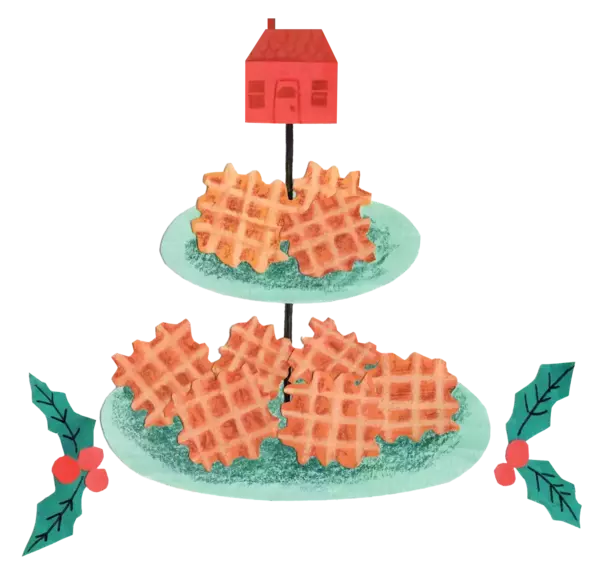
"I don’t know why your family likes these so much. They are too dry,” my father said to my mother the first time he sampled her family’s Belgian waffles. This was early in their marriage. I envision him hovering at the countertop in my parents’ apartment kitchen, waffle in one hand, the other cupped beneath it to catch crumbs.
The waffles that my mother and many members of her family make at Christmastime have a unique texture. Their dryness, although noteworthy, was not overly off-putting for my father. Before that week was through, he had eaten his way through the tin.
“Arceneaux Menou Belgian Waffles,” appears like a legal name in my mother’s recipe book, whereas I’ve always known them simply as “Belgian waffles.” By labeling them so precisely, she distinguished them from generic waffles, and rightfully so. These homemade confections are intended to be handled and dunked. They are not fluffy. They are not meant to be forked.
When someday my mother’s stand mixer dies, I suspect it will occur while stirring the batter for her Belgian waffles. The motor will sputter out nobly, like a farmer who suffers a heart attack while plowing his field. Sensing the mixer’s machinery warming as the bread hook stirs the bowl’s floury contents, I tell myself, It’s a machine, this is what it’s made for. Yet when its desperate whirring ceases, I sigh in relief.
I imagine my mother, a Bernheim, channeling her maternal Arceneaux and Menou family lines whenever she spoons this dough into a waffle press. It was a wise ploy of our ancestors to instill family heritage through recipes. Spices like nutmeg and cinnamon can steer us toward core memories, even collective ones. One such memory is the strength of my Great-Great-Grandma Menou, who mixed her dough by hand — following the original recipe, which calls for triple the waffles of that of my mother’s generation. That it is dough, and not batter, some family members staunchly assert, holding snapped wooden spoons in testimony.
An Arceneaux Menou Belgian Waffle needs to be broken in order to be dunked. The grid provides easily identifiable axes by which to do this, and the waffle is surprisingly amenable to the split. Homemade goods rarely cleave so cleanly. Instead of the amoebalike sprawl of a homemade pancake, our waffle has a hardy, rigid structure.
My father’s first review, “too dry,” may be fair, but these Belgian waffles are not brittle like biscotti. They do not crunch but rather crumble. The sensation reminds me of the feel of the soil around a houseplant watered a week ago; it’s hard to tell if it’s moist or dry or somewhere in between. The waffle’s texture is part of its intrigue and appeal, driving you onward to the next bite.
My mother’s oldest sister, Stephanie, died two years ago. At the hotel breakfast area on the morning of her funeral, their youngest sibling, Uncle Peter, said to me, “I have a Christmas waffle left. Do you want me to get it?” He retrieved from his room a Ziploc bag with a small waffle, light brown in color.
Peter, like many members of the family, has tweaked the original recipe. He makes his waffles with chocolate milk, espresso powder and a splash of Godiva liqueur or vanilla extract. Aunt Nancy experiments with eggnog and extra cinnamon. Great Uncle Menou cured his waffles in a pillowcase in his closet to perfect their staleness. (Freezing waffles was sacrilege in his estimation, although I suspect some relatives have violated this standard.) I like seeing photos of my family’s wintertime countertops, golden grids stretching to the horizon, kitchen landscapes overtaken by waffles.
Last year I spotted a Belgian waffle cookie sample at a Whole Foods bakery display. I extracted the specimen with a wax paper square. The cookie was crunchy, flecked with pearl sugar. I did not need more to know it was not what I was looking for.
In honor of my December birthday, my mother usually allots me a gallon bag of her waffles. I’ll retrieve one for breakfast and pour myself a mug of milk on a dark winter morning. In the kitchen’s light, I’ll study the waffle’s rows and columns like a trusted map — a map that soon disappears. Yet moments later, taking my final sips, I discover a breadcrumb trail marking my way back home.
Erin Buckley is an occupational therapist and writer who lives in Richmond, Virginia.