When Dave and Marilee Mahler joined the Notre Dame Chorale shortly after its inception, they did not anticipate the strength of connections the group would provide.
Marilee Mahler ’78 joined the chorale in 1974, its first year, as a way to make new friends and continue her passion for singing. The group was brand new, part of an effort to create a mixed choir after Notre Dame became coeducational in 1972. Dave Mahler ’78 sang in the Glee Club before joining the chorale during his sophomore year, one of very few Glee Club men to join both groups that year.
The pair had different friends in chorale. But when Marilee returned to rehearsal with a brace on her leg, Dave’s grandfather, who was visiting for the weekend, could not help but notice. “Who’s peg leg?” he asked. Dave didn’t know, but his grandfather and Marilee hit it off. On the next chorale tour, the group passed through Dave’s hometown in Faribault, Minnesota. In charge of arranging housing for the weekend, Dave assigned Marilee to his grandfather’s house.
“I was just like, ‘Huh, these people would get along with my parents really well, so I better take another look at their son,’” Marilee says. After that, the couple just “gravitated toward each other.”
Dave and Marilee got married after graduation. David Isele, the founding director of the chorale, played organ, and two chorale/Glee Club members sang at the wedding.
Going on their 47th year of marriage, Dave and Marilee still thank the chorale for bringing them together. “We’ve sung together our whole lives,” Marilee says.

In honor of the chorale’s 50th anniversary and the retirement of long-time director Alex Blachly, the group will perform on Friday, April 4, featuring the current members and almost 100 alumni returning to sing. The program will feature Blachly’s own arrangements of pieces by Schubert, Schumann and Debussy.
The Notre Dame Chorale is a mixed concert choir of 60–70 voices that specializes in choral works from the Renaissance to the present. While many choirs extend their repertoire by including contemporary pieces, the Chorale is unique in its inclusion of Renaissance music, Blachly explained.
“I think the biggest difference [between the Chorale and other University choirs] is that we apply a certain amount of historical performance practice to the way we do things,” he says.
In addition to regular on-campus concerts and a regular domestic tour, the Chorale is known for its yearly rendition of Handel’s Messiah with a baroque orchestra.
Isele joined the department of music in 1973 as the successor to Daniel H. Pedtke, the Glee Club’s director since the 1930s. Facing pressure to create an official mixed ensemble given the introduction of women to Notre Dame a year prior, Isele decided to start auditioning for a new group in the fall of 1974.
Many of the Glee Club members were anxious about the introduction of a mixed ensemble, remembers Pat Scott ’76, a Glee Club alumnus who has researched the history of both groups.
“If there was anything you could say about people who had bad feelings, it would be Glee Club jealousy over losing some of their perks — singing for the Board of Trustees, singing for the alumni senate, singing the national anthem at basketball games and commencement,” Scott says.
Isele, affectionately known as Coach, directed both groups. By the time the upperclassmen graduated, the Glee Club’s hesitation had largely diminished, thanks in part to the Glee Clubbers who participated in both ensembles. Marilee and Dave Mahler were presidents of the chorale and the Glee Club, respectively, their senior year.
The chorale started going on short tours under Isele’s direction and adding to their repertoire.
Blachly, who is retiring this year after 32 years as director, is only the third full-time choirmaster of the chorale. He is also a professor of musicology and director of the professional New York vocal ensemble Pomerium. Since he joined the chorale in 1993, the group has become a staple of the music department, says chair Berthold Hoeckner.
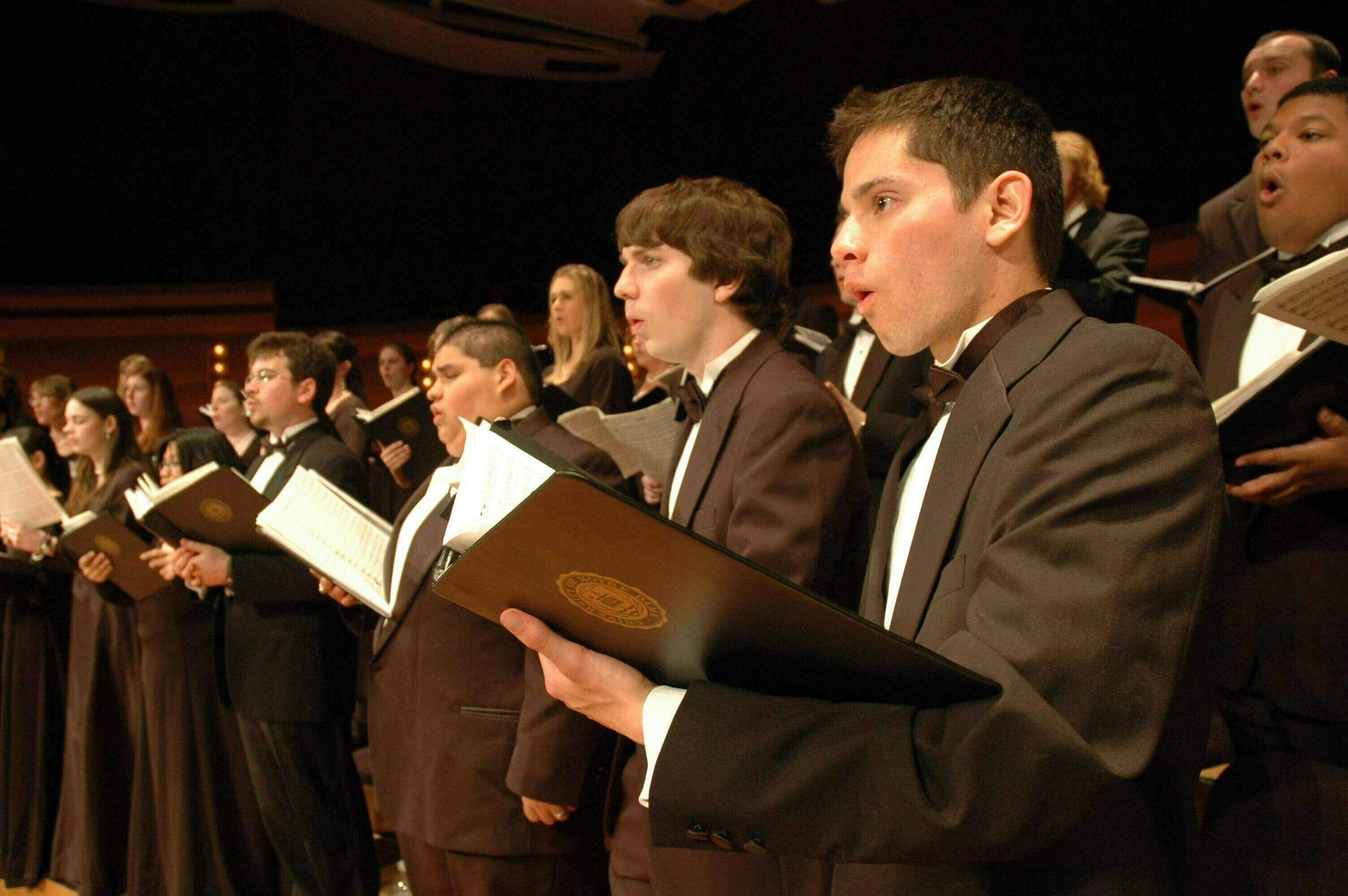
Over his tenure, Blachly introduced a baroque orchestra to accompany the chorale. Baroque instruments, he says, are easier to sing with because they are closer to the human voice. He has also trained the chorale singers to sing with Renaissance tuning, also known as just intonation, to fit with the repertoire of the group.
“I have a particular approach to choral singing that I’ve been instilling in the chorale singers for 32 years, and they’ve gotten very used to it. They sing very much like a Renaissance choir,” Blachly says.
The group has gone on six international tours, besides the annual domestic tours, visiting places such as Italy, New Zealand, Switzerland, Germany and Austria. In 2011, the ensemble traveled to Rome for a weeklong stay and sang for Pope Benedict XVI. They also perform a regular concert for Notre Dame’s Language and Culture Week, singing in French, German, Italian and more.
“He has had this impact for more than three decades and has been able to shape this group and establish traditions and a kind of culture of what a performing group should have — regular tours, core repertoire as well as changing repertoire,” Hoeckner said. “It sustains itself as a group that people and students . . . seek out to deepen their understanding of music.”
Blachly has directed multiple children of the chorale’s 600 alumni. Many of them will return to sing another time with the group, wishing Blachly farewell with a united performance of Bach’s “Dona nobis pacem” and, as always, acapella versions of Notre Dame’s school songs.
Katie Muchnick, an English and economics major and journalism minor, is this magazine’s spring intern.