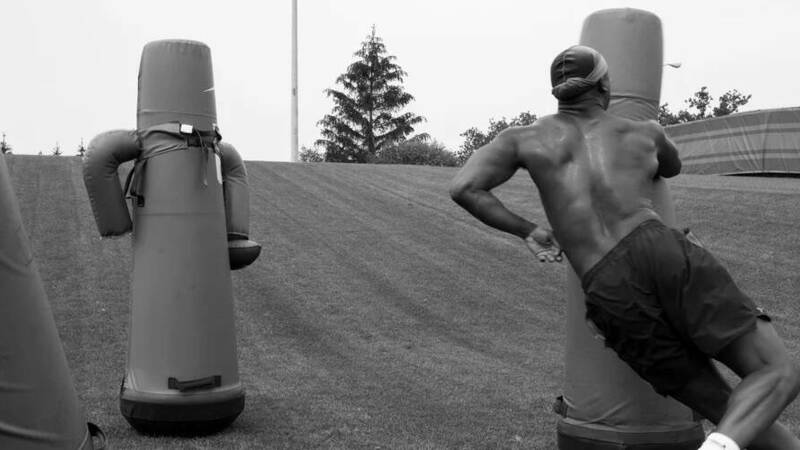
Romeo Okwara ’16 spends a lot of time sifting through photographs.
The walls of his studio showcase 10 years of images: New York City streets. Firefighters in Brooklyn. Teammates in locker rooms. Musicians under stage lights. Ordinary people caught in unguarded moments. Okwara is assembling them into a book now, searching for the through lines.
“I finally had time to look back,” he says. “To make sense of the work I’d been making alongside football.”

After 18 years structured by his sport — as a teenager, at Notre Dame, in the NFL — Okwara retired in 2024. Every hour of his life had been predetermined by football: meals, training, rest. Now, it’s different. He still wakes up early. He still trains. But that discipline is also translating into long studio hours, revisiting images until patterns emerge.
“That ‘chop wood, carry water’ mindset,” Okwara says. “I had to figure out what that looked like in art.”
He remembers holding photographic negatives up to the light when he was a child in Lagos, Nigeria, turning them in his hands, fascinated by how an image appeared when you learned to see it. Even after two decades devoted to football, art’s pull hasn’t diminished.
Okwara’s American story began when he was 10. In 2005, he boarded a plane for a 29-hour journey from West Africa to Charlotte, North Carolina. When he stepped into the autumn air of his new home, he saw his own breath for the first time.

The move wasn’t quick or easy. His mother, older brother and younger sister had gone first. Romeo and his younger brother Julian ’20 stayed behind in Nigeria for two years, living with their housekeeper while their father traveled between continents, holding the family together.
America was exciting. It was also disorienting. At his new school, Okwara was two years younger than most of his classmates due to the strength of his Nigerian education. But he spoke a form of West African pidgin. His accent drew attention.
“I didn’t really know where I fit in,” he says.
Then there was football. He found the sport through his older brother, who had joined his middle school team a few years earlier. “That was sort of my intro to the game,” Okwara says. “I just tried to follow in his footsteps.”
On the field, language mattered less. Sport offered him a team, a way to belong. It also gave him structure and a role. But his first season playing organized football — in seventh grade — didn’t go well. He wasn’t very good, he says. Then his father pulled him from the team to focus on academics. Okwara tried out again in eighth grade, but he didn’t make the cut.
As a seventh grader, Okwara also enrolled in an art class. The first piece he made — the bust of a pirate — earned a grade of 90 percent. It sits today on a desk in his studio.
Even before taking art classes, he had been drawing instinctively, filling notebook margins with sketches. His mother’s brother, Emmanuel Isiuwe, is a painter and photographer in Nigeria.
“I was fascinated by him,” Okwara says. “I thought it was really cool that you could just paint for a living and that could be your life.”
As he matured, football and art both grew in importance. He made his high school team and took classes in drafting, graphic design, theater programming and AutoCAD, gravitating toward the technical side of creativity. Architecture felt like a natural destination in college — until football intervened.
At Notre Dame, the demands of the sport clashed with the demands of the architecture school, particularly the required year in Rome. Okwara chose to study accounting instead, a practical decision that allowed him to stay on the field. He set art aside as a career goal, but he refused to let it disappear from his life.
He enrolled in art history and studio art classes, especially ceramics and drawing. And in his free time, he carried a camera. He photographed teammates, mostly. When he studied in Greece during the summer of 2015, he became the unofficial documentarian of the trip. Not everyone understood. Back on campus, one coach told him to put the camera away and focus on football. Okwara refused: It wasn’t affecting his performance. The other players took photos on their phones “all day long,” so what was the difference if he used a real camera?
Football carried Okwara, a defensive end, further than he imagined. The Irish played Alabama for the national championship when he was a freshman. After graduation, he played in the NFL for the New York Giants and the Detroit Lions. Over eight seasons, he recorded 25 sacks, including a standout year in 2020 with 10 sacks and a reputation for consistency and discipline.
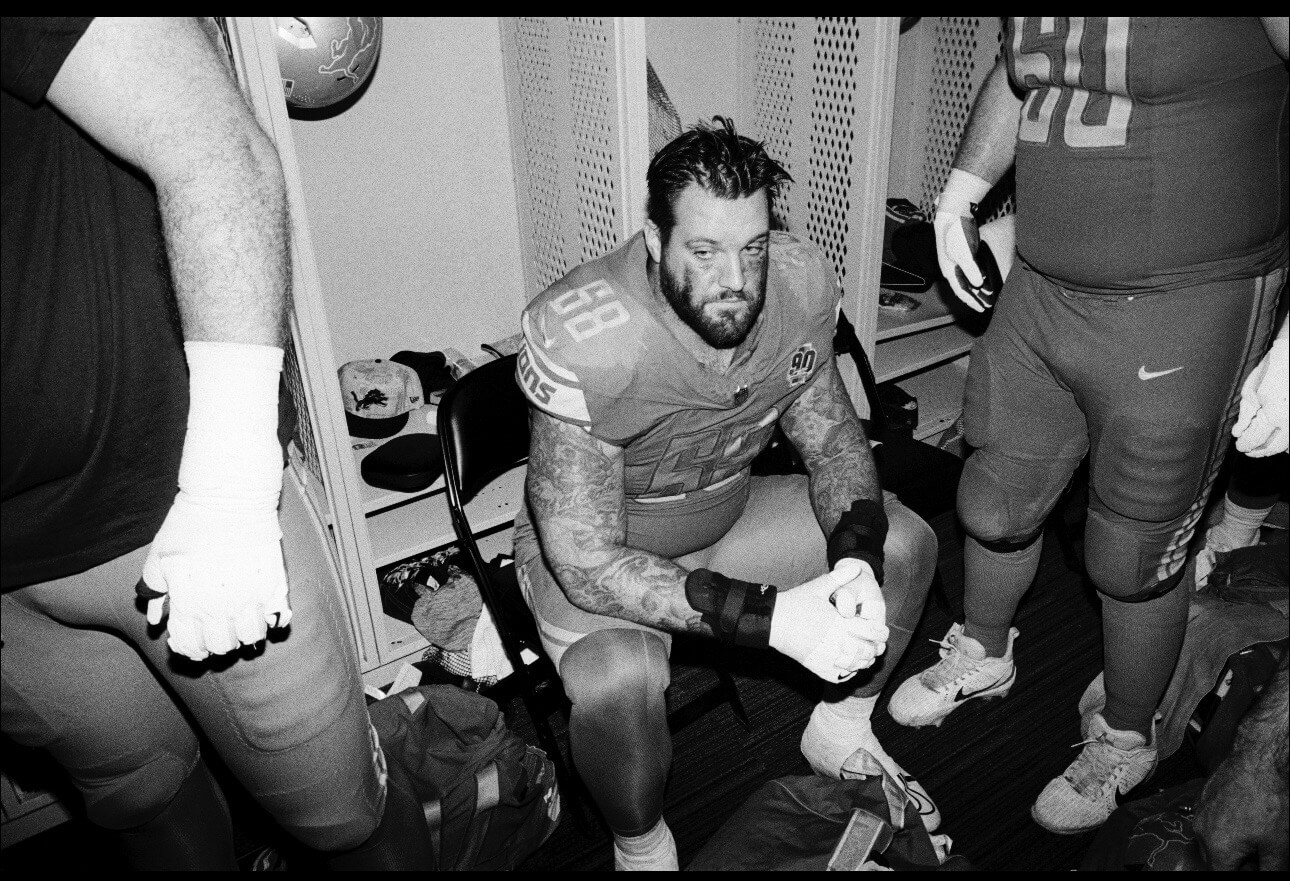
But his football career was often interrupted by injuries. Whenever football paused, art surged back into focus. In 2017, Okwara sprained his knee during a Giants practice. He didn’t need surgery, but he couldn’t practice for months. The rigid structure of his life vanished overnight.
“I had all this time,” he recalls. “I’d do rehab for a couple of hours, and then the rest of the day was mine.”
He bought a camera and walked the city. Photography wasn’t new, but with that time and solitude, it became a more serious pursuit. He visited museums, met other photographers and took photos of people he saw.
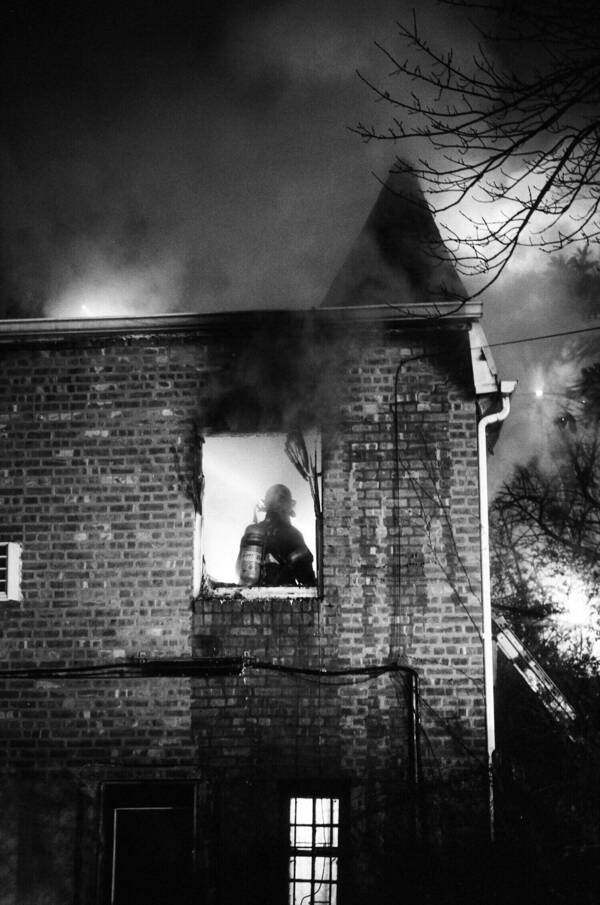
During his recovery, members of the New York City Fire Department’s elite Rescue Company 2 visited a Giants practice to speak about resilience. Okwara attended and later took a firehouse tour. One visit became many. He would spend more than 20 nights at the Brooklyn firehouse, quietly observing the rituals, the humor, the intensity. He listened. He earned trust.
Out of that trust grew a photo project documenting the behind-the-scenes rhythms of Rescue 2. The images captured brotherhood and the unspoken understanding among people who depend on one another — something Okwara recognized immediately.
“It mirrored football,” he says. “That sense of structure. Of being part of something bigger than yourself.”
His work caught the attention of Leica Camera executives. In 2019, Okwara mounted his first solo exhibition at the Leica Store SoHo, timed to open before September 11 to honor New York’s firefighters.
Photography, he saw, was a way to tell stories. His camera has since brought him into rooms with well-known musicians and public figures. Most recently, he was invited to photograph The Black Keys in Memphis, Tennessee. But celebrity isn’t what most interests him.
“I think the work I enjoy most is just kind of the everyday person,” he says. “Even if there’s a famous person, what I try to do is humanize them. It’s more about the sheer humanity.”
Okwara’s desire to capture these human stories didn’t come out of nowhere: His family lost all their photographs and memorabilia during the move from Nigeria. Years later, a computer crash erased his early college images. Those losses helped him see how meaningful pictures could be for an individual or a family.
“Storytelling is the basis of everything I do,” he says. “Family stories. Locker room stories. Even the first film I made — it was a self-portrait of a certain time in my life.”
Okwara was 28 when he retired from football. He felt the loss of structure anew. He wanted to commit himself fully to his art. Graduate school offered both structure and permission to slow down and devote himself to the work. He enrolled at Cranbrook Academy of Art outside Detroit, studying under its artist-in-residence and head of photography Chris Fraser.
“It felt like the right place to figure out what my practice looks like when it’s the main thing,” he says.
Surrounded by serious artists, Okwara brought less in terms of formal training, but he had his archive: nearly a decade of work compiled in the margins of another career.
“What originally attracted me to Romeo’s photography was a sense of quietness, a sense that the world was organized and poised and about to reveal something to you,” Fraser says. “I think that he has a way of finding the outsider within a crowd. He has this lovely way of making loud scenes feel very quiet.”
Fraser pushes Okwara to experiment across mediums, to find the right form for each story he wants to tell. Football, inevitably, resurfaces — especially in his sculptures. In a favorite piece, he uses a concrete base, purple Nigerian fabric his mother gave him, and a Gatorade towel to speak about memory and his layered identities: Nigerian, American, athlete, artist.
“I don’t always know why I’m drawn to something in the moment,” he says. “But when you look back, the through lines are there.”
He has founded Middle Gray, a Detroit nonprofit that grants visual artists studio space, equipment and stipends so they can develop their work. The project seeks to build community among artists and strengthen the city’s arts landscape. Okwara is also working on a short film with a former high school teammate, revisiting the place where his American story began.
“It feels full-circle,” he says. Like the negatives he held up to the light as a boy. The work now is to create art that lets others see what he sees, too.
Michelle Cuneo is an associate editor of this magazine.