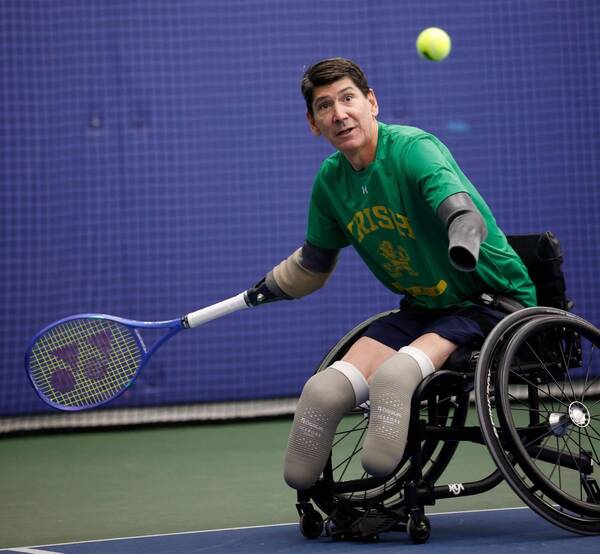
On an overcast Friday afternoon in March 2026, the Notre Dame men’s tennis team arrived in Dallas for a match against Southern Methodist University. The SMU Mustangs stood shoulder to shoulder along one sideline, the Fighting Irish mirroring them on the other. The usual prematch chatter and excited whoops from players and onlookers petered out as Ron Rosas ’93 stepped forward, a tennis ball strategically balanced in the crook of his left prosthetic arm.
The spectators quieted, the net swayed slightly in the breeze, and everyone watched as Rosas let the ball roll off his left arm. His right prosthetic arm, fitted with a racket, came through in one smooth motion, sending the bright yellow ball in an arc over the net. A grin spread across Rosas’ face as his rally with one of the players unfolded. A cluster of Irish fans, clad in green sweatshirts, holding on to their baseball caps on the blustery day, leaned forward in the stands, clapping as the ball traveled back again. Rosas met it once more, then turned toward them, lifting both arm and racket overhead in triumph, his grin spreading wider.
Rosas, a native of El Paso, Texas, who has called Dallas home for nearly 30 years, says his allegiance these days usually runs with the Mustangs. But on that spring afternoon, as the applause for his honorary first serve lingered and the two teams gathered for a photograph with Rosas in the middle, he was unmistakably with Notre Dame.
During his years as a Notre Dame student-athlete, Rosas was a standout on Coach Bobby Bayliss’ men’s varsity tennis teams, making it to the NCAA tournament in three of his four seasons. In 1992, alongside David DiLucia ’92, Andy Zurcher ’93, ’97MBA, and other leading players, Rosas helped drive the team’s Cinderella run that carried the Irish all the way to the national championship match. Entering the tournament with one of the lowest rankings in the 16-team field, the Irish defeated seventh-ranked Mississippi State, third-ranked Georgia and top-ranked Southern California to reach the final against Stanford, ending the season as runners-up.
Thirty-four years later, appearing at SMU, the ball rising and falling over the net, Rosas was simply enjoying the rhythm of the rally and the familiarity of being on the court — a moment that until recently he wasn’t sure would be possible.
Rosas was a healthy and athletic man in his early 50s when, on December 29, 2022, a bout of feeling under the weather progressed quickly into a case of pneumonia so bad that emergency room physicians at Texas Health Presbyterian Hospital hustled him to the ICU when they determined he couldn’t breathe on his own. Doctors in the ICU intubated him and induced a coma. When Rosas woke 16 days later, septic shock had left him with severe tissue necrosis in his arms and legs.
Looking back on that fateful day of his trip to the ER, Rosas remembers waking up early with the shivers and not feeling well. He drove himself to the local urgent care clinic, where he tested negative for the flu, strep throat and COVID. Returning home, he quarantined himself in an upstairs bedroom. It was Christmastime and his family — his wife Victoria and their four children — was enjoying the holiday break.
Bored, Rosas moved a chair to attempt a mini-workout, something to keep himself busy — ever the athlete, even in illness. Then his muscles started to hurt. At first he thought he was just dehydrated, but he soon realized he was dealing with something different from the regular aches and pains that come with exercise.
Victoria remembers how her husband kept saying his muscles weren’t engaged. “I’m like, that doesn’t make any sense,” she says.
Seeing his condition deteriorating, she grabbed a pulse oximeter, a fingertip device that measures oxygen levels in the blood. Testing it on her finger, the device read 99 percent. Normal. Placing it on Ron’s finger, she found the oximeter gave no reading at all.
It took Victoria seven tries to get Ron’s oxygen reading, and when she did, it was 62 percent — much too low. She called for an ambulance. By the time they reached the hospital, Ron was in respiratory failure.
There, Rosas remembers instinctively covering his arm with his hand so the doctors couldn’t administer the medication that would put him in a coma. He wanted to talk to his wife first.
“The doctor just looked at me and said, ‘There’s no time.’”
As the infection in his lungs spread to his blood, Rosas went on life support. In the early morning hours of December 30, a priest administered him last rites.
Seeking to raise Rosas’ dangerously low blood pressure, doctors put him on vasopressors, medication that keeps vital organs like the heart, kidneys and liver functioning while restricting blood flow to the extremities. His chances of survival were slim; if he did survive, the vasopressors would likely leave him with permanent damage.
The treatment ultimately saved Rosas’ life. But when he awoke on January 14, 2023, nothing felt the same.
“I couldn’t move. My arms didn’t work, my legs didn’t work, and they were just all wrapped up, so I couldn’t see them either,” he says.
When the bandages eventually came off, Rosas’ limbs were unrecognizable.
“My feet were this grayish black, and my knees and my arms,” he says. “Up high, it was all black,” he adds, pointing to the scar running across his upper arm.
At the hospital, he heard rumblings about losing fingers and toes. Then, after nearly a month, Rosas was moved to a rehabilitation center where the wound care for his limbs and the next steps for rehabilitation became clearer. Doctors informed him that it was no longer fingers and toes he would lose, but his arms and legs. Surgeons explained that both legs required amputation below the knee, his left arm below the elbow and his right arm above the elbow.
“That was probably the hardest thing to hear, because I’m a right-handed tennis player. I can’t lose my elbow joint,” he says. “Not to mention, I didn’t really want to lose any of my limbs.”
But Rosas was still holding out hope. Saving his right elbow joint would make all the difference. If surgeons could preserve it, there was a chance he could one day hold a tennis racket again.
Better news came during a video call with Dr. Jason Souza, a reconstructive surgeon at The Ohio State University Wexner Medical Center. Souza said he believed he could save Rosas’ right elbow joint. Rosas clung to this glimmer of hope. He wanted to live as pain-free as possible, and he wanted to be able to play the sport that had shaped his life.
“I wasn’t even thinking about daily activities like trying to comb hair or brush teeth,” he says, laughing.
The couple flew to Ohio at the end of February. Ron spent the next nine weeks in and out of the operating room: nine surgeries totaling 70 hours.
Souza was able to preserve Rosas’ right elbow joint, reconstructing his forearm using muscle taken from his back. With the joint made functional in this way, the transposed muscle could provide control signals for a prosthetic arm.
Rosas’ right knee was damaged to the point that saving it required his kneecap to be shaved down. Surgeons used part of his iliotibial band to reattach his kneecap to his shin. The reconstruction left him with a “floating patella.” Rosas points to his upper leg, where his kneecap sits higher than its typical location at the front of the joint.
He says he has spoken with other amputees who were told they would have a below-knee amputation, only to awaken from surgery and find that the surgeon was forced to amputate higher than expected and they have lost more of the leg above the knee. Rosas feels the extra surgeries at Wexner were worth the trouble, knowing that his team was committed to saving both elbows and preserving as much of his legs as possible.
The hospital gave Rosas a room that overlooked Ohio State’s football stadium. “I think they thought it would be funny — and fortunately, I do have a good sense of humor,” he says.
The Saturday after he arrived for the first surgery, the Notre Dame men’s tennis team happened to be in town for a match against Ohio State. Afterward, head coach Ryan Sachire ’00 stopped by Rosas’ room. Sachire brought a big Notre Dame blanket with him, joking that Rosas could hang it over the window so he wouldn’t have to look out at the Buckeyes’ field.
Over the months that followed, Rosas received many messages of support from former teammates, Irish tennis players from other eras and current students. He credits his success to this kind of encouragement from his family, from Notre Dame friends, from his community in Dallas and his church.
A team of specialists in Dallas fitted him with his first prosthetics. On June 9, 2023, surrounded by his family, physical therapist and prosthetist, he stood for the first time on his new legs.
At first Rosas was only able to stand with help for short periods of time, but as the weeks went by, he began to move around on his own with a walker.
He says it was “awesome to be back on two feet — even if they weren’t my feet but prosthetic feet.” Feeling his way toward balance was a challenge, he adds, but achieving it felt great.


In November 2025, Rosas returned to the tennis court for the first time since his recovery with a special socket on the prosthesis of his right arm that enabled him to hold a racket. He hit some balls while standing and some from his wheelchair, testing out different approaches.
By February 2026, he was visiting the court more regularly, ramping up his efforts each week. He says he has no time to waste. He intends to compete at the U.S. Open Wheelchair Championships in September and expects to hear in July whether he has qualified for the tournament.
The U.S. Open added men’s and women’s wheelchair singles and doubles in 2005 and introduced a Quad division in 2007 for athletes who have lost most of the motor or sensory function in at least one upper limb. But few athletes compete as upper-limb amputees.
Rosas hopes he can show that upper-limb amputees can play with a prosthetic tennis arm and find a pathway to compete at a high level. He believes having played tennis competitively for Notre Dame gives him an advantage.
“Even though it’s a different version of tennis, the tennis court hasn’t changed. It’s the same dimensions, just the way I’m doing it is a little different,” he says.
“Tennis is something he’s always done,” Victoria Rosas adds, “and I think it gives him a lot of joy to be back out there and have some normalcy.”
Much of what playing tennis as a quadriplegic athlete looks like is new not just to Rosas, but to the sport. Many adaptive devices exist, but no single tennis-adapted device is widely used, so Rosas has conducted his own research on the best materials and equipment and what potential modifications might optimize his game — larger wheels on his chair or a tennis arm made of a more durable material, for example.
In March, he received his first tennis wheelchair. His biggest challenge has been navigating the court. Most wheelchair players use the bottom of their hand to maneuver the chair. But Rosas’ tennis arm links his elbow directly through a socket to his racket, which he must use to move and steer the chair. It is simply harder for him to move around the court.
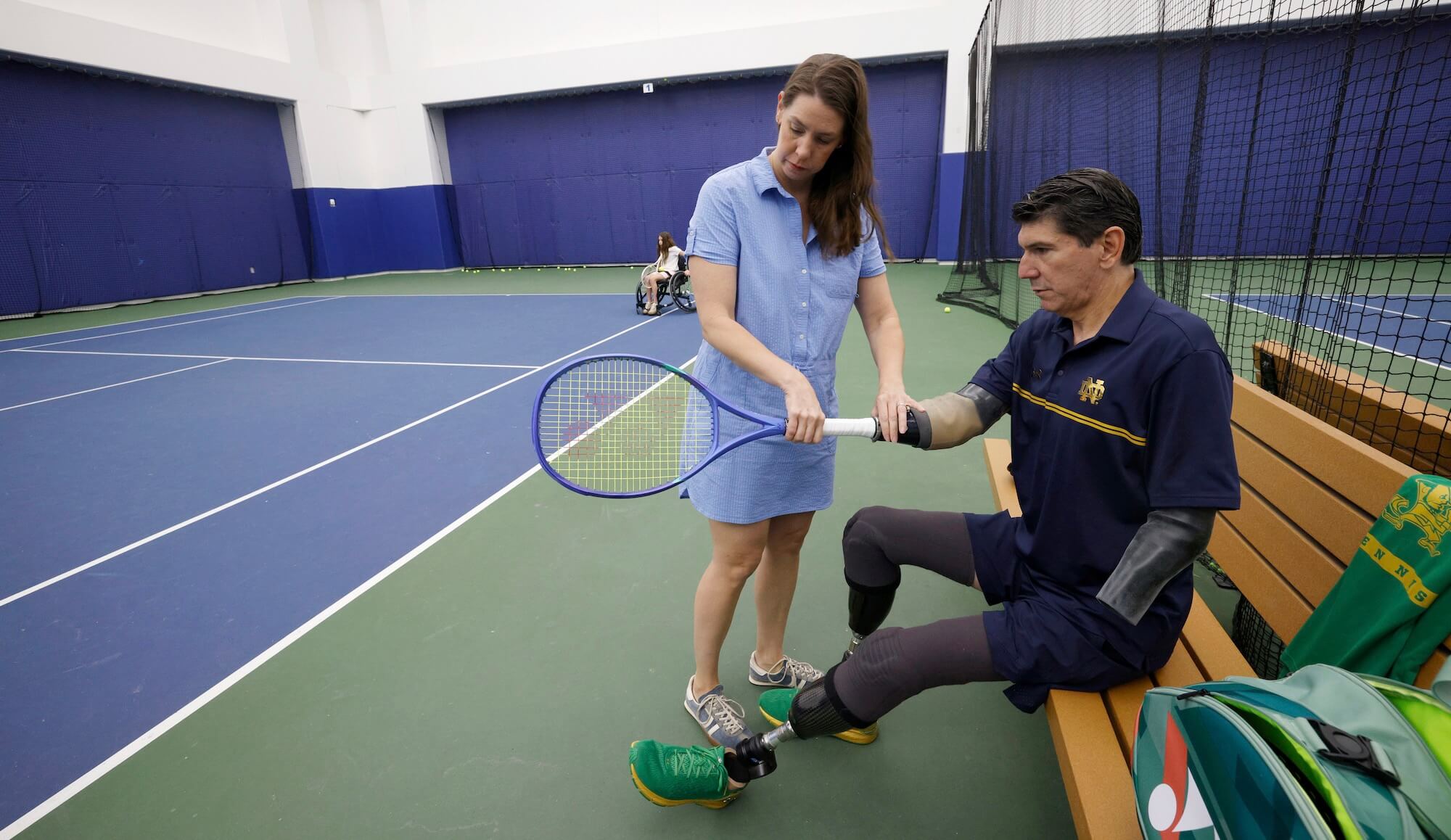
And before he can even hit a ball, he has to set up his arm. With help, he fits the prosthetic sleeve over his right elbow, angling the pin in its socket just right so he can lock his racket into place. The first racket he tried out couldn’t withstand the force of his hitting and fell to pieces after a few practice sessions. His latest racket has held up well.
On Sunday mornings, Rosas often plays at the Dallas Country Club tennis courts where he has coached, given lessons and taught his own children how to play. As his youngest daughter, 9-year-old Vivienne, helps him attach the wheels to his tennis wheelchair, Victoria works on getting his arm ready, laying the prosthesis on a courtside bench. Ron chats with friends who joke that since they can’t play him anymore, they’re left having to play against each other.
With the tennis ball machine set up on the opposite side of the net, Rosas wheels his chair into position, facing the net sideways. The launcher delivers a ball, and he falls into a rhythm, practicing his return of a serve. Bringing his racket back, he swings across his upper body and hits the ball with a satisfying thwack. He adjusts his chair slightly with his left arm before the next ball sails through the air. Rosas meets each one with the center of his racket.
His hitting is methodical, forehand and backhand. Each ball lands close to the back line. He knows that if he wants to win matches, he needs to win every serve, or as many as possible. That means power, strategic placement and precise execution, minimizing the movement required by extended rallies and controlling the pace of play.
Soon Rosas practices his lob, a return stroke that will buy him more time to reposition himself on the court and catch his breath. Before long, the navy blue court is littered with neon yellow tennis balls, each hit reverberating crisply in the air.


The club is also where Rosas met Dallas filmmaker Rocky Powell. After Rosas’ illness, Powell and his son Dillon began working with him on what they expect will be a 90-minute feature documentary, Second Serve. The crew will follow Rosas’ journey as he sets his sights on competing for a Grand Slam title — winning the Australian Open, French Open, Wimbledon and U.S. Open Quad championships in a single calendar year.
More important than his drive to compete in tennis again, Rosas hopes that by telling his story — whether through the documentary or by speaking with local tennis teams, meeting with other amputees or appearing for the honorary serve at the Notre Dame-SMU match — others might see that pursuing what they love is still possible, even when it looks and feels different.
“Be willing to get out and do things,” he says. “There are a lot of people who have trouble even just getting out of bed, and certainly there have been those days for me, but having something to look forward to makes all the difference.”
Rosas wants his tennis dreams to serve others the way tennis has served him. “It’s a difficult thing to go at it alone,” he says.
And he isn’t. After his honorary first serve at SMU, Rosas paused to meet the Irish players — a quick elbow bump, a good luck gesture — before they settled in across the net.
Caroline Collins is an editorial fellow at The Dallas Morning News. She studied environmental science and journalism at Notre Dame and was previously an intern for this magazine.