The directions are simple. Three left turns out of my old neighborhood. A quick right on to U.S. Route 422. Take Interstate 476 north for a little over an hour. Then due west on I-80 until you hit South Bend. By my estimation, I’ve made some version of this drive from suburban Philadelphia to Notre Dame over 50 times.
White Haven, Pennsylvania (593 miles to South Bend): Route 80 begins outside of New York City. It traverses the Rust Belt, around the outskirts of Chicago, across the endless plains of Iowa, over the jagged mountains of Utah, before fading into the Bay Area. Not long after commencing though, I-80 reaches Northeastern Pennsylvania, or NEPA as it’s affectionately known, and any remnants of its big city origins have been shed — a bare union of tar and concrete that serves as an unofficial exit from the East Coast, pointing only westward.
The Philadelphia airport never scheduled a direct flight to South Bend while I was a student. After factoring in the drive to the airport (1 hour), the crawl through security, the wait at the gate, boarding, and time on the tarmac (2 hours); the flight to O’Hare or some other connecting hub (1.5 hours), the layover (1 hour), the boarding and flight to South Bend (1 hour), and a cab to campus (0.5 hours), total travel times become comparable. And these are generous estimates — rarely does PHL accede to your best laid plans. Also, my dad hates flying, so earthbound we’d remain.
I applied to Notre Dame at the last minute and didn’t visit campus until the winter of my senior year of high school. I had made long drives before, so the 10-hour ride (nine since my dad sped) didn’t scare me. I don’t remember much about this first trip: mountainous snow piles, endless highways, uncrowded horizons. But that’s about it. Somehow, after the visit, I had unknowingly made a lifetime commitment to this drive.
Lugging my belongings to campus, brimming with anticipation, high school in the rearview mirror, all I remember about the next trip is arriving on the north side of campus for freshmen orientation. After listening to me wax poetic about Notre Dame’s beauty for months, my mom thought I was delusional as we passed Stepan Center, the power plant and the backside of Hesburgh on our way to the cinderblock palace that is Siegfried.
Please note: She eventually made it to the prettier parts of campus.
Lordstown, Ohio (301 miles to South Bend): As route 80 careens into Ohio, the snaking, erratic turns of the Appalachians stabilize. My ears no longer pop through altitude dips and climbs. The road steadies, becomes more predictable, widens. The Lordstown auto plant marks about halfway — and the first structure remotely resembling a landmark in either direction. Over the years, it’s served as a crude economic barometer. How full is the lot? What model cars are parked? Who even owns the plant now? On the other side of Lordstown, the road opens up, the drive becomes effortless, the mind drifts, reflection comes easily.
In almost any other scenario I would prefer to fly. Business trips, seeing friends, visiting family, whatever. Give me a decent book and put me on a plane. But for reasons that defy logic, I always talked myself into driving to and from Notre Dame. So and so had a car and could get me to Harrisburg. A friend of a friend in P-Dub is driving a group and has extra space — chip in gas money and you’re in! Later on, I had the car and could pay it forward to other vehicularly limited students. It was an odd way to travel, looking back, but it always seemed most efficient and oftentimes more fun.
Over the years, I’ve made every variation of the trip, with every possible driving companion: my parents, my brother, best friends, students I barely knew, classmates I didn’t care for, girlfriends, my grandmother and many times alone. Today, it’s usually my wife and daughter — even our cat joined once. I’ve made the trip with passengers added at the last minute, like the time my brother missed his earlier ride. I’ve picked people up along the way, like a friend’s brother at an unnamed institution in Ann Arbor.
I’ve made the drive through blizzards, torrential downpours, balmy summer heat spells, and the tail end of a polar vortex — fortunately no tornadoes thus far. I’ve made the drive in one fell swoop, stopping only for gas. And I’ve left campus so late I’ve needed lodging along the way, calling hotel rooms in Elyria, and West Middlesex, and Clarion home for the night. Other times I’ve left before the sun’s up to avoid traffic, a catastrophic misstep when rest stops (with coffee!) don’t open before 7 AM — not recommended. I’ve even driven through the night — definitely not recommended!
The reasons for making the drive have changed through the years too. What was once a simple commute to school has now been made for football games, for weddings, for reunions, for graduations, for Easter. Last year, I made the trip for no reason at all — just to squeeze in a visit to campus with my daughter. I’ve made the trip east to surprise my mom for her birthday, to interview for jobs and to drive my now-wife to a work event.
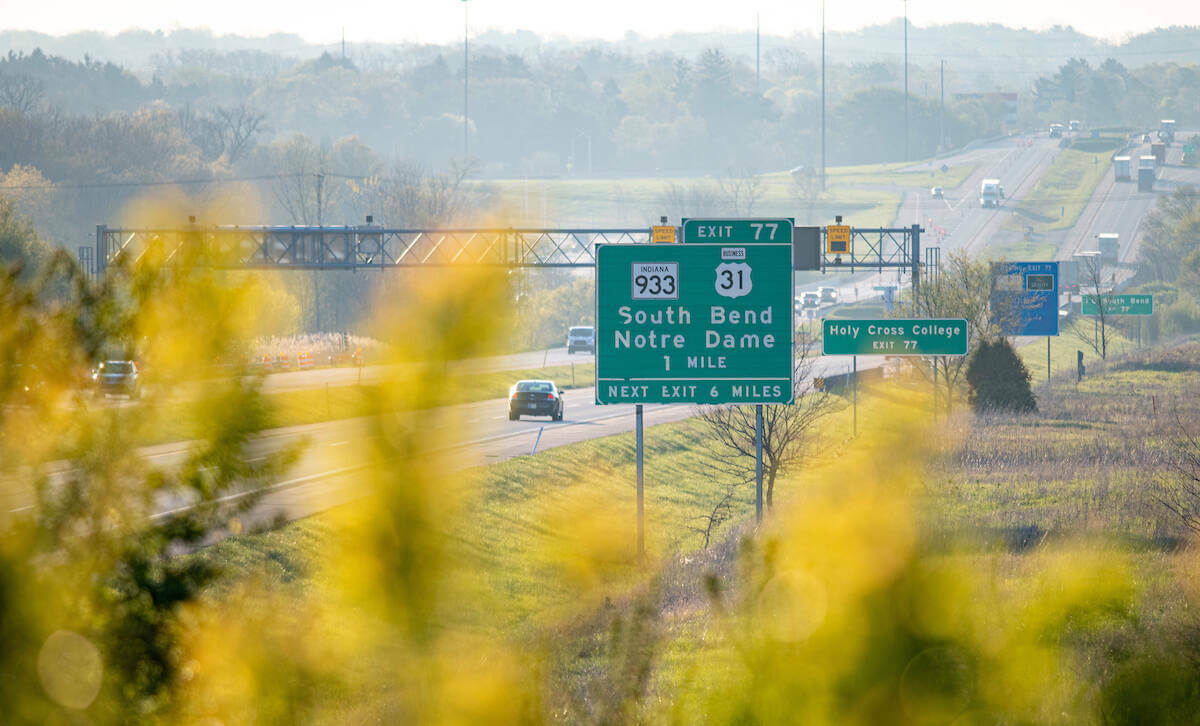
Bristol, Indiana (26 miles to South Bend): As my thoughts race through Ohio, while the highway moves with anticipated rhythm, my tailbone grows sore and I stretch my right foot so it stays awake. The toll into Indiana snaps me back into focus. The drive is nearly complete. Once I cross into the Hoosier state, the farmlands look more lush, more manicured, more industrialized and commercial. I cruise by the RV Hall of Fame outside Elkhart — a friendly reminder that I am nowhere near home, but also nearly there.
As I racked up more and more drives to and from South Bend — five, 10, 20, 50 — it became more manageable, almost easy. I knew the beats of the highway so well I could tell you rest stop mile markers before Alexa or Siri. My prehistoric Highlander with 200,000 miles in 2012 had a hyper-specific autopilot mode long before Elon saddled Teslas with the technology (the simple command: drive to Notre Dame).
Looking back on the 30,000-plus miles I’ve logged, not a lot has changed about the route. I live in Washington, D.C., now, so the first couple hundred miles are technically different — but not really. Summer months still overwhelm the highway with construction delays, so you better leave early. Tolls now broach $70, instead of the $40 when I was a freshman. I look for rest stops with better salad options these days instead of the cheapest burgers and pizza I can find (though not always). And nine-hour straight shots are no longer feasible with a baby in tow. There are fewer discussions about arcane philosophers or theoretical public policies — the kind only college students have so freely — and more chats about daycare drama and interest rates.
As I made more trips to South Bend, the drive became intertwined with my Notre Dame experience. A necessary prerequisite to stepping into the bookstore, strolling campus or grabbing a pint at Rohr’s.
If a D.C. airport offered a nonstop flight, I’m sure I’d take it occasionally. But I’d certainly think twice. There’s something cheap about it. Something off. Everyone knows the old Emerson adage that it’s not about the destination, it’s about the journey. My nostalgia for this drive isn’t necessarily about the journey itself; it’s about South Bend, it’s about Notre Dame (i.e., the destination). This “journey,” after all, is literally just a journey. But after years of driving 10 hours each direction, across three (now five) very different states, with all sorts of people, for all sorts of reasons, the journey for me has almost become indistinguishable from the destination.
Early morning coffee, Appalachian roads, Lordstown economic indicators, Ohio rest stops, the RV Hall of Fame. They’re now every bit a part of my Notre Dame as Touchdown Jesus, O’Shag and LaFun.
I cherish the pilgrimage, my time on the open road.
Matt Razzano is an attorney in the Washington, D.C., area.