
August 6, 2025, marks the 80th anniversary of the dropping of the first of the atomic bombs that the United States deployed against Japan at the end of World War II. The targets of those bombs, the cities of Hiroshima and Nagasaki, will host observances of the only wartime uses of nuclear weapons in history and the destruction and death they caused. Among those who will gather for the solemn remembrance of those dark hours will be delegations from the University of Notre Dame and from other Catholic institutions in the U.S. Among the points for their collective meditation will be the obvious and troubling fact that nuclear weapons have hardly gone away.
In fact, nukes are coming back after nearly 40 years of declining numbers — and declining public attention. The good news is that after the estimated global nuclear warhead inventory surpassed 70,000 in 1986, the total has fallen below 13,000 today. But the slope of that downward curve has flattened, and prospects are that several of the nine nations known to have nuclear arsenals — Russia, the U.S., China, France, the United Kingdom, India, Pakistan, Israel and North Korea — may once again expand them.
In the U.S., the potential for reversal began under President Barack Obama, who entered office in 2009 envisioning a nuclear-free world but left in 2017 with a $1.7 trillion weapons “modernization” plan, a concession to congressional Republicans for approving the 2011 New START Treaty, which established the lowest limits to date on nuclear warheads in the U.S. and Russia.
Since then, President Donald Trump and Russian President Vladimir Putin have stepped away from nuclear arms control treaties, even as the war in Ukraine — a nation that once possessed nuclear weapons — drags on and Putin has lowered the threshold for Russia’s use of atomic warheads. China is ramping up its stockpile amid international tensions. The nuclear threat looms in the background of renewed violence between India and Pakistan and the Israel-Hamas war in Gaza, where hostilities have involved several neighboring states, including nuclear-aspirant Iran. No wonder the Bulletin of the Atomic Scientists recently moved the hands of its Doomsday Clock — set at 17 minutes to midnight in 1991 when the United States and the Soviet Union signed the first Strategic Arms Reduction Treaty — to 89 seconds to midnight, the closest the internationally recognized symbol measuring global existential threats has ever come to forecasting worldwide catastrophe.
We are in what is often referred to as “the third nuclear age,” following the Cold War and the period of relaxed tensions and arms reduction in the post-Soviet period, notes Shannon Bugos ’16, a foreign affairs officer in the U.S. State Department’s Bureau of Arms Control, Deterrence, and Stability. Observers have described this third age as being like the Cold War but worse, with more nuclear states, more powerful weapons and technology, and instability in traditional postwar alliances.
During this period, military establishments and political think tanks like The Heritage Foundation and the Atlantic Council have urged Western nuclear powers to enhance their deterrent capacity in response to current events. At the same time, the Treaty on the Prohibition of Nuclear Weapons (TPNW), developed in the United Nations, entered into force in 2021 despite the boycott of nuclear-armed nations and their chief allies. The Vatican took a leading role in promoting the treaty and was among the first of its more than 90 signatory nations.
Bugos’ former professor at Notre Dame’s Kroc Institute for International Peace Studies, Gerard Powers ’86J.D.,’88M.A., is the director of Catholic peacebuilding studies and coordinator of the Notre Dame-based Catholic Peacebuilding Network. He reports “more students interested in nuclear issues than at any time in my 21 years at Notre Dame,” thanks in part to campaigns supporting the TPNW and the mounting threat of a new nuclear arms race. That uptick, he says, comes as several Kroc alumni “are now becoming leaders in the field.”
At Notre Dame’s commencement exercises in 1983, referring to the “vivid awareness” of the leading “danger of our times,” Cardinal Joseph Bernardin spoke about “The Challenge of Peace,” the U.S. Conference of Catholic Bishops’ pastoral letter on nuclear weapons. Released days earlier, the letter called for reduced nuclear arsenals, echoing and in ways exceeding Pope John Paul II’s reluctant interim tolerance of deterrence as long as it worked toward full, global disarmament.
Established in 1986, the Kroc Institute was founded at least in part in response to the bishops’ letter; its name comes from McDonald’s heir Joan Kroc, who had heard Father Theodore Hesburgh, CSC, then the University’s president, speak about peace. For four decades, Kroc has educated students and the public on a variety of peace issues, including nuclear war.
Powers, whose work in the field began as a Princeton graduate and Jesuit volunteer in 1980, came to Notre Dame in 2004 from the bishops’ Office of International Justice and Peace. He says Kroc approaches strategic peacebuilding somewhat differently than programs at other institutions do, particularly in regard to nuclear weapons. “The conventional nuclear debate has focused primarily on a negative peace,” he explains, “avoiding nuclear war through nuclear deterrence and arms control” and focusing on the “military, political, technological and economic dimensions of the nuclear predicament.”
Deterrence, according to the Carnegie Council for Ethics in International Affairs, happens when “the retaliatory potential and destructive force of nuclear weapons prevents nations from launching a nuclear attack.” But strategic peacebuilding must also embrace “positive peace,” considering, Powers says, “how to create new systems of cooperative security . . . make nuclear weapons far less central to national and international security, and ultimately create the conditions in which mutual, verifiable nuclear disarmament is possible.”
Positive peace also incorporates a wider range of “factors and actors.” Powers credits the Catholic Church with helping to “ensure that morality is not an uninvited guest at an exclusive party” dominated by “realists,” the term for proponents of a strong nuclear deterrent. In addition, “religious actors, like the Catholic community, help democratize an otherwise elite debate,” opening it to more voices, especially those of women.
“Like many working in this field I certainly didn’t plan for a career in arms control and nonproliferation,” says Kelsey Davenport ’11M.A., the director for nonproliferation policy for the Washington, D.C.-based Arms Control Association. As an undergraduate at Butler University in Indianapolis, Davenport had an internship with former U.S. Senator Richard Lugar, a key player in the international effort to secure the collapsing Soviet Union’s arsenal. The work “drove home the saliency of the nuclear threat,” she says. Before that, “nuclear weapons were an anachronism” for her.
Looking for graduate work in peace studies, she chose Kroc. “There are lots of places where you can study security,” she says, but few that focus on the peace that emerges “after the fighting stops.”
Erin Connolly ’21MGA, now a program analyst for the Energy Department’s National Nuclear Security Administration, also joined the nuclear reduction effort before coming to Kroc. While interning for a D.C.-based advocacy group, she found that trying to educate members of Congress felt like “banging our heads against the wall,” because they agreed with the arguments but said they couldn’t support them because their constituents didn’t. She encountered resistance of a different kind while presenting the issue in high schools. Younger people “don’t share our assumptions,” she says, “so they challenge our traditional view of national security.”

Connolly resented hearing from others in the field that “to succeed as a woman, you needed an advanced degree,” and she thought about leaving the work in search of other opportunities but says Kroc’s approach intrigued her.
Bugos, along with her State Department colleague Monica Montgomery ’19 and Melinda Davis ’19, who works for Kroc’s Peace Accords Matrix program, all speak to their experiences with Catholic social teaching as among the reasons they chose to study at Notre Dame.
In 2017, the Vatican convened a conference titled “Prospects for a World Free from Nuclear Weapons and for Integral Disarmament.” The participant list included Nobel laureates, diplomats and scholars from many international institutions, including Powers and more than a dozen of his colleagues, alumni and students from Notre Dame.
Catholic condemnations of the bomb date from Pope Pius XII’s outcry against the horrors of Hiroshima and Nagasaki and include calls for nuclear arms reduction in Pope John XXIII’s 1963 encyclical Pacem in Terris and the Second Vatican Council’s statement on the Church’s place in the modern world, Gaudium et Spes. In a kind of approval through faint damnation, speaking to the United Nations in 1982 and framing the approach of the U.S. bishops a year later, Pope John Paul II said, “deterrence . . . certainly not as an end in itself but as a step on the way toward a progressive disarmament, may still be judged morally acceptable.”
In his address to the 2017 gathering, Pope Francis made what Powers terms the strongest statement on nuclear weapons the Church had made to date, essentially dismissing nuclear deterrence and endorsing disarmament as a moral imperative. Citing “the catastrophic humanitarian and environmental effects of any employment of nuclear devices” and “the risk of an accidental detonation,” the Holy Father said, “the threat of their use, as well as their very possession, is to be firmly condemned.” Recognizing that the Church’s toleration of deterrence as a path to disarmament wasn’t working, Powers says, Francis took the next logical step.
For Bugos, as for other Kroc students of nuclear peace, the Rome moment was pivotal, both for the international arms control movement and her own career. There were conversations “about the future of arms control,” she says. “I wanted to be part of those discussions.”
Yet in practical terms, deterrence as a policy goal endures. The main tools of nuclear peace remain diplomacy toward nuclear security, defusing a new arms race, and further stockpile reduction — and the military objective of deterrence.
The overarching purpose of the work these Kroc alumnae do in Washington today is “to prevent nuclear conflict, to prevent the spread of nuclear weapons, and work toward a world free of nuclear weapons,” affirms Montgomery, who notes that her comments, like those of her colleague Bugos, do not reflect the policy positions of the State Department. “Great responsibility came from the development of these weapons, and I do think that underlies our core motivations across partisan divides. . . . As long as we can continue to control and reduce, that is a victory.”

The Arms Control Association, where Davenport works, counts nearly 30 international arms control agreements since the original Limited Test Ban Treaty signed in 1963 by the Soviet Union, the U.S., the U.K. and dozens of other countries. The Strategic Arms Limitation Talks and Strategic Arms Reduction Treaties (START) of the 1970s through 1990s significantly reduced the numbers of nuclear weapons held by the U.S. and the Soviets. New START, with its still-lower limits, is today the only remaining treaty governing the superpowers’ arsenals. It expires in 2026. Many worry that with it may go the stability that such treaties have reinforced.
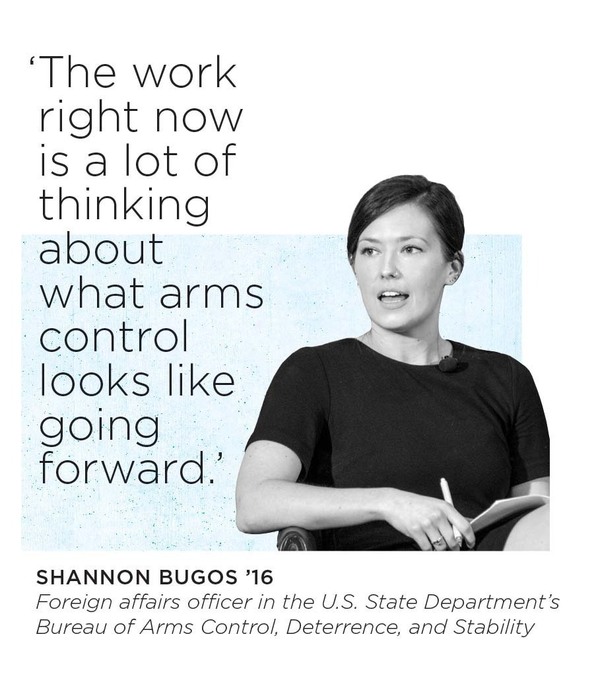
“The work right now is a lot of thinking about what arms control looks like going forward,” Bugos says. Russia’s geopolitical actions and China’s rapid nuclear buildup have shifted the landscape. Additionally, new Russian delivery systems — methods of delivering nuclear weapons to their targets, in this case, nuclear-powered missiles and submarines — don’t fit “traditional definitions” in treaties, she says.
Arms control has usually been bilateral, but the U.S. must now deter “two countries at the same time, and so that will affect what nuclear forces and posture look like,” Bugos says. In this more complex environment, arms control must balance deterrence, alliance commitments and the evolving capabilities of multiple nuclear-armed states. The question becomes whether traditional, treaty-based arms control will still work or if new approaches are needed. The latter may not need to be legally binding, she explains, but might include “confidence-building measures”: international commitments and risk-reduction strategies aimed at maintaining crisis stability and preventing an arms race.
Senior officials from China and the U.S. met in November 2023 for what the State Department called a candid and in-depth discussion, the countries’ first formal arms-control meeting in years. Montgomery provided strategic and logistical support for the assistant secretary of state for arms control, verification and compliance and worked closely with interagency partners to ensure talking points and strategy aligned with the Biden administration’s objectives. As one State Department official later described the meeting, “we had questions, and they had questions. . . . The more we can answer, the better.” The outcomes were modest, but merely engaging with China was a start.
Behind the scenes, State Department staff consult with allies and partners, often in classified sessions. Bilateral meetings may get coverage, Bugos notes, but “a lot of the nitty gritty work gets done on the sidelines,” at workshops, “and it does inform a lot of the thinking and decision-making that we have to do in our day-to-day jobs” and, ultimately, in diplomacy.
Alas, whether by design or indifference, the Chinese stepped away from the talks eight months later, blaming U.S. support for Taiwan.
Multilateral work continues, primarily within the United Nations, Montgomery says. Key examples include the U.N. First Committee, which focuses on international security, and the Conference on Disarmament, which negotiates arms control treaties. In the committee in 2024, the U.S., Japan and Argentina collaborated on a resolution to strengthen the 1967 Outer Space Treaty. “This was most important,” says Montgomery, because Russia was considering deploying nuclear weapons in space. Ultimately, the resolution passed overwhelmingly, with China abstaining rather than opposing it. Montgomery called it “really a promising moment.”
Another fundamental international agreement is the Treaty on the Nonproliferation of Nuclear Weapons, which since 1968 has worked to prevent the spread of nuclear weapons by promoting disarmament and peaceful uses of nuclear energy. Only four nations have not signed on: South Sudan, India, Israel and Pakistan. The latter three acquired nukes after the treaty took effect and per its terms would have to dismantle them. According to the Center for Arms Control and Non-proliferation, Israel has never acknowledged its nuclear arsenal, though its existence is widely presumed. North Korea initially signed the treaty but announced its withdrawal in 2003.
“Looking back at the number of states many predicted would have acquired nuclear weapons by now,” Montgomery says, “the mechanisms we use to prevent new states from developing” weapons, like economic sanctions, which “are often perceived in the peace studies world as a very dirty word,” or pressure — the “carrots and sticks” — have been effective. “We know the toolkit,” she says. “We know how to do it. Sometimes it’s just finding the moments, finding the political will.”
The most significant nonproliferation effort in recent years has targeted Iran’s nuclear program. In 2013 a broad coalition of nations, including the U.S., resumed talks with Iran. Davenport, representing the Arms Control Association, “spent a lot of time in Vienna on the outskirts of the negotiations, talking to the parties.”
The talks produced a deal to halt Iran’s nuclear weapons program. Davenport was inspired to see how such an agreement is negotiated — “and not just any agreement, a highly effective agreement,” she emphasizes. “Diplomacy can work. Adversaries can sit across a table [and] reach an agreement that addresses the needs of both sides. It was incredibly powerful.”
It was also “incredibly disappointing” when the United States withdrew in 2018. “I still strongly believe the 2015 deal was an effective, verifiable agreement, and the Iranians were meeting their end,” she says.
For a few years, her organization was involved with Iranian officials in Track 1.5 talks — the term for unofficial, informal, nongovernmental diplomacy — before the Trump administration initiated new, formal talks with Iran earlier this year.
Meanwhile, the circumstances have changed. Since 2018, she says, “Iran’s nuclear program has advanced to the threshold of nuclear weapons.” Yet Davenport remains hopeful, thanks to the informal diplomacy. “By continuing to engage Iran over the years, even when official diplomacy stalled,” she says, “we’ve been seeking solutions to these challenges that I hope will be useful for negotiators.”

She appreciates how her Kroc education helped her “internalize the importance of dialogue, the importance of listening, even with people you don’t agree with — even with regimes that you know violate so many of the values that you personally hold as important.”
One must “understand the other, even when it is a repressive regime,” Davenport has learned. “When the officials involved won’t even shake your hand, you [still] have to sit across the table from them.”
Long the default stance of the U.S. nuclear security community, deterrence has a long history in war in general. As long as the United States maintains its nuclear arsenal, anyone in U.S. security inevitably works toward it. That effort extends beyond government, so Melinda Davis, the Kroc researcher who worked for the Holy See and contributed to a 2021 Vatican webinar on disarmament, hopes Notre Dame will proactively advise students on their career choices.
She wishes that political science, business and engineering majors who wish to work for weapons manufacturers would ask themselves, “Is that really what you want your legacy to be?”
Many commentators today have praised the late pope’s condemnation of nuclear weapons — and their deterrent purpose. Many more seemed to go about their business as though nothing had happened, as though the Holy Father couldn’t really have meant disarmament.
Will larger arsenals actually enhance deterrence, or will they invite greater risk? One doesn’t need to read much nuclear weapons history to find trigger-happy advisers among national security “inner circles.” The Cuban Missile Crisis in October 1962 is commonly understood to have been the closest the Cold War superpowers came to nuclear war, and historians credit President John F. Kennedy with resisting his advisers’ urgings to strike. JFK believed the chance of nuclear war then was as high as 50-50 — at the time, the superpowers together held some 30,000 nukes. Sixty years later, in 2022, U.S. intelligence estimated a 50 percent chance Russia would use a nuclear weapon in Ukraine.
History also reveals the risk of misunderstandings and mistakes. In 1983, in the tension following the Soviet shootdown of a Korean Air Lines passenger jet, an action that claimed the lives of 269 people including more than 60 American citizens and a Georgia congressman, a Soviet air defense post detected a U.S. missile launch. Reasoning that the U.S. would not start a war with only five intercontinental ballistic missiles, the post’s commanding officer, Stanislav Petrov, concluded the alarm was false, a determination that likely prevented a nuclear conflict. Bugos identifies Petrov as a personal inspiration. Fortunately, accidents and such near misses have been rare.
Nuclear weapons have still taken a toll. At the 2017 conference, Pope Francis highlighted their financial, health and environmental costs. Davenport has been affected by “downwinders” who are exposing the long-term health and environmental effects of nuclear testing and uranium mining and the resulting degradation to southwestern Native American lands. While the U.S. conducted its last such test in 1992, hawkish voices are now calling for their resumption.
Davenport was also touched by meeting hibakusha, survivors of the Hiroshima and Nagasaki bombings. “It’s hard to describe how moving that is and how challenging, particularly as an American, to hear about the devastation,” she says.
The revival of interest in nuclear arms control among Notre Dame students comes at a challenging time. The retirements of Professors George Lopez and David Cortright ’68 — two Kroc faculty members who are major figures in the field — left Powers to serve as the lone in-house authority. He notes recent plans that call for enhancing resources as circumstances allow. Under his leadership, the institute has since 2014 partnered with the U.S. bishops and other institutions on The Project on Revitalizing Catholic Engagement on Nuclear Disarmament. The project has collaborated on numerous gatherings and presentations largely at diocesan levels and in educational institutions.
Students considering a career in the field should know that the work can be difficult, to say the least. The challenges don’t just come at the negotiating table. “I’ve gotten personally attacked for my willingness to sit down with Iranian officials,” says Davenport. Some critics have gone so far as to call her “an agent of the regime.” Fortunately, she says, Kroc instilled “the mental toughness to sustain a career where the wins are few and far between and the consequences of failure can feel like an omnipresent weight.”
As their labors continue, Kroc graduates take the long view and turn to multiple sources of inspiration, including each other, for reinforcement and mutual support. Connolly and Bugos have enjoyed gathering with colleagues for a happy hour they call “Gin and Atomics.”
Montgomery looks at “the grand history of the buildup of nuclear weapons and the reduction” and appreciates that despite the recent plateauing, “we still are much lower than we were at its peak.” She believes that across political parties, most people in her field are working to prevent the use and spread of nuclear weapons. “And that does still inspire me.”
It would be hard to go to Hiroshima and Nagasaki this summer and not be impacted philosophically and morally by what happened there. The world may hope and pray for peace and disarmament, but is the genie permanently out of the bottle? A rising generation of capable professionals and students believes otherwise. We might feel a little safer knowing such people are entering the nuclear weapons policy inner circle.
Patrick Gallagher lives and writes in Aberdeen, South Dakota.