Famed Fighting Irish football coach Frank Leahy ’31 once said that life began for him on the day he first stepped foot on the Notre Dame campus in 1927 at age 18.
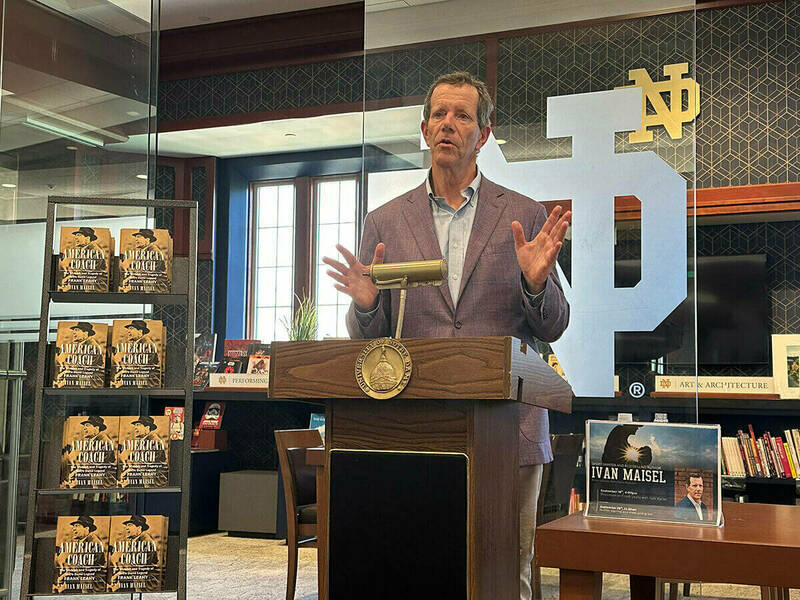
Leahy’s love for the University fueled his remarkable coaching career, according to veteran sportswriter and author Ivan Maisel, but it came with an enormous price. “He was so singularly focused on winning that in the end it cost him his health, it cost him a good bit of his family life and it cost him his career. He had to leave the game, leave coaching at age 45, because he just wasn’t healthy enough to coach anymore,” Maisel said September 18 during an appearance at the Hammes Notre Dame Bookstore to discuss his new book, American Coach: The Triumph and Tragedy of Notre Dame Legend Frank Leahy.
Maisel said he wanted to write about Leahy because he was intrigued by the fact that the coach — despite a superlative record — wasn’t voted into the College Football Hall of Fame until 17 years after his retirement.
The other coaches who did the voting didn’t like Leahy because his teams had beaten theirs so badly, Maisel said. Leahy also was an introvert who was socially awkward and didn’t spend time drinking and socializing with other coaches.
“He was not a guy for small talk,” the author said. “He’d rather be watching film or doing something that would help win a football game.”
The Hall of Fame in those days was an old boys’ club, Maisel said, and it wasn’t until Leahy’s health began to fail in the late 1960s that there was an organized push to get him inducted. He finally received that honor in 1970, just three years before his death.

Leahy was Notre Dame’s head football coach for 11 seasons: 1941-43 and 1946-53. His teams played to six undefeated seasons and four national championships. When he retired as Notre Dame’s coach, he had the second-best record (107-13-9) in the history of college football — ranking just behind his mentor, Knute Rockne.
Yet Leahy’s name isn’t always mentioned in the same breath as Rockne, Parseghian and Holtz. Such paradoxes are explored in the book.
“Leahy’s successes bolstered the university so it could take advantage of its football renown to transform into the premier Catholic institution of higher learning,” Maisel writes.
He also describes friction between the coach and University administrators, including young Notre Dame President Rev. Theodore M. Hesburgh, CSC.
It’s rare that any college football coach leaves a university of his own volition and happily, Maisel said. And that includes Leahy. His all-consuming focus on winning took a toll on his personal and family life, leading to health issues and a contentious relationship with his successor, Terry Brennan ’49.
Brennan’s five-year tenure produced a disappointing 32-18 record, and Leahy publicly criticized the results — bad form for a former coach. “And I think that contributed to how Leahy slowly disappeared from public view,” Maisel said.
While working on the book, Maisel found himself totally immersed in Leahy’s life. “It was really, to me, a microcosm of America in the 20th century,” the author said.
Born in Nebraska, Leahy spent one childhood winter with his family living in a tent at their new homestead in South Dakota. He learned farming and cowboy skills, then excelled in sports during high school — where his football coach was Earl Walsh, a 1922 Notre Dame graduate who had played for Rockne.
Leahy “wanted to be somebody and he wanted to play for Knute Rockne,” Maisel said. He met that goal, but never got much playing time. He was injured his junior year and missed most of the season, then badly hurt his knee senior year a few days before the season opener.
Rockne took Leahy under his wing, including arranging a post-graduation job for his protégé as an assistant coach at Georgetown University. It was one of Rockne’s last actions before he was killed in an airplane crash in March 1931.
Leahy and his wife, Florence, had eight children, but he was mostly an absentee father. Fred Leahy, one of the sons, once said: “Dad belonged to the world and Mom had eight kids,” the author recalled.
The family lived near Michigan City, Indiana. During the season, Leahy slept on a cot in the Notre Dame firehouse, then he’d get up early the next morning and go right back to his coaching office. And when the season ended, he ran football clinics and went on speaking tours for the University.
Despite the sad circumstances of his departure from coaching at middle age, Maisel said, Leahy never lost his love for Notre Dame.
Fighting Irish football great Johnny Lujack ’48, the 1947 Heisman Trophy winner, recalled that years after Leahy retired, he and Creighton Miller ’44 had dinner with their former coach in South Bend. Afterwards, as they drove by campus, Leahy spotted moonlight shining on the Golden Dome and asked Lujack to stop the car, Maisel said.
“Gents, there might be the greatest sight the world has ever known,” Leahy declared. “It’s a shame that everyone can’t see it.”
Margaret Fosmoe is an associate editor of this magazine.