
Sophia Yu ’25 strolls around a large room in Notre Dame’s Engineering Innovation Hub, checking on progress in one 3D printer and removing a completed student project from another. She’s preparing the next design in the computer queue. Even with 38 3D printers in this room and the next, it’s not unusual for nearly all the devices to be running at once.
“Toward the end of the semester, it’s so busy in here,” says Yu, an aerospace engineering major. She works part time in the hub, uses it to produce her own class projects and has helped craft prototype rocket parts here as the payload design lead for the Notre Dame Rocketry Team, which participates in an annual national competition.
Three-dimensional printing — also known as additive manufacturing — is a process that creates a physical object from a digital model. Different printers may produce objects made of different materials, including plastics and metals.
At locations across campus, 3D printers are used for innovative teaching and learning. The devices offer an economical way to produce quick prototypes for work in engineering, science, architecture, art, entrepreneurship and other fields.
The innovation hub is a 10,000-square-foot space for learning and making that opened in Cushing and Fitzpatrick halls in 2021. The facility offers a variety of tools, including advanced manufacturing stations, fabrication and machining technology, and 3D printers.
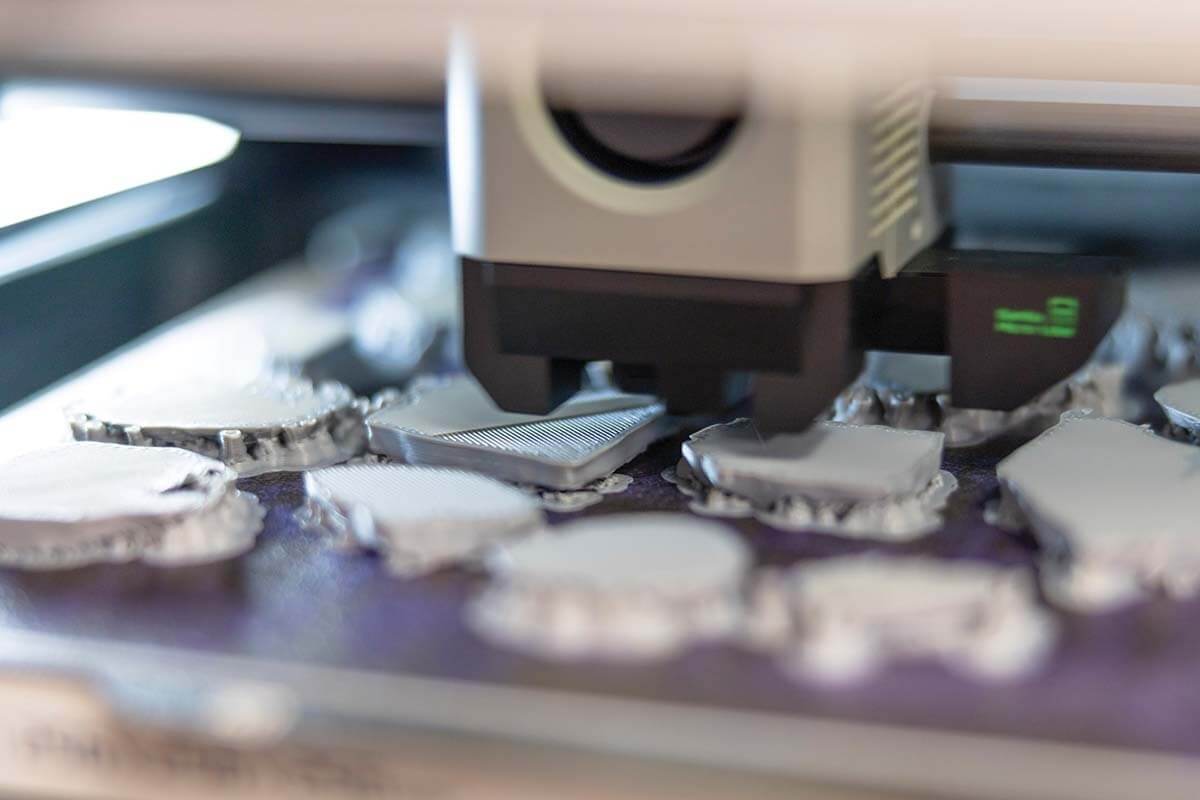
A 3D printer typically looks like a tabletop box with a platform inside and a window that allows a view of the work in progress. A moving print head releases filament layer by layer, depositing material in a designated pattern. The material becomes solid as it cools, forming the final product.
From the outset, Yu knew her studies would involve 3D printing. Engineering students use computer-aided design (CAD) to brainstorm and develop their projects, then realize them in three-dimensional form with the printers.
“There’s just so many parts when you’re designing things that you can’t manufacture or machine everything. They have to be 3D printed,” she says.
The devices support extracurricular work as well. While the rocketry team crafts prototype parts to build better rockets, Notre Dame’s engineering-based e-NABLE bio-design group relies on 3D printing in its efforts to help people in the community. One project fashioned prosthetic hands for a local girl who was born with half a palm and one finger on each hand.
Before the invention of 3D printing, engineering students primarily created prototypes using methods like hand-carving, milling or casting, relying on materials such as wood, clay or foam. Or they might simply draw and study a model in two-dimensional format, without the benefit of an actual prototype.
Crafting a prototype of metal would be expensive and time-consuming. “It would require a manufacturing-like process,” says Jing Wang, an associate teaching professor of aerospace and mechanical engineering. “The 3D-printing skills, the design skills that students learn here at Notre Dame are going to be helpful for their future careers.” Wang regularly assigns projects requiring student CAD work that results in 3D prototypes or models.
The tools in the Engineering Innovation Hub help prepare students for cutting-edge engineering work, says Daryl Peterson, the hub’s managing director.
Additive manufacturing helps industry bring products to market quickly. “Otherwise it would just take years and years and years. And by that time, somebody else would’ve already invented what you were trying to do,” Peterson says. “I want students to leave here knowing what capabilities are available to them when they start their jobs.”
Speedy prototypes facilitate efficiency in research, development — even marketing. “You can quickly test it to see if it will work or to get a customer’s feedback,” Peterson says.
At the School of Architecture, 10 3D printers are busy producing scale models of the Jefferson Memorial, a Mayan temple and other structures. On a shelf stands a 26-inch-tall electric lamp, its gold base and white shade fabricated on 3D printers. Nearby is a 3D-printed model of Fallingwater, the landmark house that Frank Lloyd Wright designed and built atop a Pennsylvania waterfall.
Matt Noffsinger, a makerspace and graphics specialist for the Hesburgh Libraries, introduces architecture students and faculty to 3D-printed modeling and its advantages. He offers workshops and one-on-one training on how to use computer software to create architectural and interior design projects. Students can monitor their projects as they move through the process.
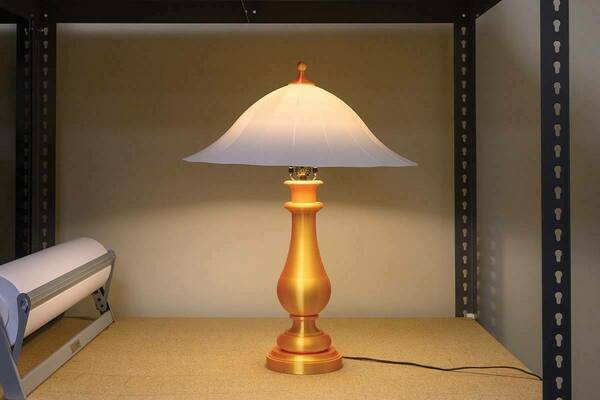
John Gleason is a second-year graduate architecture student who designed the 3D-printed lamp for a lighting and acoustics class taught by Professor Alan DeFrees ’74. Gleason’s was the only 3D-printed lamp in the class — he made everything but the wiring and bulb using the technology — and he earned an “A” on the project. It’s so new, he says, most students don’t even know the library has these machines.
Gleason thinks 3D printing will become increasingly important in the profession, and he foresees opportunities in classical architecture where such elements as crown moldings and door and window casings are no longer widely produced by hand. “It’s a great tool in the toolbox,” he says.
Noffsinger’s long-term goal is to train students to operate the printers themselves. 3D printing isn’t yet part of the formal architecture curriculum, but more students are following Gleason’s example, and professional firms are increasingly relying on 3D models to help clients visualize their proposals.
“I want to help the students in the real world, after they graduate,” Noffsinger says. “This gives them another edge. They graduate from a school of architecture with classical design principles, but they know 3D modeling, too. That means more job opportunities.”

The technology isn’t limited to particular disciplines. Students and employees may use the six 3D printers in the Navari Family Center for Digital Scholarship in the Hesburgh Library. And anyone — including off-campus entrepreneurs — may seek assistance from the Innovation Lab at the Idea Center, Notre Dame’s technology commercialization unit, which has 16 3D printers.
“It’s a modern technology that everyone needs to know about and learn about,” says Matt Leevy, the lab’s director.
The Idea Center was one of the first facilities on campus to offer 3D printing, starting with consumer-grade printers before moving to advanced, professional-grade machines. The devices offer a range of applications, from anatomical models for biology labs to prototypes for startup manufacturers launched by students or entrepreneurs in the South Bend region.
The lab regularly produces research prototypes for science and engineering faculty. Professors may arrive with a design in mind or ask the lab to handle the design and prototype creation.
“Three-D printing is the future of manufacturing,” says Joe Admave, program manager of the machine shop in the basement of the Radiation Research Building.
The shop ventured into 3D printing five years ago and now runs four machines. Admave introduced the technology because he knew it would offer speed and economy. He’ll design and print a requested item in various synthetic materials. If the prototype fits the space and need, he then crafts the part in metal.
Campus researchers regularly ask him to design and print lab equipment. Admave fabricates test tube and cuvette holders in custom sizes and designs molds to form lead radiation shields. He also designed a part for the University’s linear accelerator. After the 3D-printed plastic prototype fit perfectly, he machine-tooled the permanent piece in stainless steel. From design to finished product, the process takes no more than a few days.
Lucy Schultz is a second-year master of fine arts student with a focus in industrial design and an interest in aquatic fitness.
Schultz used her knowledge and skills to invent a lightweight paddle for a design class project. The device is round with fin-like projections, and it folds flat for easy storage. In use, it increases the resistance a person encounters in water, helping them build strength.
She crafted her first prototype working by hand with corrugated plastic, but she has fine-tuned her invention iteratively via 3D printing. The paddle “needs to be small enough to easily carry and store,” says Schultz, who hopes to market her invention herself or sell the concept to a sporting goods manufacturer.
She predicts the greatest interest will come from older adults who take water-fitness classes and want a greater challenge to build endurance.
For entrepreneurs, 3D printing “has changed the game because you can do it in a day or two,” Schultz says. “And if there’s something wrong with it, you tweak it and make a new one.”


Margaret Fosmoe is an associate editor of this magazine.