A new psychology clinic for area residents is now up and running in the neighborhood south of Notre Dame, while construction work proceeds in downtown South Bend on a collaborative research and innovation hub. The two projects signal a fundamental shift in the University’s approach to community engagement: making regional involvement and partnerships a formal institutional priority.
The Wilma and Peter Veldman Family Psychology Clinic, which opened in June, is part of the University’s $68 million commitment to address the national mental health crisis by expanding access to care and developing new treatments. A mile to the west, the Colfax Corner project, slated to open in 2028, centers around a full renovation of the 105-year-old former South Bend Tribune building — vacant since the newspaper’s staff moved in 2019 — paired with the construction of a five-story research and office tower on the same block. The total cost of that project is estimated at $135 million, which is being funded by numerous community partners, including the University.
The initiatives represent two of the most significant commitments in South Bend and surrounding communities in the University’s history. Both align with goals in Notre Dame’s strategic framework, which charts the University’s projected course through 2033. Published in 2023, the plan set the establishment of a community mental health clinic as a specific goal, projected further investment in science and engineering facilities and research, and promised increased engagement with the city and the region.

The Veldman Clinic
Located between campus and downtown on a city bus route that runs along Hill Street,
the clinic starts a new chapter in Notre Dame’s commitment to community service. Natural light streams through its large windows into nearly every room and corridor, a purposeful design element, along with interior artwork, intended to reduce stress and create a welcoming atmosphere.
Local residents are the clinic’s clients. The new, state-of-the-art, 35,000-square-foot building includes therapy suites, faculty laboratories, childcare space and group meeting rooms. The clinic, which does not accept or bill insurance, offers low-cost child and adult therapy — as low as $10 per session — as well as autism and psychological evaluations and research-based treatments focusing on trauma, substance abuse and suicide prevention.

“We envision ourselves providing at least 15,000 hours of clinical service by the end of the next [fiscal] year. And we’re going to look to expand from there,” says Kristin Valentino, a professor of psychology and the clinic’s director.
The clinic includes Notre Dame’s William J. Shaw Center for Children and Families, which has moved from another location in South Bend. The Shaw Center is an integrated research and clinical services outreach for children and families, focused on such topics as navigating adversity, building healthy relationships and promoting well-being.
Doctoral students — mostly second- and third-year students with at least a year of clinical experience — are providing much of the mental health care at Veldman under the supervision of professionally licensed faculty members. A video system securely records sessions for supervisors to review students’ work and provide feedback.
Existing services are growing, and new ones are being offered, including bilingual counseling and access to clinical trials. Some potential clients who may have hesitated to seek out services at Notre Dame find the off-campus site and Veldman’s calming atmosphere less intimidating.
“We’ve been hoping for something like the clinic for quite some time. It’s really exciting to see it finally come to fruition, and I’m thrilled to have the opportunity to help shape its direction and the impact it can have,” says Valentino, who joined Notre Dame’s psychology faculty in 2009.
The clinic works closely with community partners, including Oaklawn, a provider of mental health services and addiction treatment; Beacon Community Impact, the public health arm of Beacon Health Systems; and the CASIE Center, which is dedicated to preventing child abuse and supporting survivors. All are within walking distance of Veldman.
This academic year, about 25 graduate students are providing clinical services or working in affiliated laboratories. Undergraduates may apply to work in the labs, and faculty are developing a practicum that will allow undergrads to gain clinical skills and training. The clinic also partners with other institutions, such as Saint Mary’s College, Indiana University South Bend and Goshen College, to train master’s level social-work and counseling interns.
University officials expect Veldman to strengthen Notre Dame’s psychological research. Valentino’s work focuses on how different forms of childhood adversity, such as abuse and neglect, affect development and the risk of mental disorders — and on developing treatments. Other faculty-led projects include randomized clinical trials to better understand adolescent suicide risk, substance abuse and sleep issues.
“I think our biggest impact will not be in individual therapy, but in training workers to deliver care where people already are — to get high-quality screenings, so that people can recognize earlier when there’s an issue and get into a supportive environment before it escalates into a crisis,” says Jennifer Burke Lefever ’00Ph.D., the clinic’s managing director.
The clinic provides free single-session interventions for adolescents experiencing anxiety and depression. “We’re not only going to bring digital tools, but we’re also going to train at least 75 caring adults to deliver single-session consultations,” Lefever explains. Research has shown that teens who undergo a single intervention are more likely to seek follow-up care.
While clinical services will occupy the building’s two upper floors, its lowest level houses the University’s new Human Neuroimaging Center, which includes a functional magnetic resonance imaging machine that maps brain activity by tracking changes in blood flow and oxygen levels. The center’s founding director, Aron Barbey, the Andrew McKenna Family Professor of Psychology, also leads the Decision Neuroscience Laboratory on campus.
Abby Arntz, a third-year doctoral student in clinical psychology, was drawn to Notre Dame to work with Laura Miller-Graff ’08, the psychology professor who directs the Shaw Center and leads the Building Resilience After Violence Exposure (BRAVE) research lab. As a first-year graduate student, Arntz helped run the lab’s Pregnant Moms’ Empowerment Program, which helps expectant mothers who have experienced domestic violence. This year, she is assessing how infant development is affected by such violence.
She benefits from mentoring provided by upper-level doctoral students and returns the favor by helping to guide younger students. “When I started work at the clinic, that’s when this truly started to feel like home,” Arntz says. “The beauty of this clinic is it really encourages us to get to know our neighbors.”


Colfax Corner
Located downtown at the intersection of Colfax Avenue and Main Street, Colfax Corner is the first phase of South Bend’s new “Tech & Talent District” — a concept envisioned in the Downtown South Bend 2045 Plan to position the city as a regional center for advanced computing, data analytics and artificial intelligence.
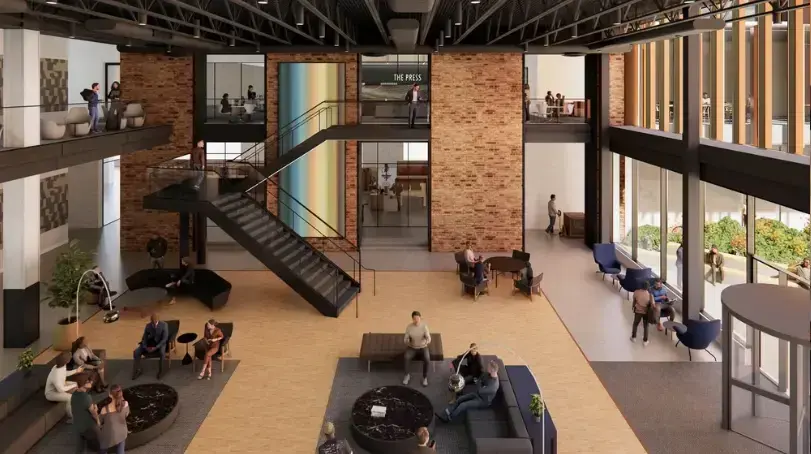
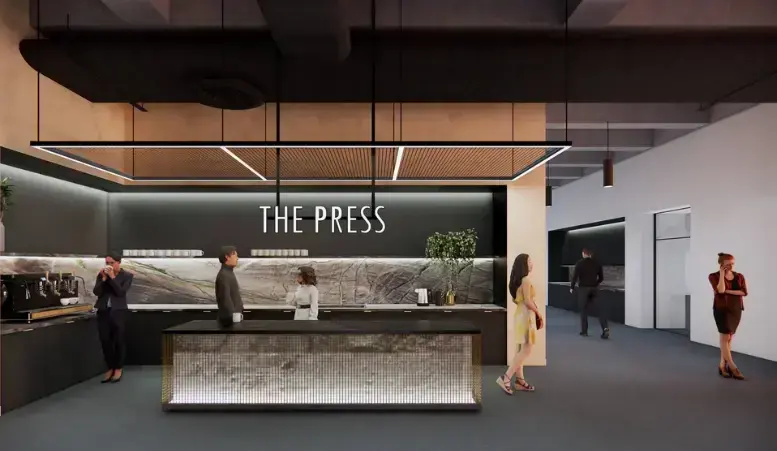
In June, workers demolished a former retail building adjacent to the old Tribune headquarters to make way for the new office tower. Together, the two-building complex will include a mid-block public plaza, a glass-walled restaurant with a rooftop terrace, retail shops and a skywalk to connect the old and new buildings.
Notre Dame foresees playing a leadership role in research and regional economic development and education and in engaging with community and industry partners at Colfax Corner, says Jeff Rhoads, the University’s Martin Family Vice President for Research. It will “provide a front door and an outlet for us to better engage the community and for the community to engage with us,” he says.
The University owns the property and will be the anchor tenant. Other partners include the city, the state of Indiana, the nonprofit South Bend-Elkhart Regional Partnership and the South Bend-based Judd Leighton Foundation. The city is providing $30.8 million in financial support, and the project also received a $30 million grant from the Indiana-based Lilly Endowment’s program to fuel job creation and economic growth in the state’s college towns.

Over the summer, the red-brick former newspaper building was gutted to prepare for its full renovation. The project will preserve some of the building’s historical elements — such as the brick exterior and the original marble central staircase — replace old windows and create new entrances on its east and west sides.
Together the two buildings will total about 220,000 square feet and include common areas for interaction and adaptable office spaces leased to private-sector businesses and tech startups to prototype, test and scale up their initiatives.
Notre Dame will occupy about 30 percent of the complex, moving related, campus-based operations, including some 60 employees, to the hub when it opens, Rhoads says. Shannon Cullinan ’93, the University’s executive vice president, says Colfax Corner will place these faculty and staff and many students in direct interaction with regional and national companies, while students gain work experience at labs and offices there. “This will be a true community asset. This is not a Notre Dame-alone project. We look forward to renewed energy, vibrancy in this space,” he says.



Josh Parker, the chairman and CEO of Ancora, the hub’s Washington, D.C.-based developer and property manager, says Colfax Corner will convene research, industry, and entrepreneurs with workforce development and community leaders, shortening the distance from research to companies, jobs and opportunity.
Proponents cite several collaborative precedents in university towns, such as The PVD Labs in Providence, Rhode Island, home of Brown University, and the Durham Innovation District near Duke University in Durham, North Carolina.
“It’s the University realizing [we] can be an influential actor in the region in a way that advances the region” and the University’s mission, Rhoads says. “One of the best lessons learned from these projects is that universities fail when they try to act alone. They succeed when they work hand in hand with their community and regional partners.”
“We think of ourselves as part of a broader ecosystem,” says David Go ’01, Notre Dame’s vice president and associate provost for academic strategy. Colfax Corner will complement other developments underway in downtown South Bend, including the “Madison Lifestyle District” — another “opportunity site” identified by DTSB 2045, currently taking shape in a $330 million mixed-use development expected to include apartments, a hotel, and commercial and retail space.

In all, city officials count 19 projects in and around downtown South Bend in the planning, construction or recent completion stage, with total investment estimated at $785 million. Advocates expect Colfax Corner alone will attract more than 400 high-skill jobs and generate a direct economic impact of more than $750 million during its first decade. “This game-changing project will not only reshape the landscape of our downtown, but also catalyze shared growth in our community,” South Bend Mayor James Mueller ’04 said in a statement last year.
While the University aims to produce research that has both a scholarly impact and an impact on society, “you can’t have that if you never get out of the office,” Rhoads says. Community partnerships like Colfax Corner offer a better chance of success, not just for Notre Dame or South Bend, but for the region as a whole.
See a one-minute video rendering of the Colfax Corner project.
Margaret Fosmoe is an associate editor of this magazine.