As a young person, I thought of the course of human events like a retirement account. There would be periodic ups and downs, but ordinary people like me should resist reacting to the daily tumult and simply trust that the long-term trajectory would trend upward.
That, of course, was a superficial reading of history as linear, a natural progression with emphasis on “progress.” To think that way was a luxury reserved for those of us insulated from the worst consequences of current events. Reality forced me to reconsider that.
I came of age in the relative serenity and prosperity of the post-Cold War 1990s. What passed for a collective concern then — fears of a widespread Y2K computer malfunction — proved a false alarm. Soon enough, though, the new century was plagued with one global conflagration after another. One of them was an actual plague.
Some of my embarrassing naivete can be attributed to oblivious youth. Many readers no doubt filled in the blanks of an era I just described as serene and prosperous with memories of conflicts and controversies that scarred the times. Even I remember, for example, rhetorical hostilities between President Bill Clinton and Speaker of the House Newt Gingrich that foreshadowed the earsplitting bombast of contemporary political discourse. To say nothing of literal wars in the Persian Gulf, Kosovo and Rwanda or the fitful peace process in Northern Ireland. The World Trade Center was bombed in 1993, for goodness’ sake — but I wasn’t alone in forgetting all about that flashing siren until September 11, 2001.
History never ended, never even paused; I just felt more comfortably removed from it than I do today. If anything, now I have the opposite problem: hyperawareness of historic events unfolding all around me in real time, a perception as misleading in its way as my blissful ignorance was back in the day. I’m still insulated from the worst of it, just subject to the firehose of information that technology has unleashed. In an ironic twist on the metaphor, that firehose only fans the flames of rancor and anxiety.
The ambiguous curse “may you live in interesting times” feels ever present. Revisiting the past offers some comfort.
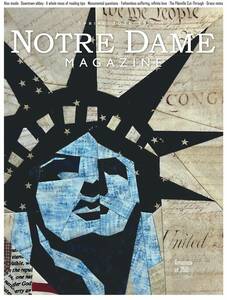
In this year commemorating the 250th anniversary of the Declaration of Independence, we invited writers to look back from their varied perspectives. They responded with an idiosyncratic assortment of personal reflections and historical analyses that call to mind William Faulkner’s aphorism: “The past is never dead. It’s not even past.”
A sampling: History professor Katlyn Carter asks the still-open questions of the Revolutionary War. Brian McMahon ’68, an architect fond of photographing the World Trade Center early in his career, contemplates the living memory of the toppled towers. Religious liberty scholar Richard Garnett documents the anti-Catholic bias that infected the infant nation. Essayist and poet Anthony Walton ’82 contrasts his optimism as a teenager during the 1976 bicentennial with the fear that compels him to carry his passport in 2026 for proof of citizenship.
Once lulled into seeing progress as inevitable, I know better now. Contributors to this issue, in their expert exploration of the contingencies of history, remind us of the right — the responsibility — we have as Americans to chart our collective future.
Jason Kelly is editor of this magazine.