Leo Varadkar embodies a changing Ireland. Becoming prime minister at age 38 in 2017, he was the youngest ever to hold the office and the first to be openly gay. Of Indian and Irish descent — his father was born in Mumbai; his mother in County Waterford — Varadkar was also the first Taoiseach, the Irish term for the country’s highest office, from an ethnic minority group.
His personal background and political positions, including support for successful referendums to legalize same-sex marriage and liberalize abortion laws in Ireland, reflect a country becoming more diverse and less aligned with the Catholic Church.
As prime minister for about five years over two terms from 2017 to 2020 and 2022 to 2024, Varadkar also faced an issue with echoes of Ireland’s historic strife with Great Britain: Brexit. Taking office a year after the United Kingdom voted to leave the European Union, the young prime minister protected the Republic of Ireland’s interests, particularly through the prevention of a hard border with Northern Ireland. In the aftermath of that deal, the Irish public gave him a 53 percent approval rating, the highest for any prime minister in several years.
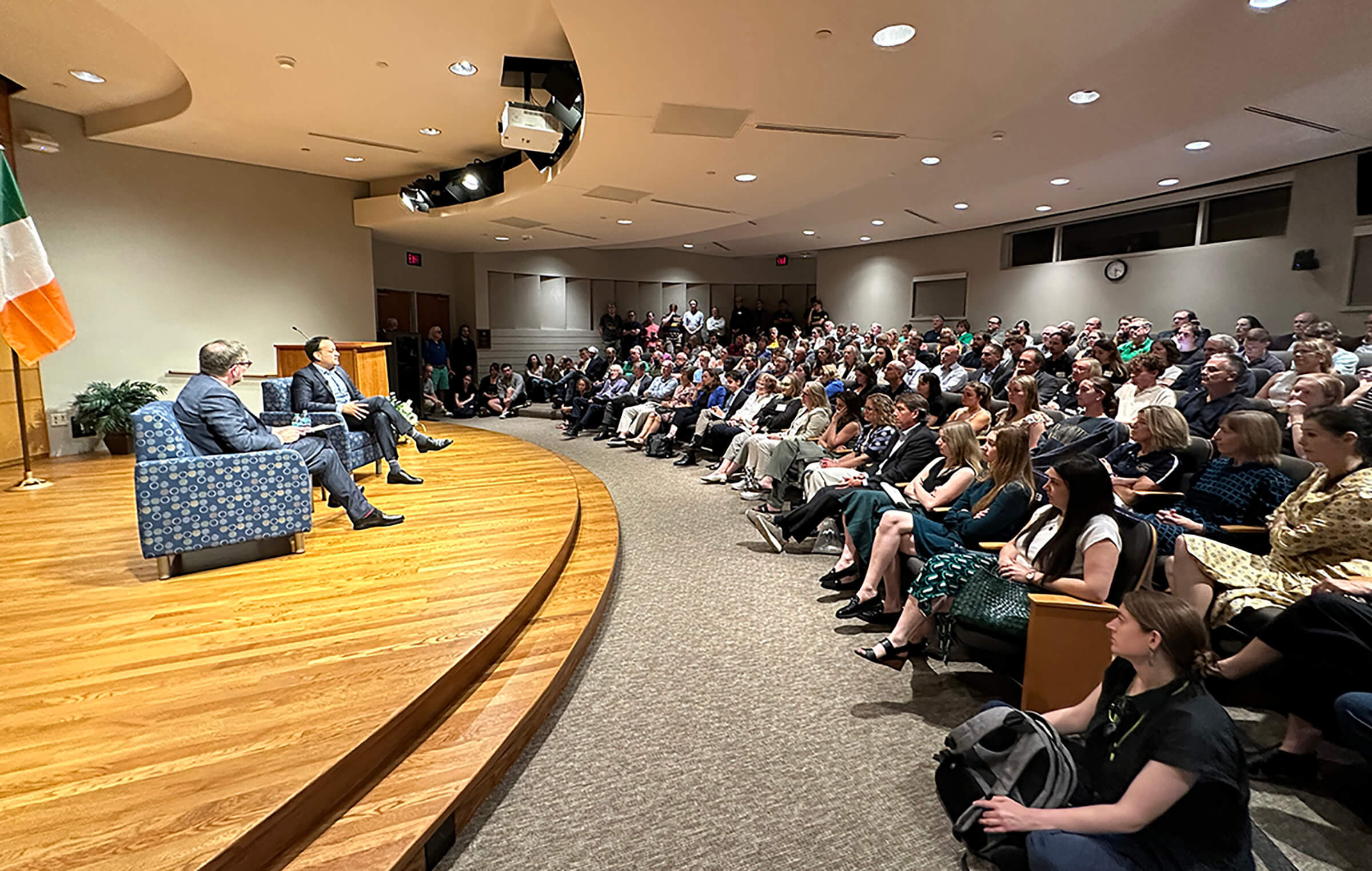
A medical doctor who served for two years as Ireland’s health minister, Varadkar’s professional expertise became critical in 2020. “He helped guide Ireland through the pandemic with public health and economic responses that were internationally recognized for their efficacy,” Mary Gallagher, dean of the Keough School of Global Affairs, said in her introduction of Varadkar for a September 20 conversation on campus.
Below are excerpts from Varadkar’s discussion with Colin Barr, professor of modern Irish history and incoming director of the Keough-Naughton Institute for Irish Studies.
On the impact of Varadkar’s Indian heritage on his political career:
I was kind of lucky when I got elected to local office the first time (in 2003), my dad being the local doctor probably opened a lot of doors. . . . Like a lot of prejudices, there’s what’s overt and what’s covert. We didn’t particularly have social media in those days, but now anytime I do or say anything, I can read on certain platforms all the reasons why I’m not really Irish. Maybe people thought that but didn’t say it at the time. But I think I had an advantage in my dad being the local doctor in our community meant that it opened a lot of doors, actually, which mightn’t have been the case otherwise. So, I guess, both privilege and prejudice.
On perceptions that he took a harder line on Brexit than the previous Irish prime minister:
I don’t think there was a fundamental difference in policy between me and my predecessor, Enda Kenney. Our policies and objectives were the same, and that was: no hard border between North and South; we weren’t going to be taken out of the European Union in any way just because the British were leaving; and that we try and make sure the Good Friday Agreement (a 1998 power-sharing deal that ended decades of political violence in Northern Ireland) was upheld. So, I don’t think there was any fundamental difference. Maybe I was more blunt — I am more blunt than Enda. I was probably more strident. What was then unfolding was this idea that, having narrowly voted for Brexit at all, they were going to go for the hard option. We had to make it clear that there were consequences for that, particular in relation to Northern Ireland.
On his medical expertise and Ireland’s pandemic response:
Sometimes in politics you think you’re not the right person for the job, but sometimes you think you probably are. I remember the chief medical officer putting graphs up on the screen, talking us through what might happen. And I instantly knew what he meant. I’d seen this before. I’d done epidemiology, I’d done medical statistics, I understood what was coming. And the one that really hit me was the graph where he showed ICU capacity and the point at which we wouldn’t have enough critical care capacity anymore. . . . That meant we could get to the point where the doctors and nurses having to make the decisions, the intensivists and the anesthesiologists, wouldn’t be giving the beds to the sickest patients. They’d be saying, ‘It’s not an appropriate use of resources to give that bed to that patient who might take 20 days to get better, so we’re going sacrifice that patient and give the bed to somebody else.’ So, I knew what it meant if we got this wrong; I knew we would have to make decisions that were unimaginable up until then.
On the prospect of a united Ireland, which under the Good Friday Agreement would require a successful referendum in both the Republic and Northern Ireland:
You have to craft proposition that people are willing to buy into. Certainly the vision for a 21st-century united Ireland is not the vision of 1916. The vision of 1916 is, ‘It’s Gaelic, it’s Catholic, it’s Sinn Fein, ourselves alone, nobody else. Let’s do it for ourselves.’ That’s not a vision [for modern Ireland]. It’s something entirely different, and something that accepts that Irishness has changed. It has to be inclusive, particularly of that minority in the north and respects their wishes.
Jason Kelly is editor of this magazine.