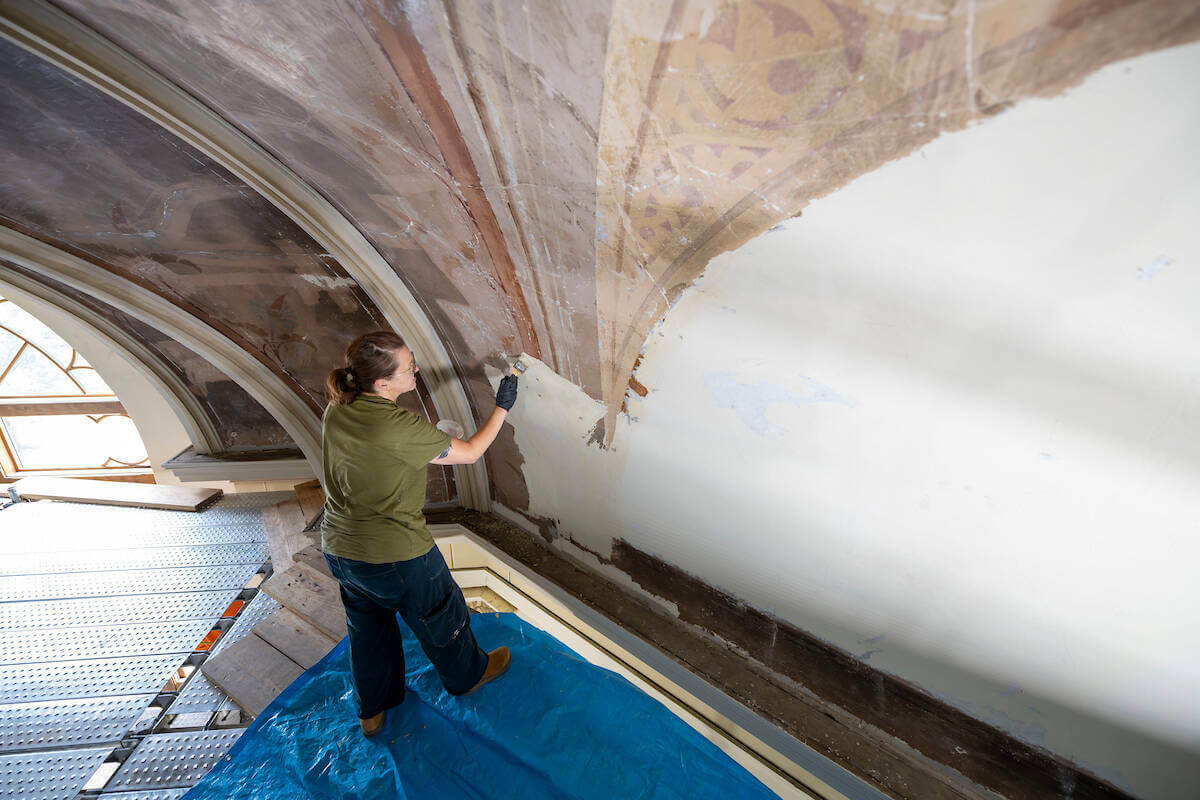
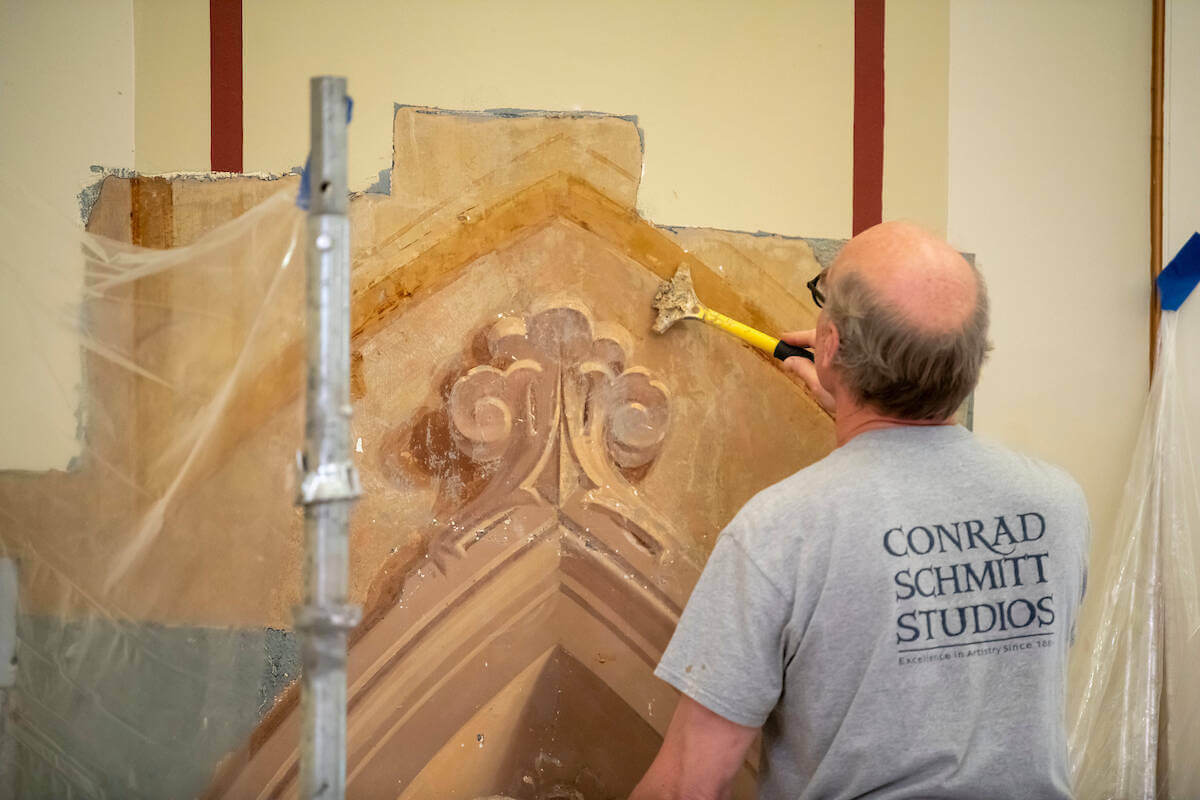
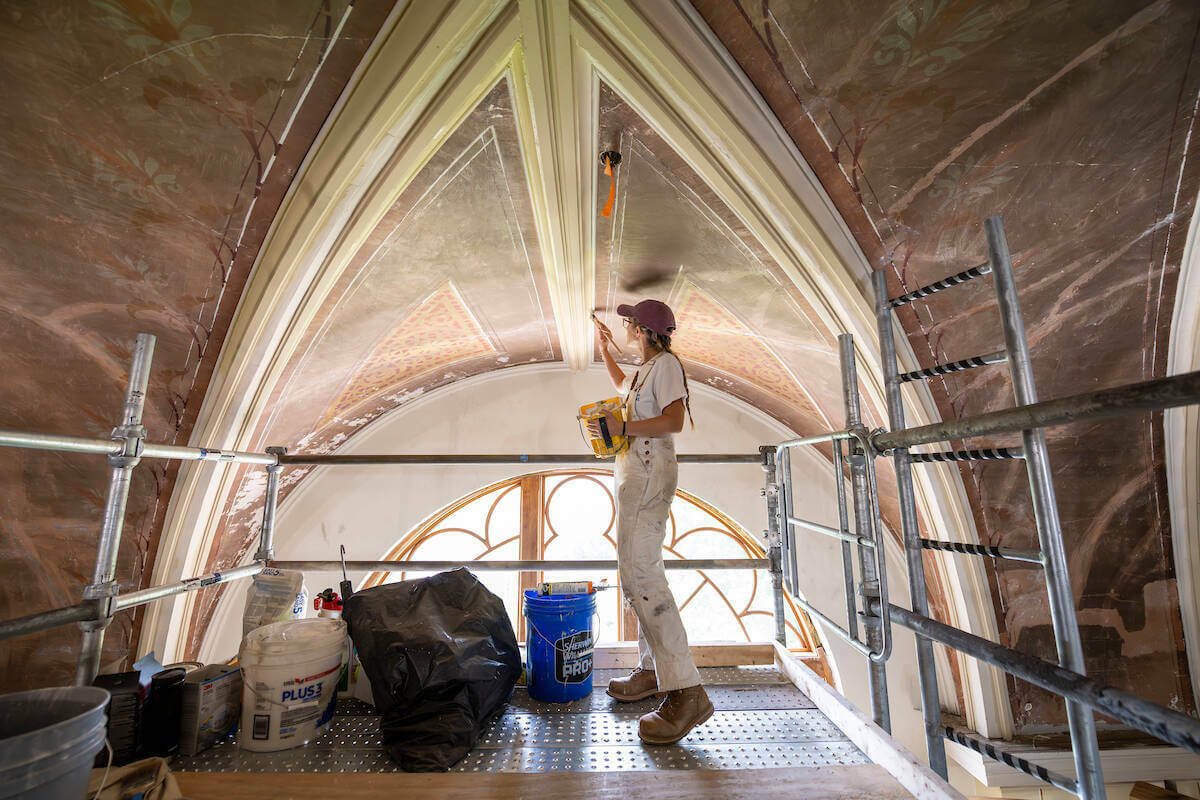
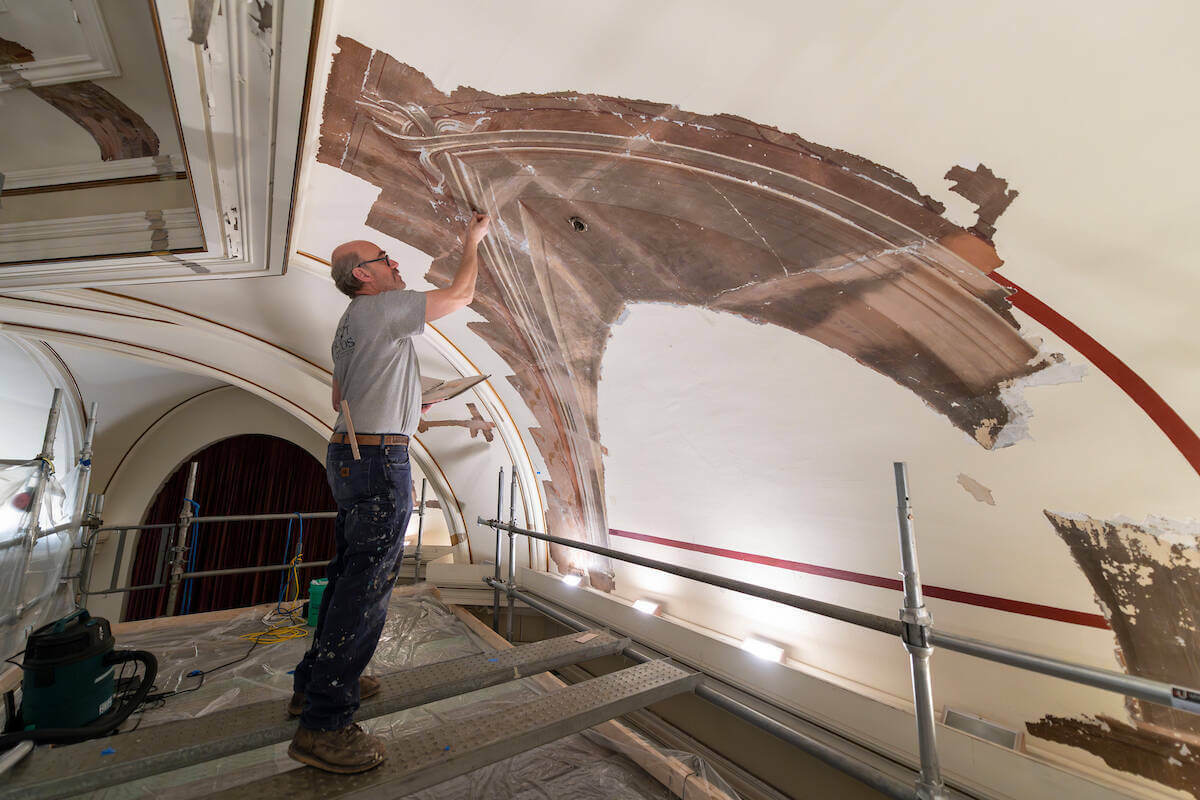
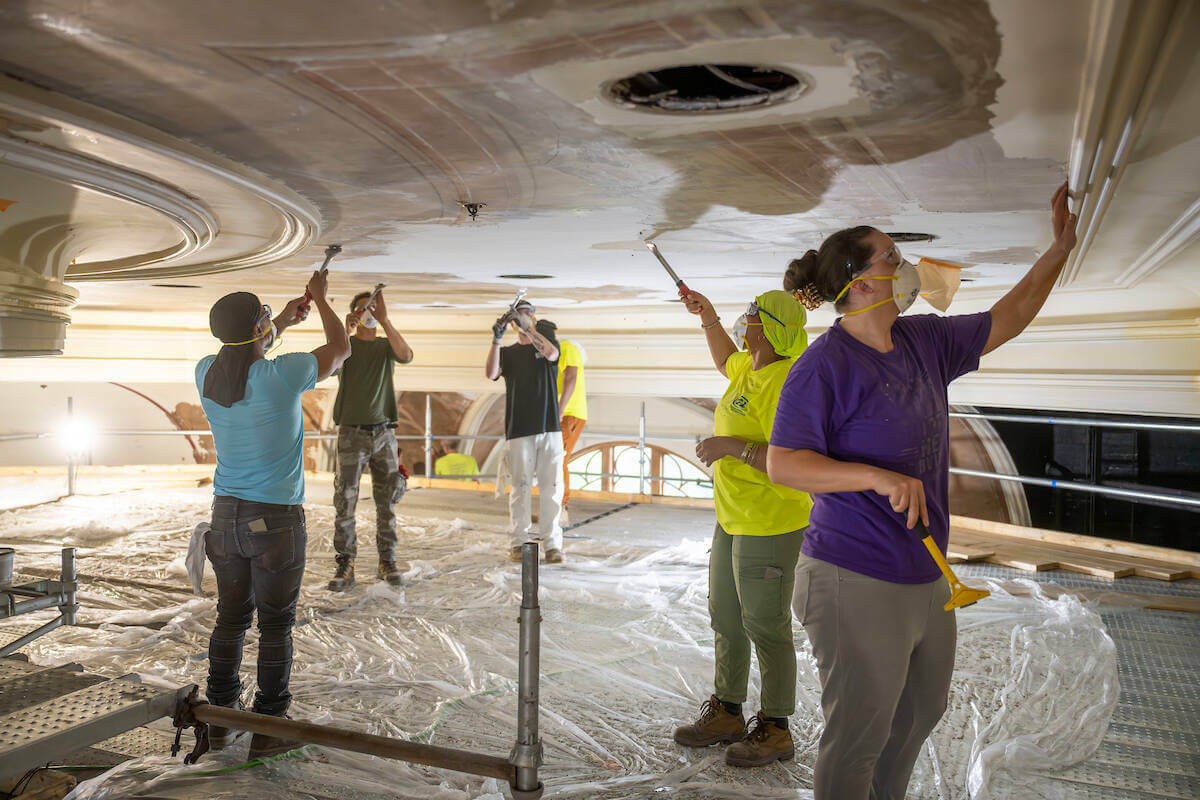
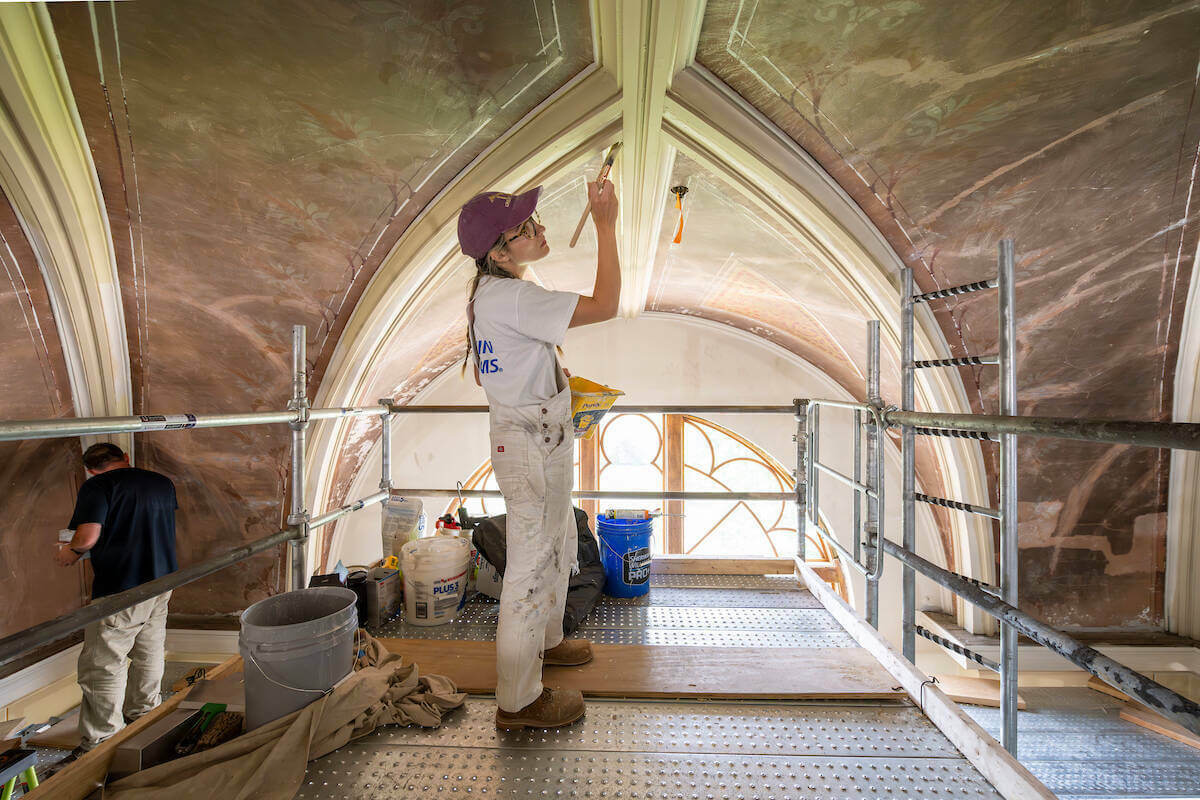
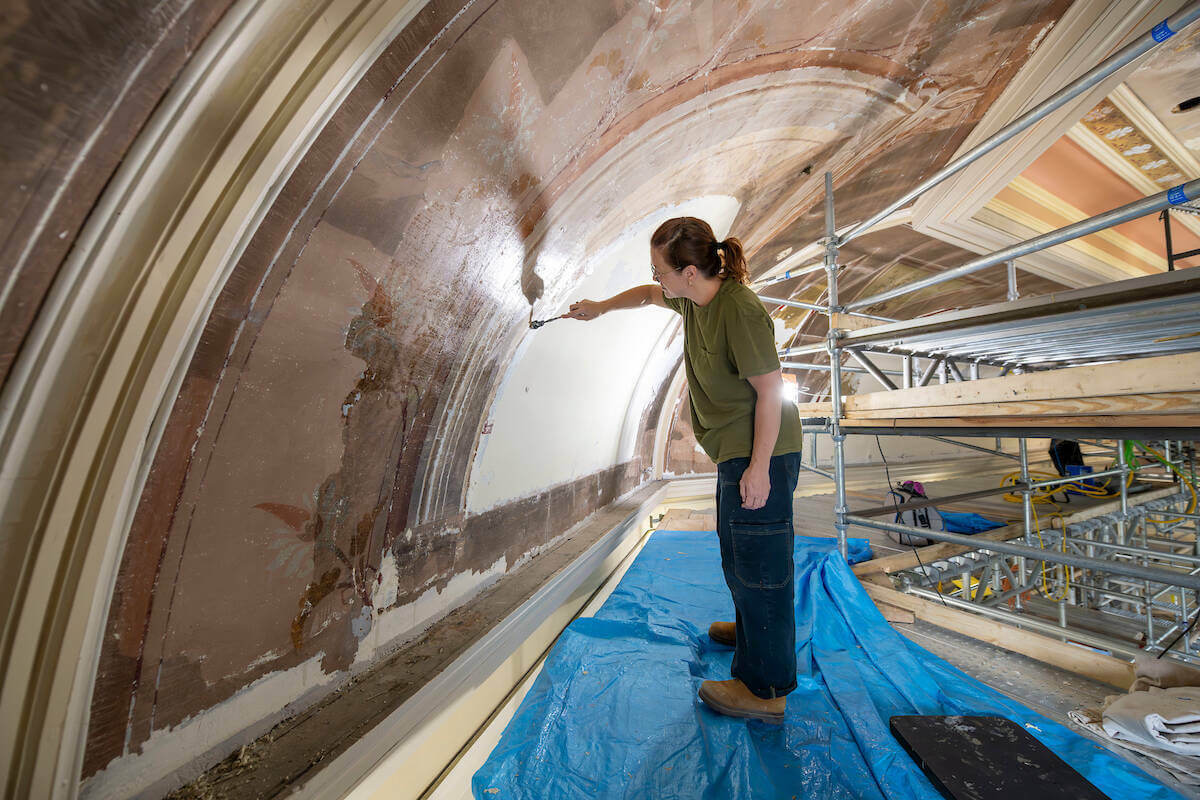
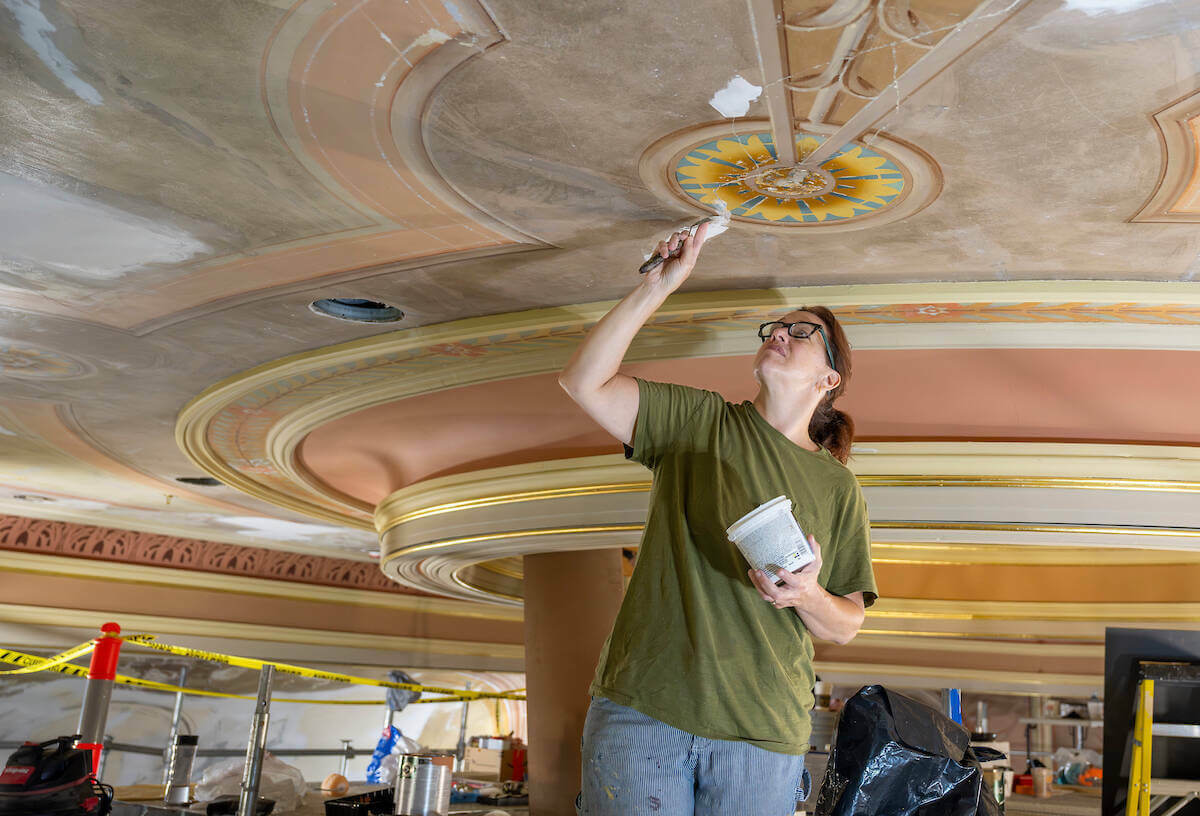
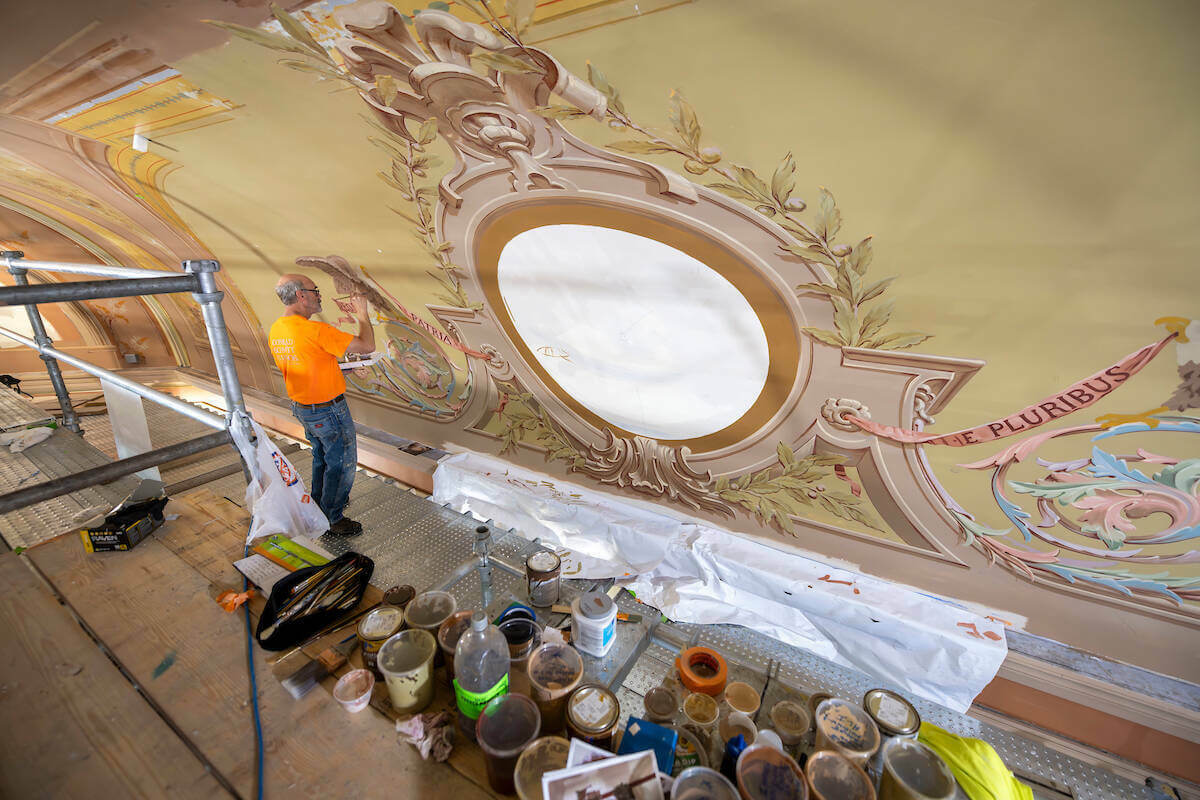
Inch by inch, Jill Eide carefully scrapes layers of paint from the ceiling of Washington Hall by hand. As the discarded bits fall to the scaffolding at her feet, luminous colors and 19th-century artistry are revealed.
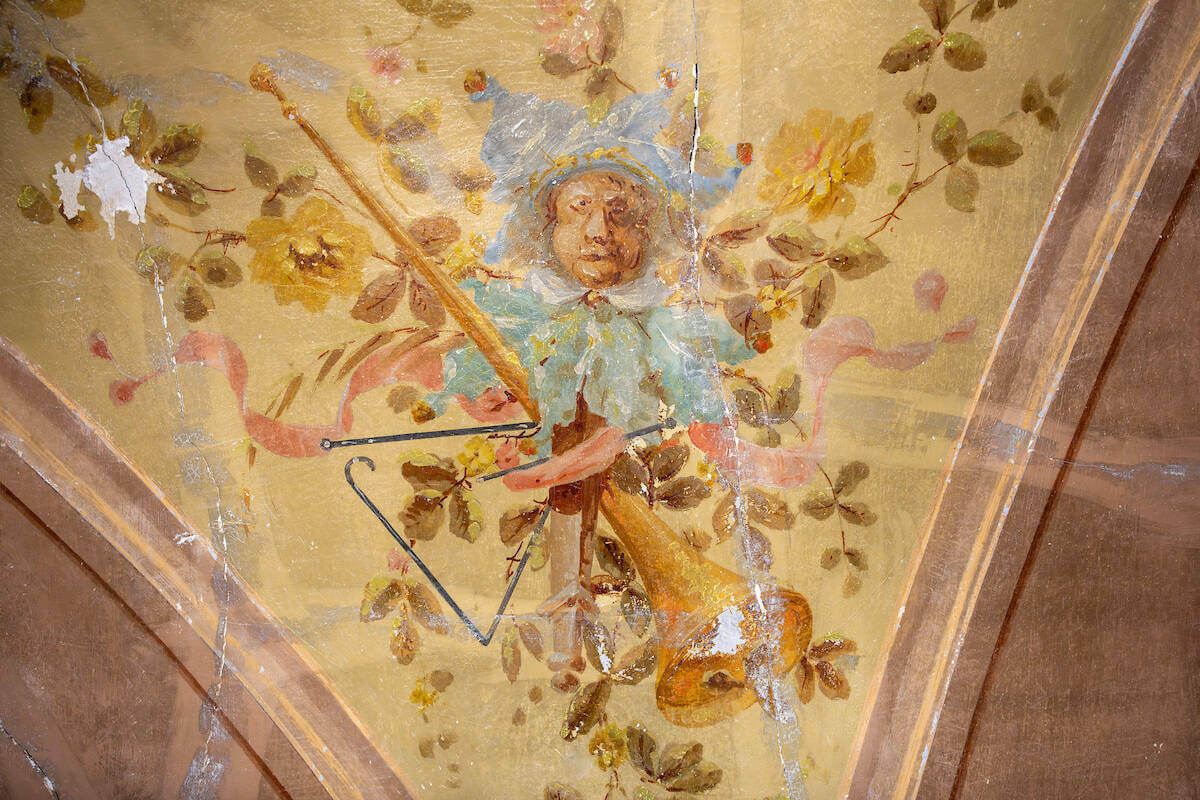
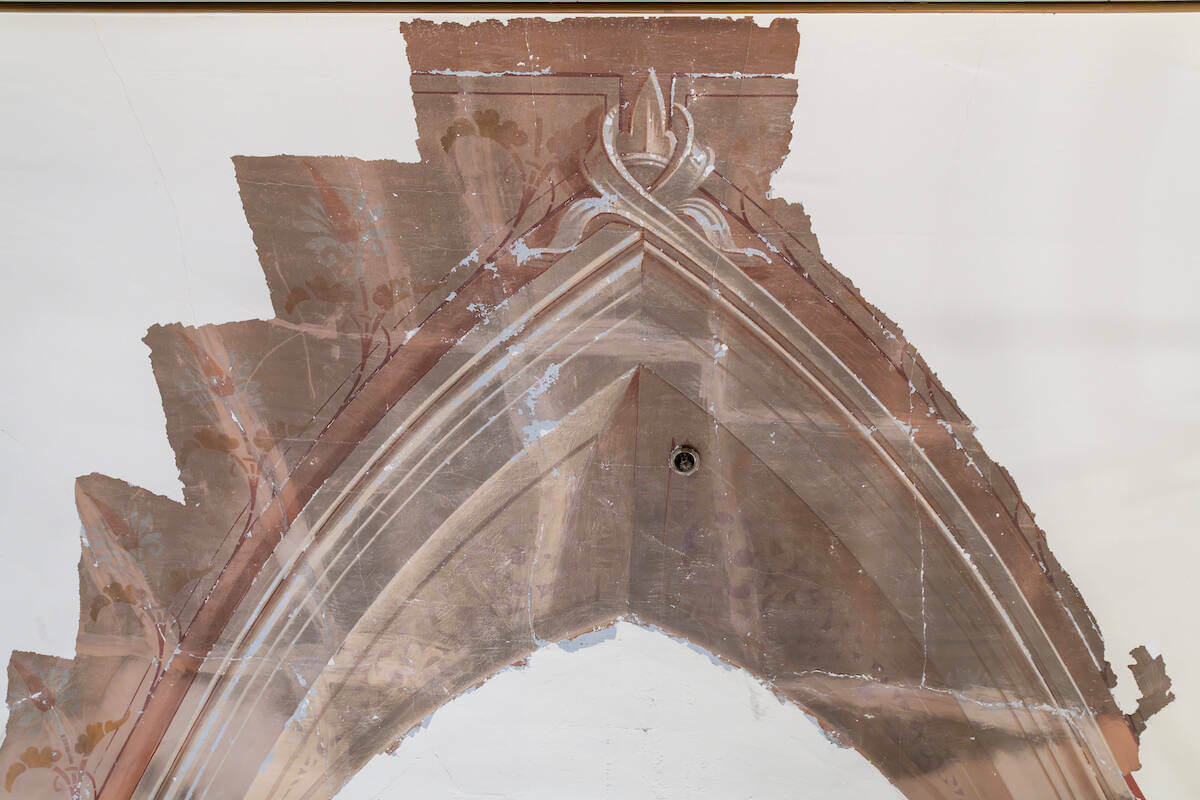
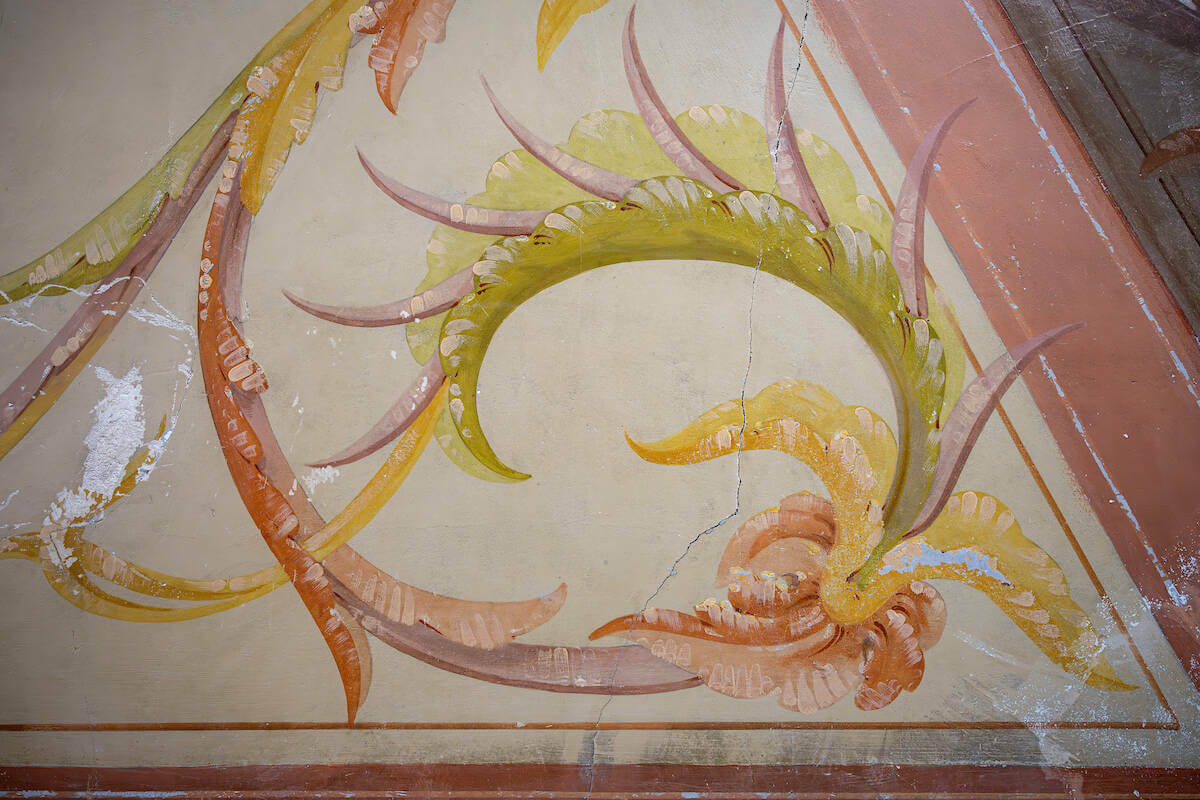
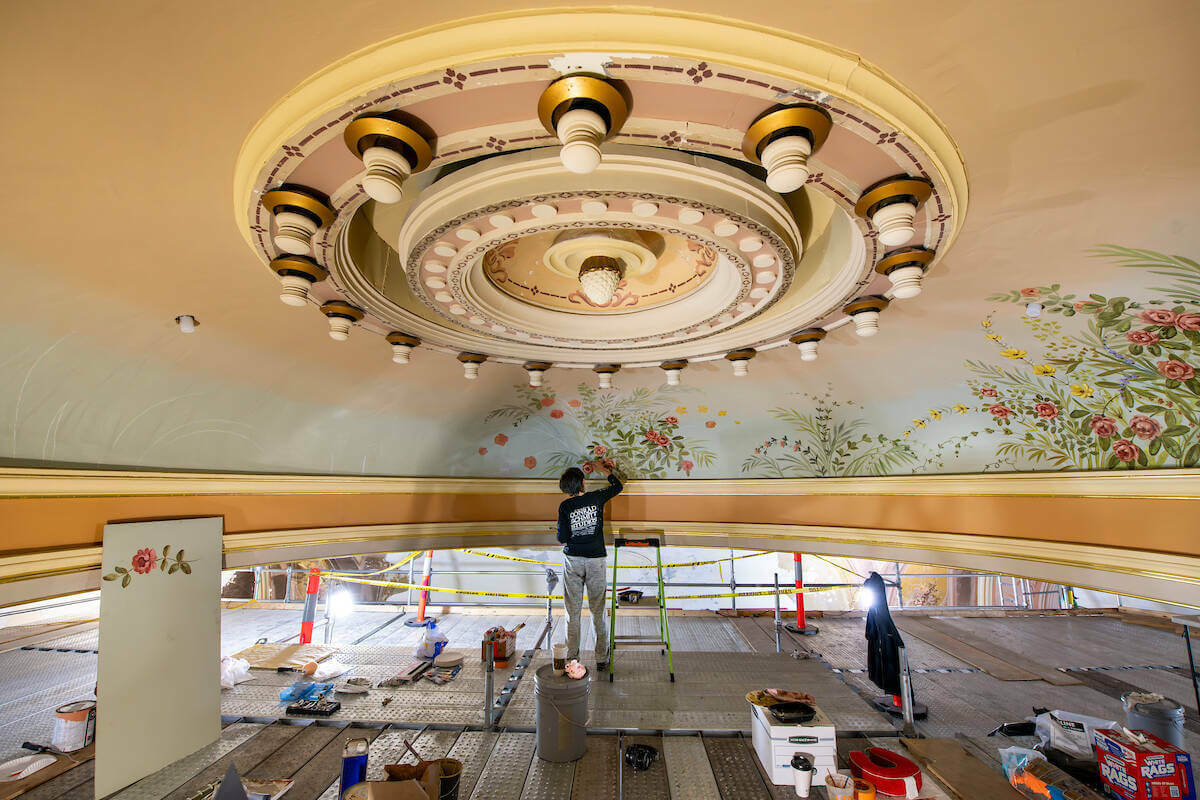
A delicate filigree motif comes to light. Close by, vibrant shades of gold, plum and olive green form an intricate swirl near a corner of the ceiling. Vines, flowers, leaves and scrollwork appear.
Eide continues her task, deftly wielding the tiny scraper that is just a half-inch wide. “When we started, we were dazzled by how much is still here,” says Eide, an art conservator with Conrad Schmitt Studios, the Wisconsin-based decorative art and restoration firm that has been doing work at Notre Dame since the 1930s.
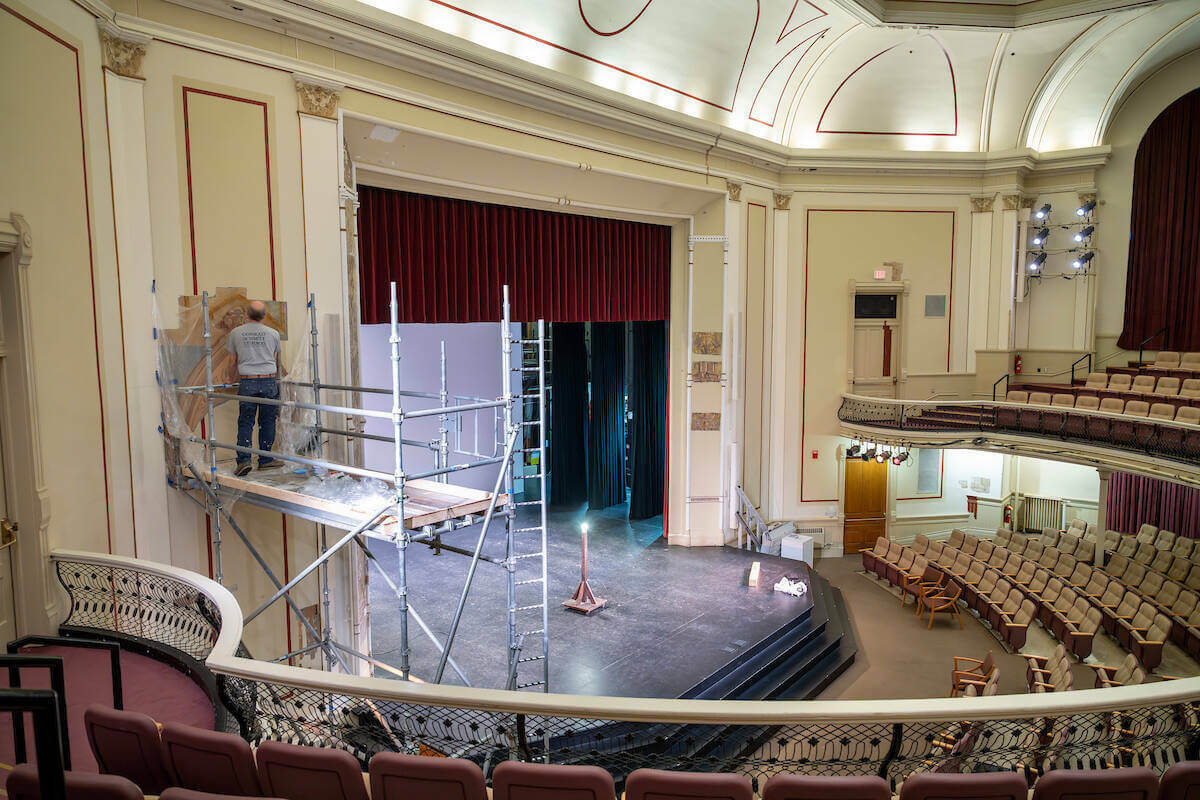
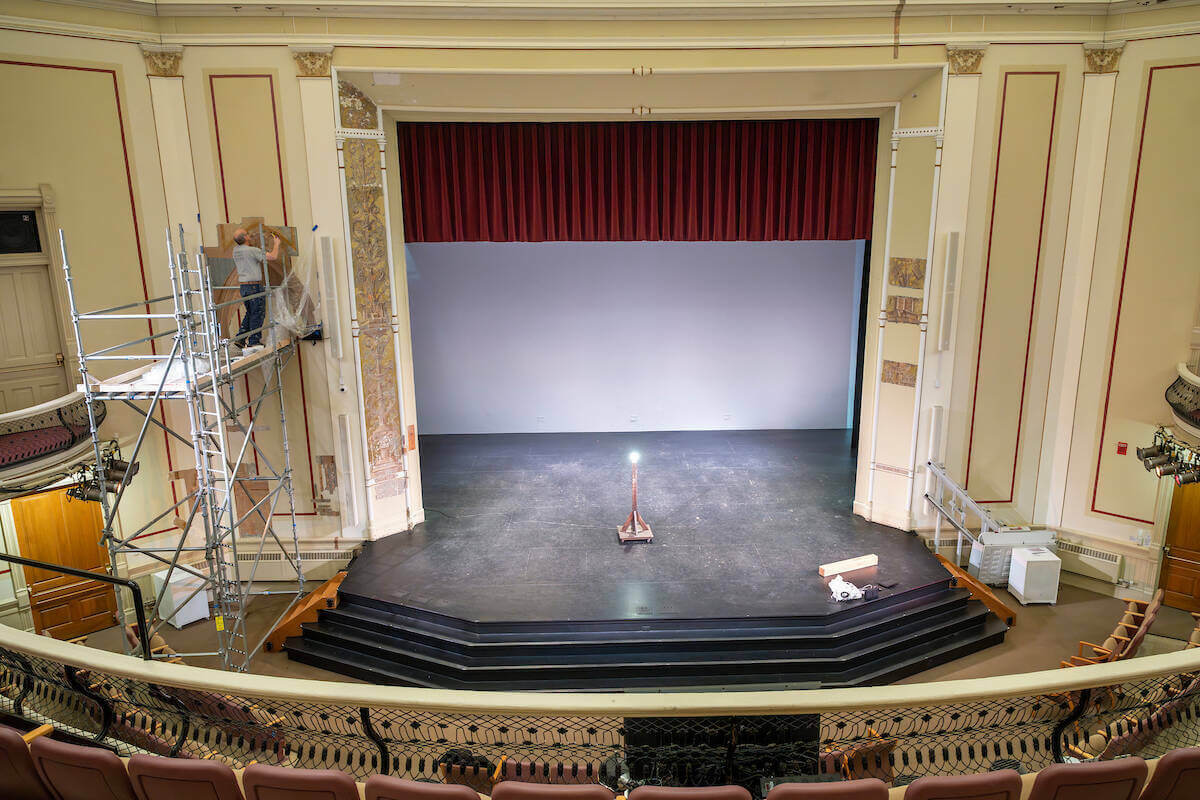
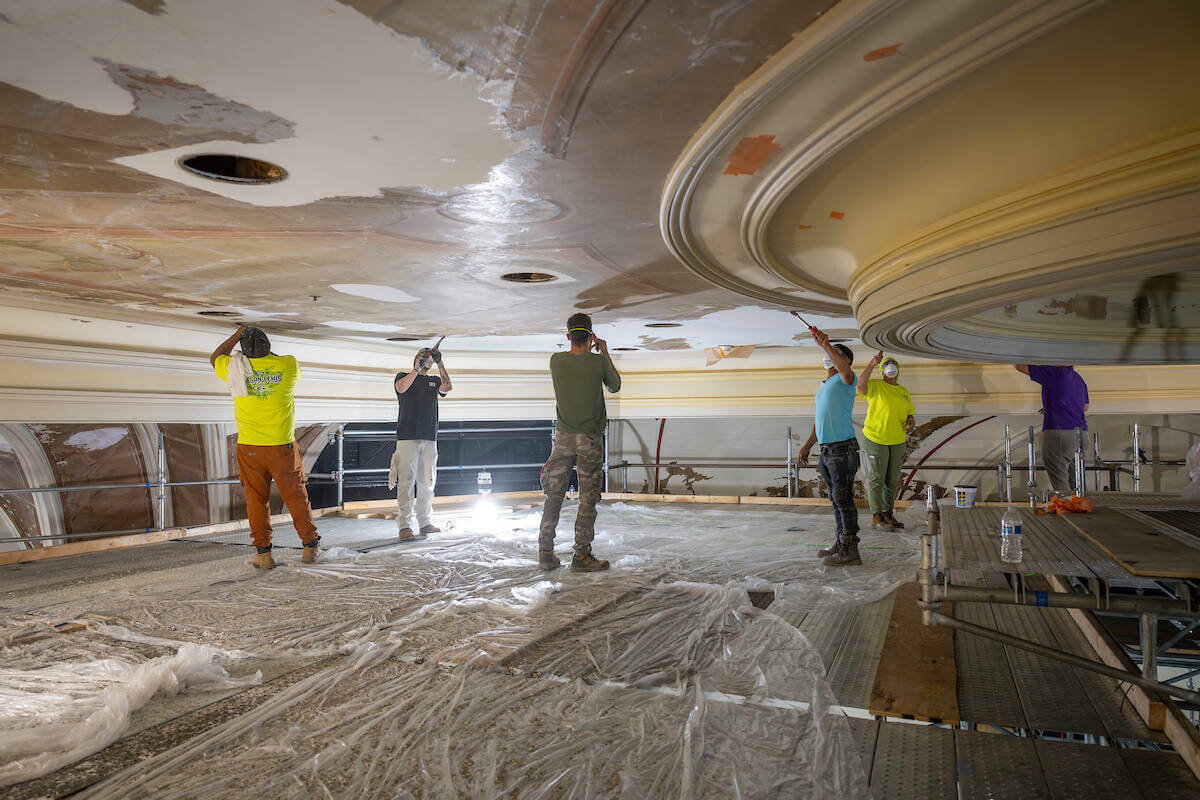
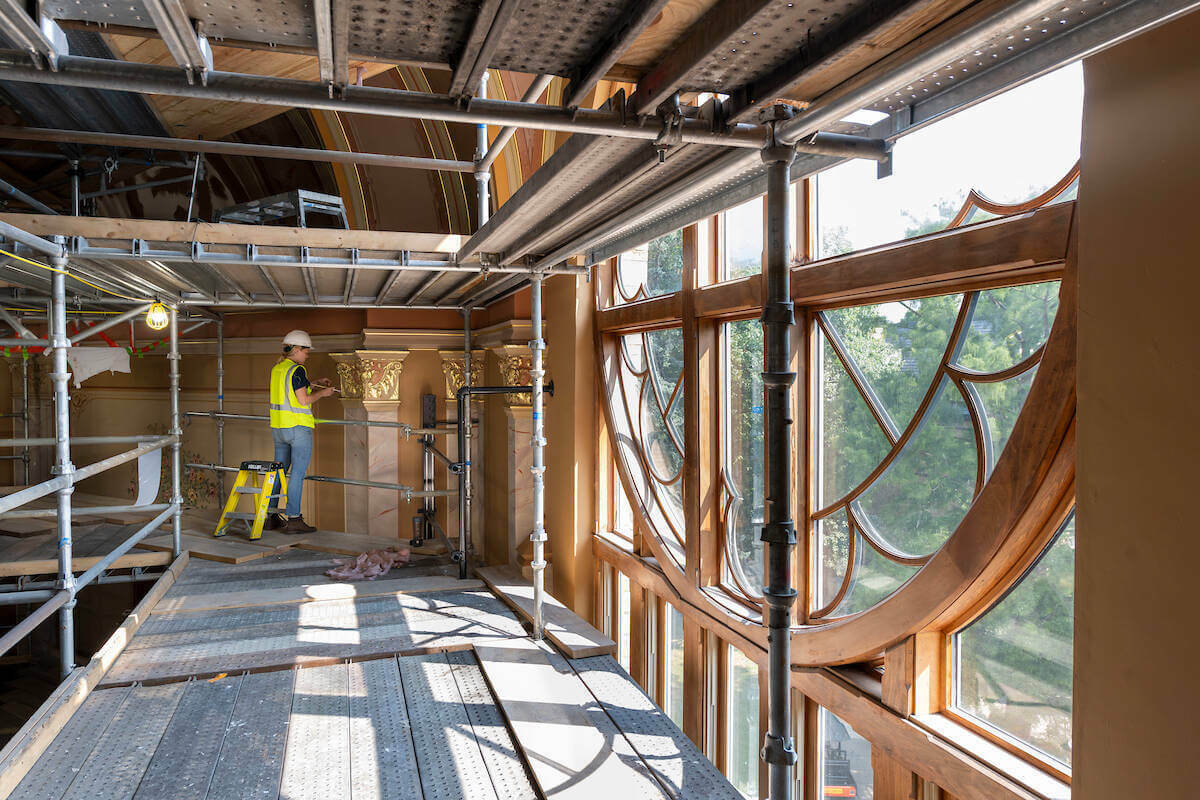
Over the summer and into the fall, the University’s 143-year-old campus auditorium underwent a major renovation. The project uncovered or re-created much of the high Victorian interior artistic details that were added in 1894 by Luigi Gregori and Louis Rusca, the artists who also decorated the interior of the Main Building and what is now the Basilica of the Sacred Heart.
The 1890s auditorium decor gradually faded over time. What remained was covered with gray paint in 1956 during a modernization project.
Now those glorious colors and details are reborn.
“I thought there was a good chance that the artwork under the paint would be there,” says Mark Pilkinton, a professor emeritus of film, television and theater and author of the 2011 book, Washington Hall at Notre Dame: Crossroads of the University, 1864-2004. He describes the theater as a jewel box.
In his book, Pilkinton made a case for restoring the auditorium, and he’s thrilled the project has finally happened.
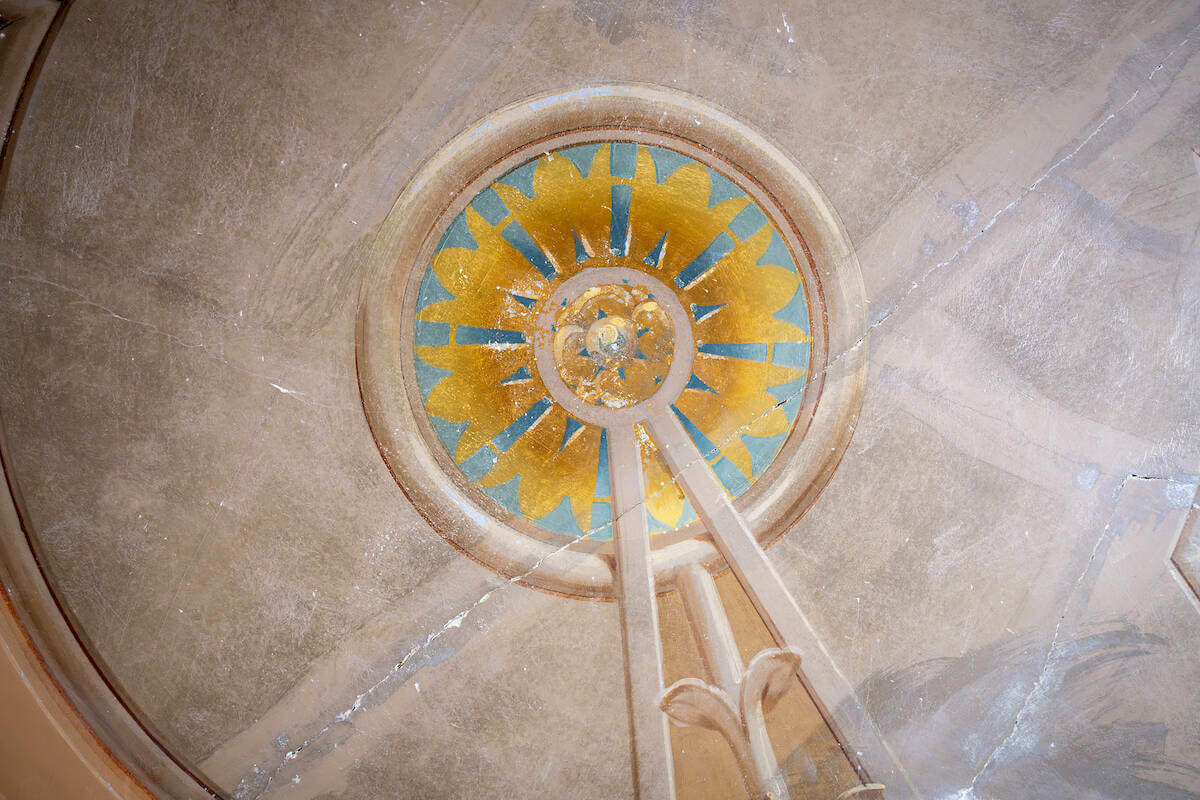
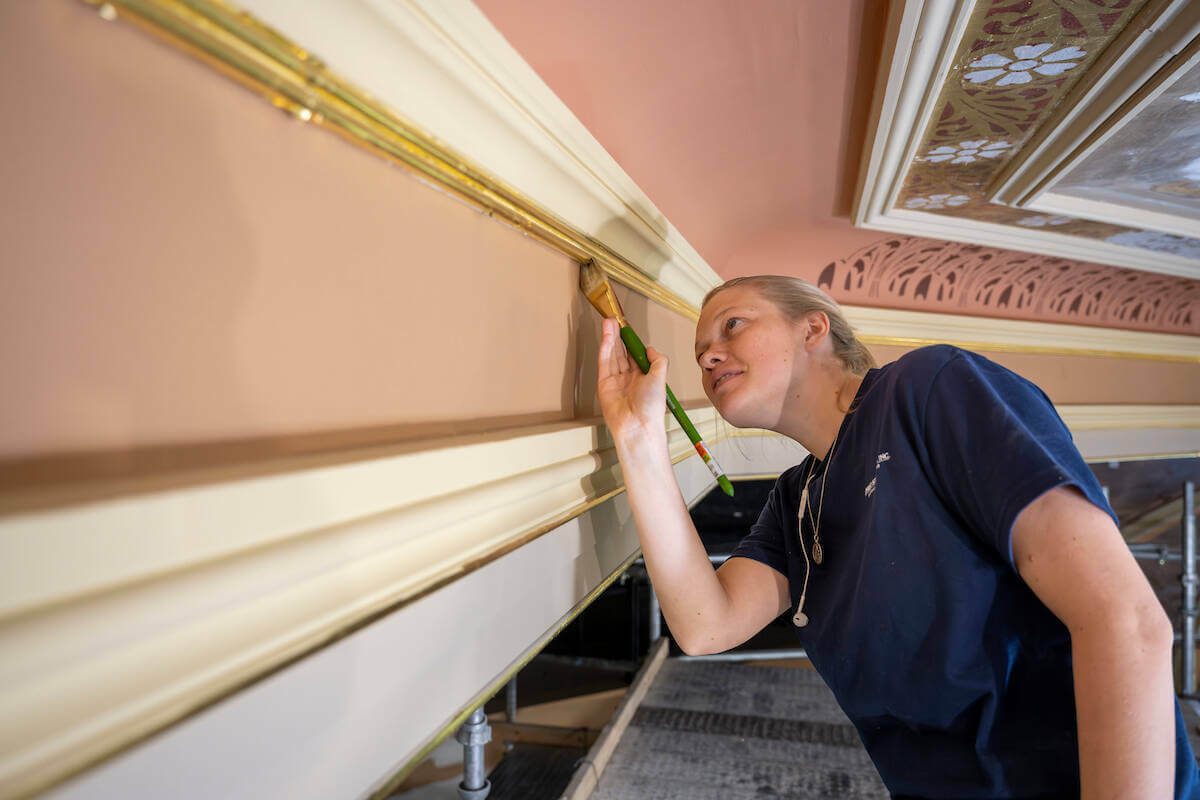
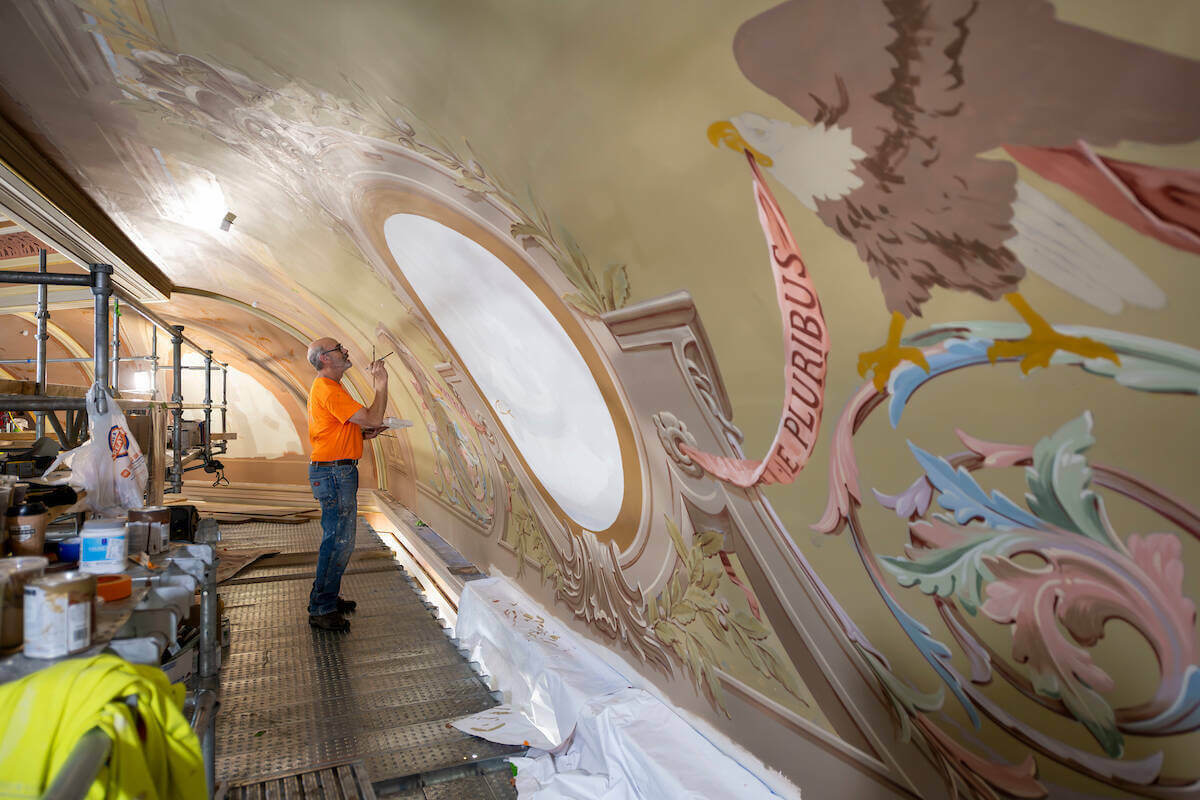
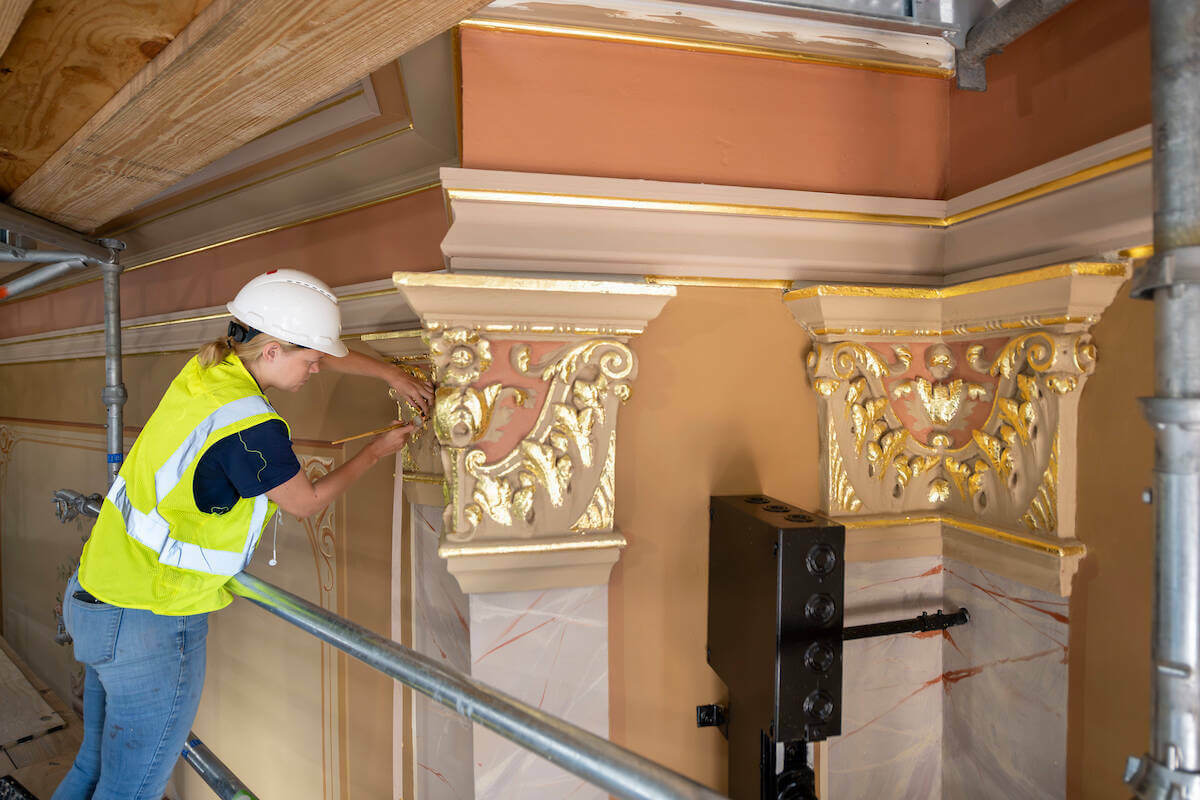
The 1890s auditorium included gold accents, created with a mica or a similar artificial-gold substance. Those details are now recreated with gold leaf. “It will shine like crazy,” says Bryon Roesselet, senior artist and architectural conservator for Conrad Schmitt. “The gold leaf really pops.”
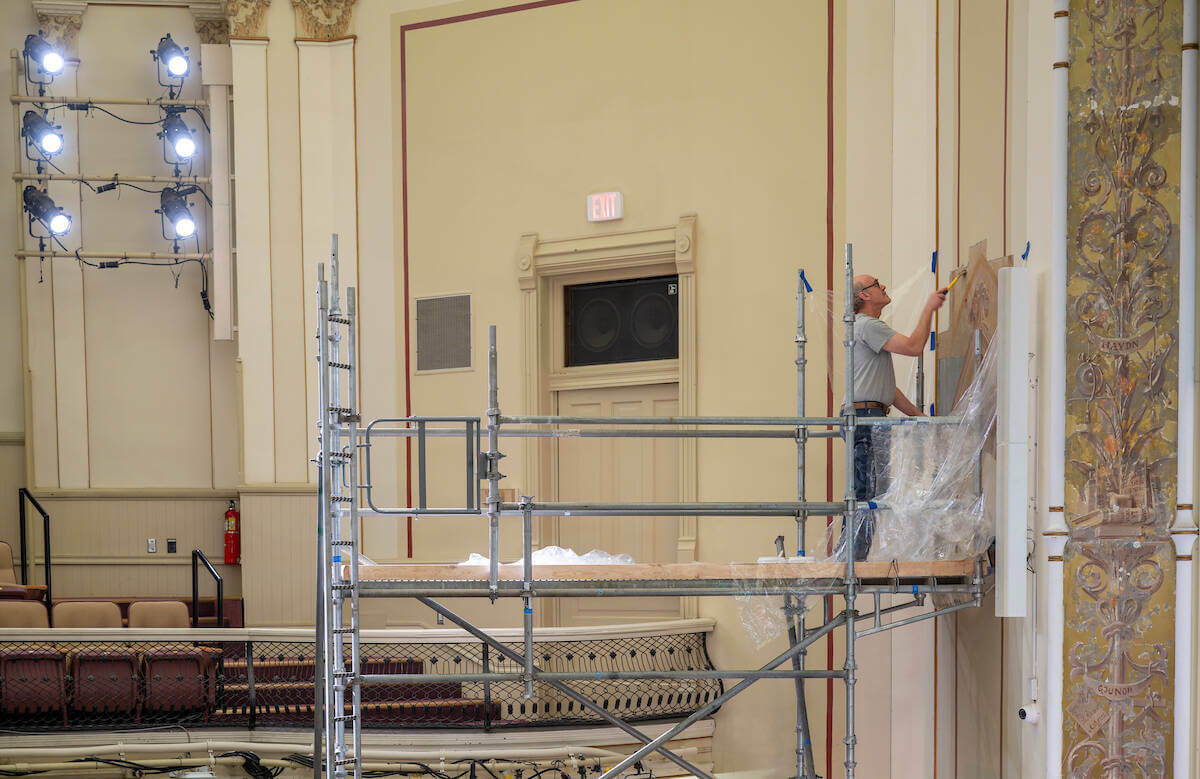
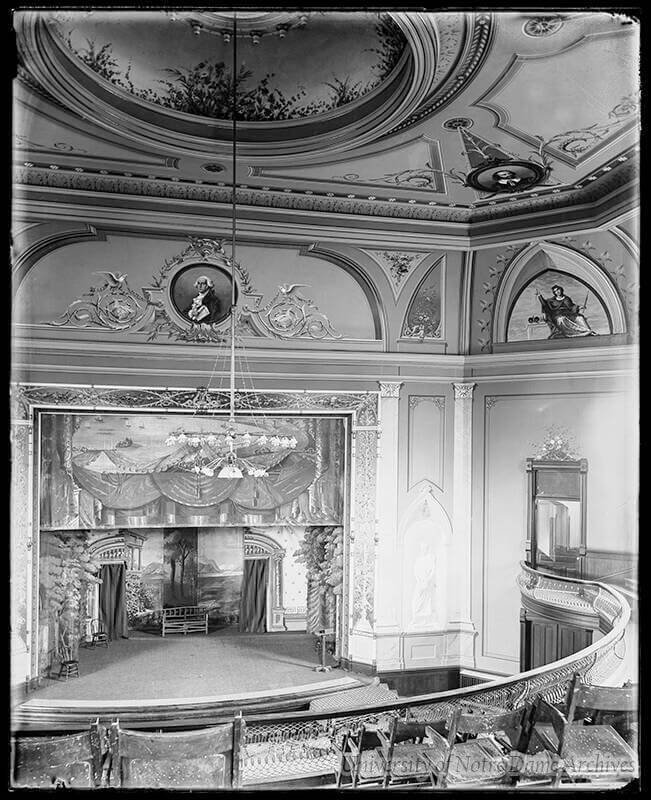
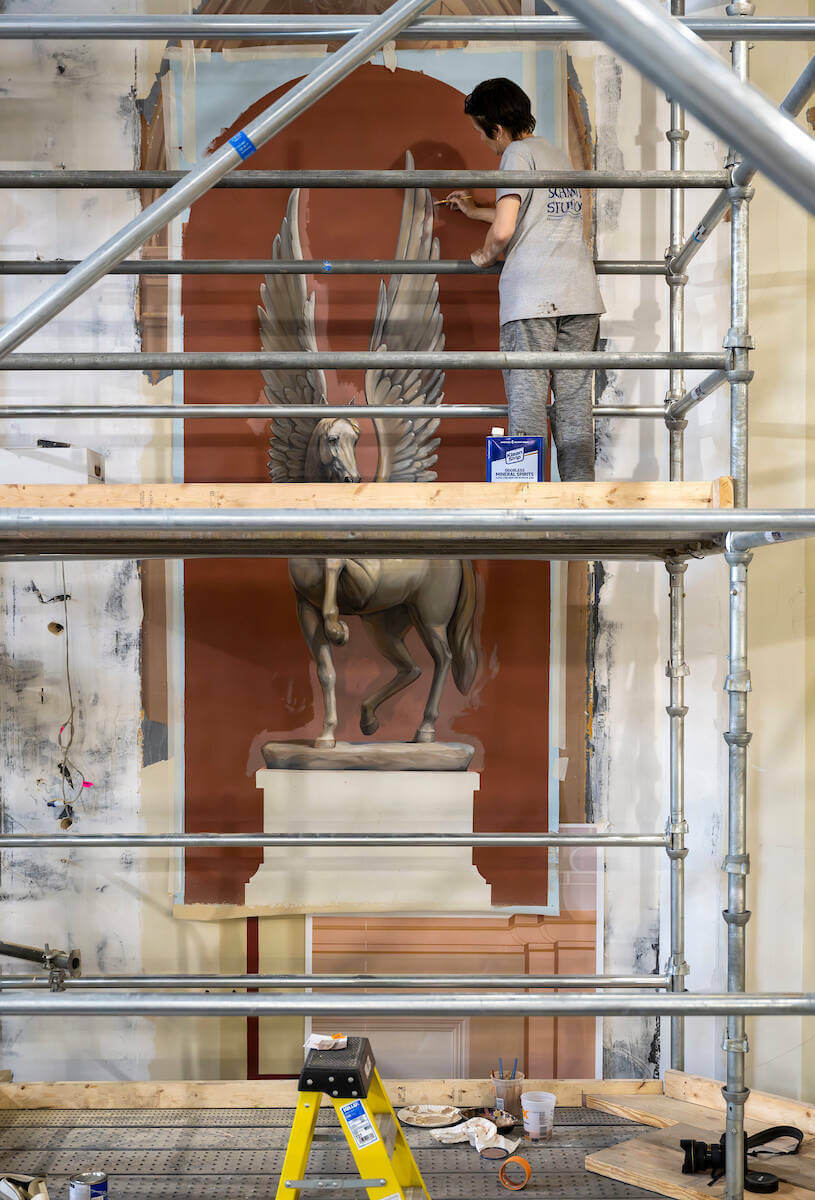
Ornate decor above the proscenium — the part of the stage that extends out from the curtain — was plastered over at some point, so those details were destroyed. However, a few photographs of the original work exist. And the Schmitt team uncovered identical scrollwork on the theater’s back wall, which was used to re-create the pattern above the proscenium.
The main goal of the renovation was to upgrade the space with new seats, new LED lighting and safety improvements, says Tony Polotto, the University’s senior director of construction and quality assurance. “In the process, we have the benefit of exposing some of the beautiful artwork that was in that building. It isn’t meant to be a historic restoration or a duplication of exactly what was there,” he notes.
New carpet with a large floral pattern fills the aisles, and faux-wood flooring beneath the seats will improve the hall’s acoustics. The renovated auditorium will seat 546 people, the same capacity as before.
The work is scheduled to finish in October, with the auditorium set to reopen for use after fall break.

Washington Hall was built in 1881 and dedicated the following year. It replaced a music hall that burned during the Great Fire of 1879 and was designed by Willoughby J. Edbrooke, the Chicago architect who also designed the new Main Building after the fire.
It is called Washington Hall in honor of President George Washington, a hero of Notre Dame founder Father Edward Sorin, CSC. It served as the University’s primary auditorium until the DeBartolo Performing Arts Center opened in 2004, and it remains in frequent use for lectures, student theater productions and other events.
Over its long history, the auditorium provided the backdrop for commencements, film screenings, St. Patrick’s Day celebrations, debates, speeches and countless theatrical and musical performances.
An 1894 Scholastic article described the auditorium’s decor shortly after its completion: “The ceiling is especially beautiful in design and color. It is divided into six large panels of a light olive tint, decorated with delicately limned ornaments springing forth in curved lines from four round golden frames containing portraits of Shakspere [sic], Molière, Mozart and Beethoven, painted by Gregori. From the centre of the ceiling rises a gracefully curved dome adorned with festoons of flowers and trailing vines on a background of the brightest tints seen in a morning sky. A large curved space, twelve feet wide, connecting the walls with the ceiling is embellished with skillfully executed niches, containing sitting figures of Tragedy, Comedy, Music and Poetry.
These allegorical representations are of majestic proportions, graceful in pose and brilliant in color. They stand out in bold relief from landscapes softened with heavenly hues.”
The portraits of Washington and the writers, artists and muses, all painted by Gregori on canvas, were removed during the 1956 remodeling and are believed to be lost.
Gregori, a Notre Dame art professor from 1874 to 1891, had retired to Italy. He completed the portraits abroad and shipped them to the University, where they were affixed to the auditorium’s walls and ceiling. The rest of the art is known to be the work of Rusca, a Swiss-Italian immigrant and Chicago-based fresco artist who specialized in trompe l’oeil — a surface painting or design that creates the illusion of a three-dimensional object — and his assistant, a Mr. Poligano.
The 1890s decor also included figures of Demosthenes, a Greek statesman and orator, and Cicero, a Roman statesman and philosopher, in trompe l’oeil niches between marbleized columns on either side of the stage.
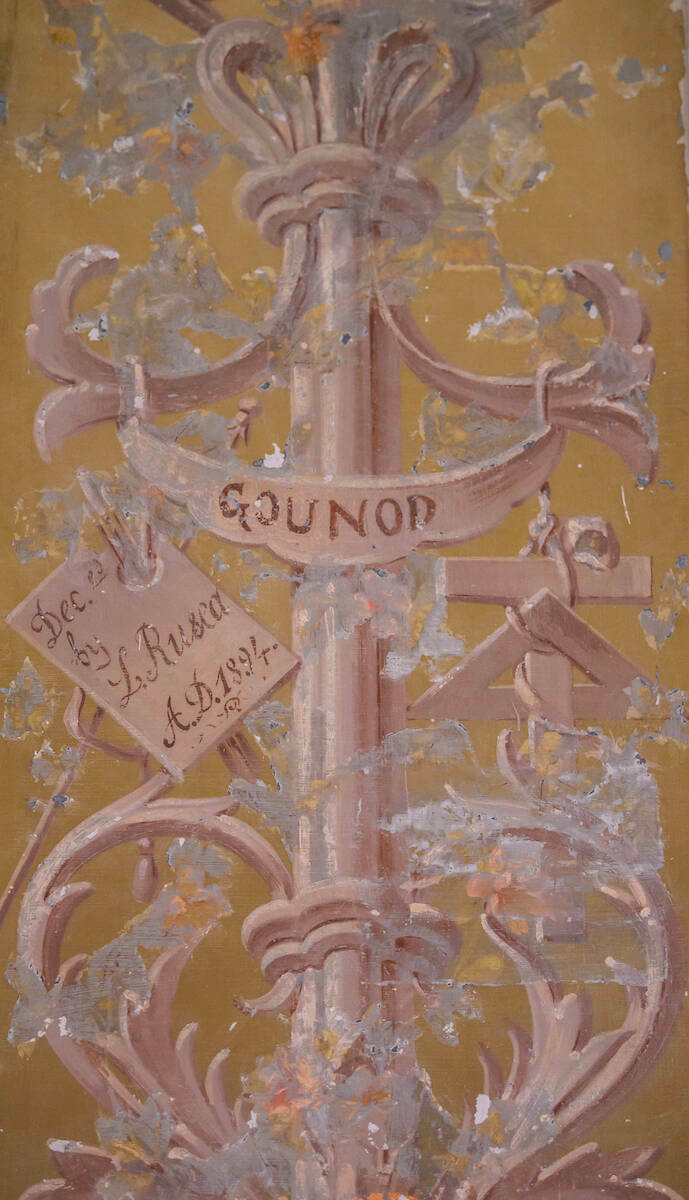
Roesselet had long wanted to work on a renovation of Washington Hall, because he’s an admirer of trompe l’oeil. He says the examples he uncovered in the auditorium and during an earlier renovation of the Main Building stand among the best he’s seen in his career. Most of it was the work of Rusca — who signed his work in painted script on the left side of the Washington Hall stage: “Dec[orated] by L. Rusca, A.D. 1894.”
Uncovering that signature came as a surprise. “Of all the decorative painting projects I’ve ever worked on,” Roesselet says, “that’s the first that I’ve ever actually found evidence of the original artist.”
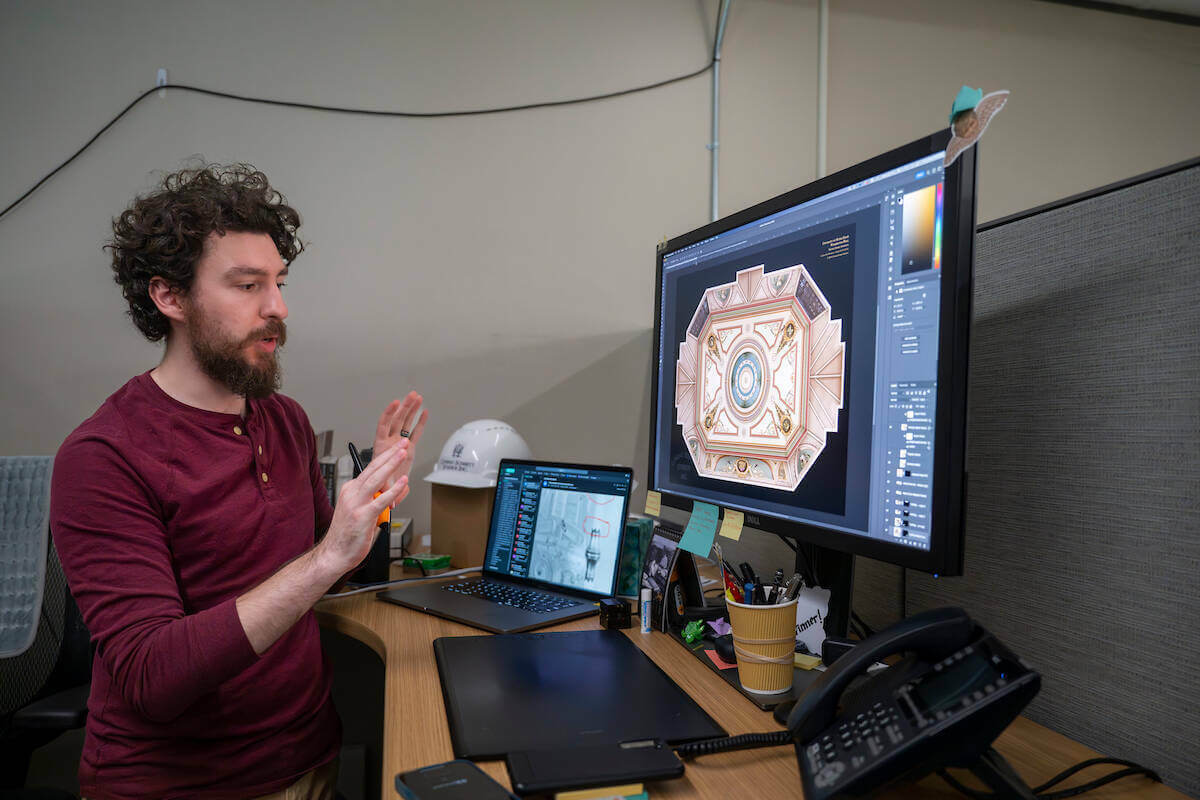
Planning for the new decor was based largely on a single image in the Notre Dame Archives: a circa-1895, sharply detailed black-and-white photograph. It shows the stage and northeast section of the auditorium, the portrait of Washington, other painted figures at the corners, a floral scene on the domed ceiling and delicate filigree and scrollwork throughout.
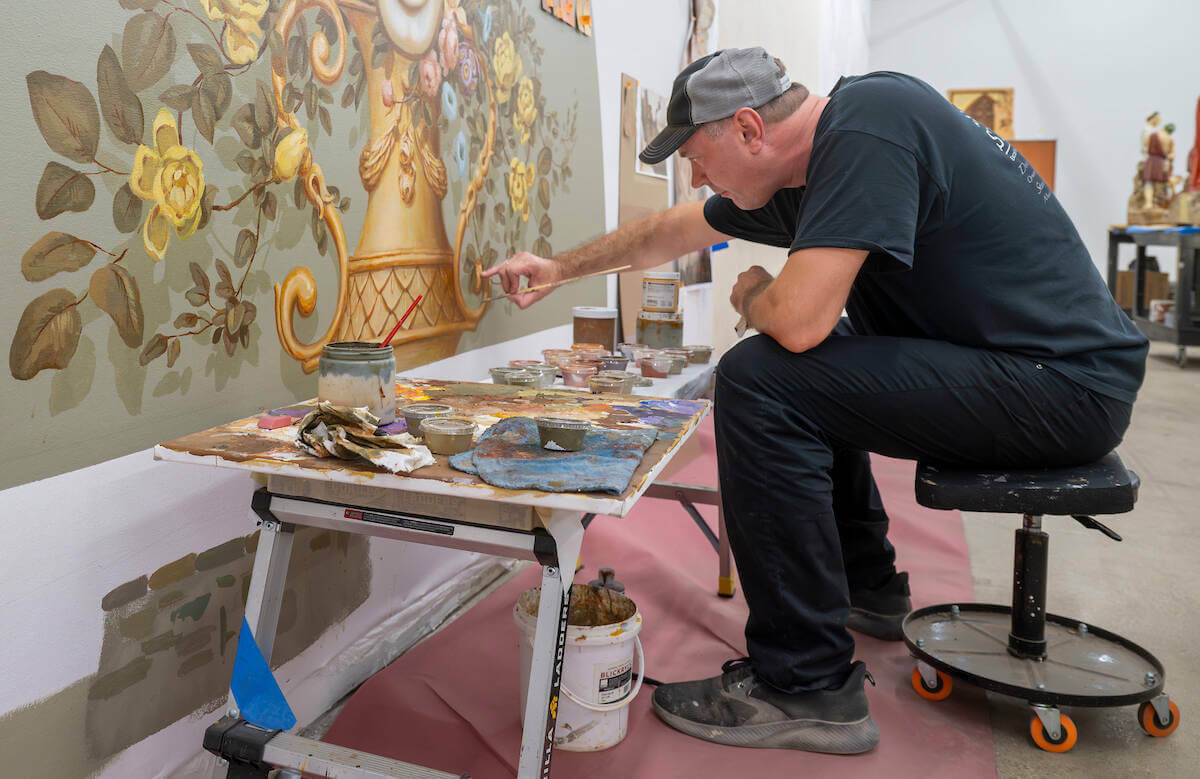
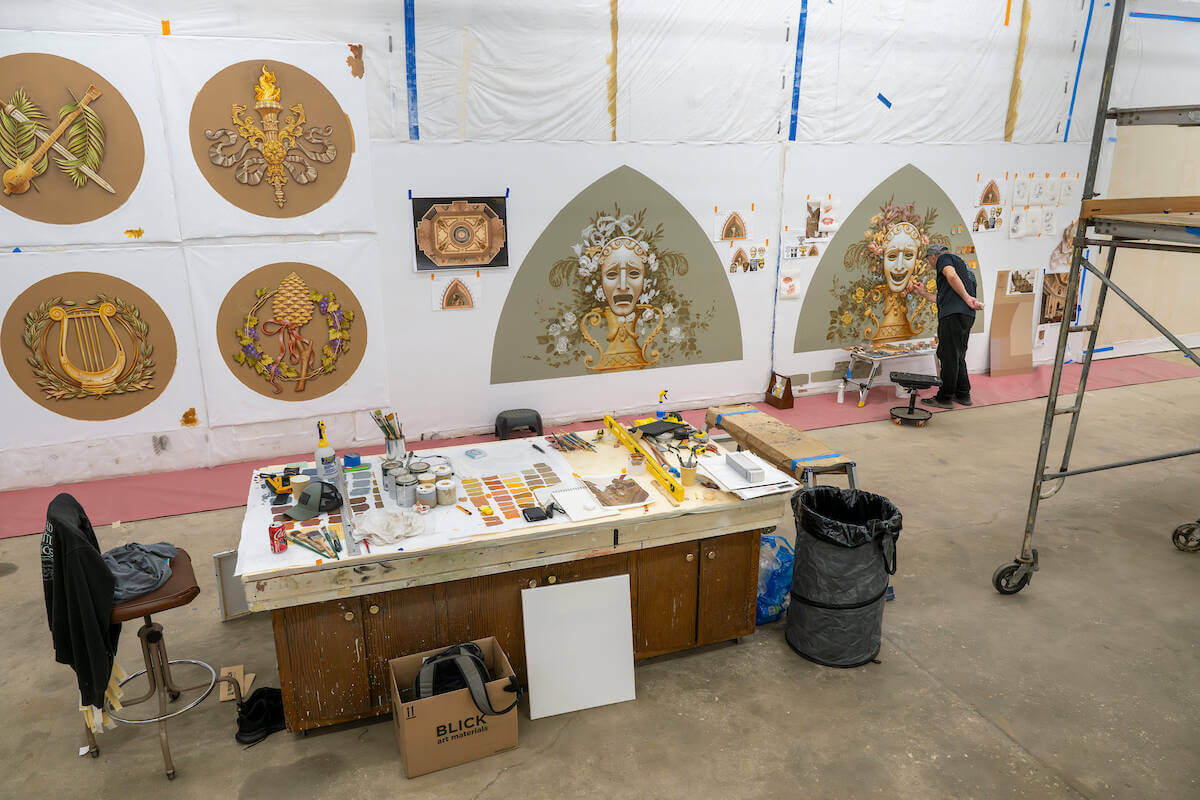
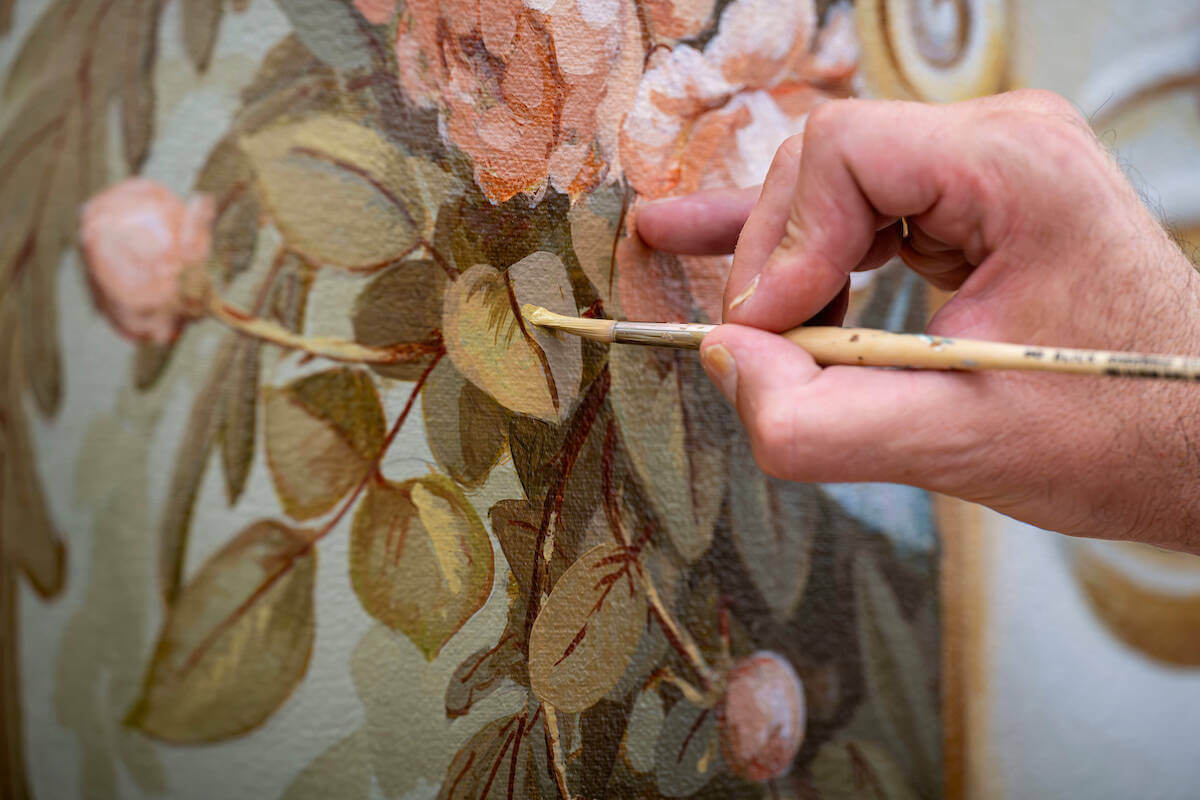
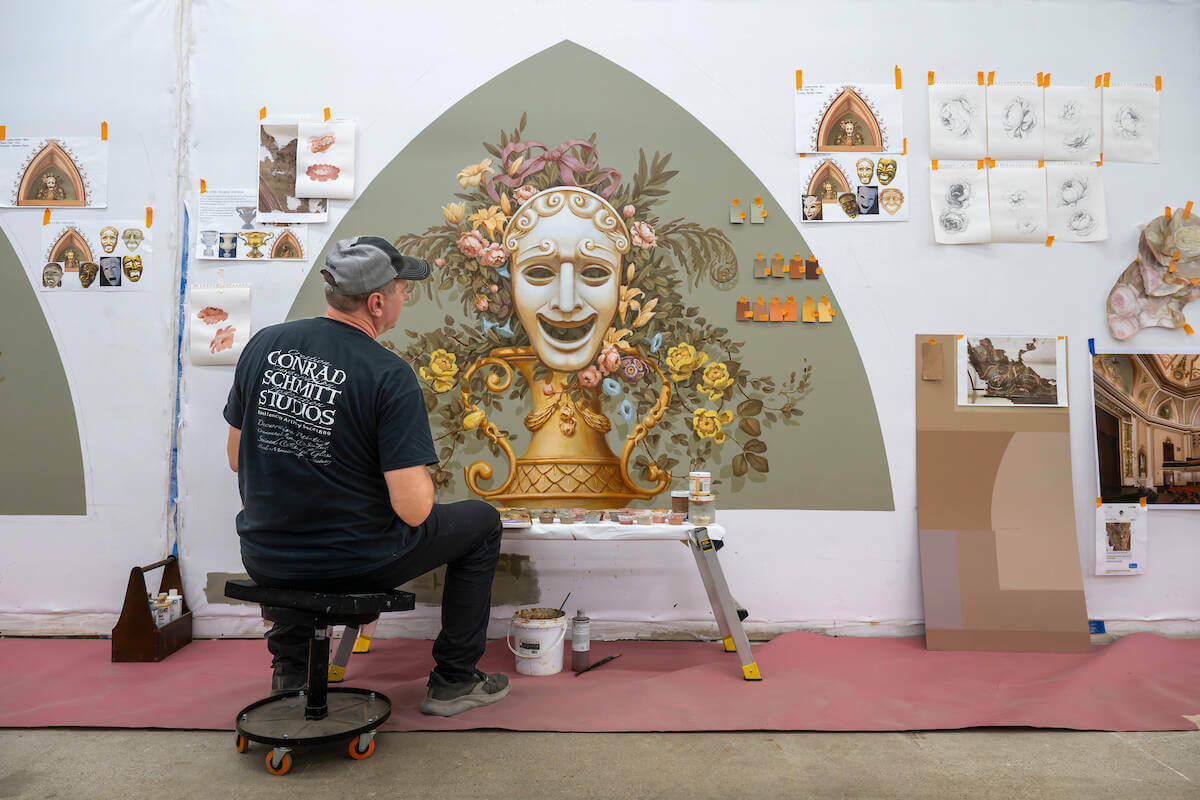
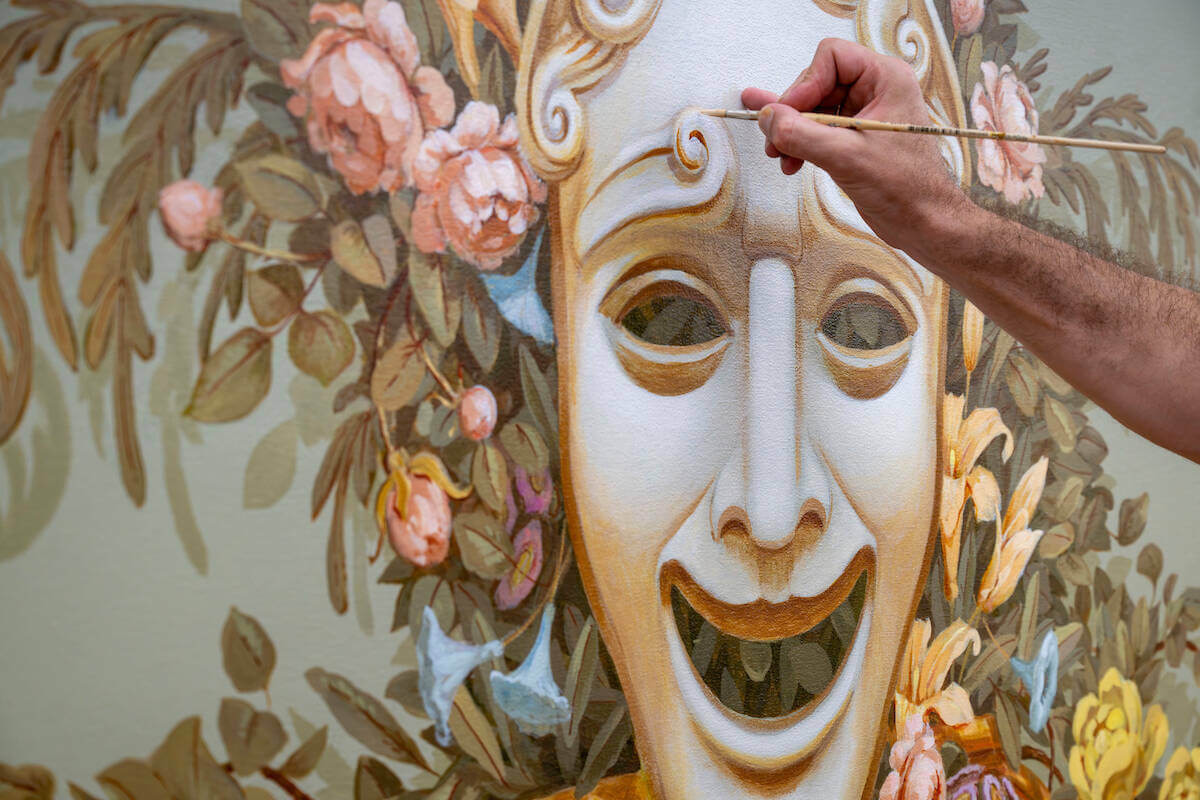
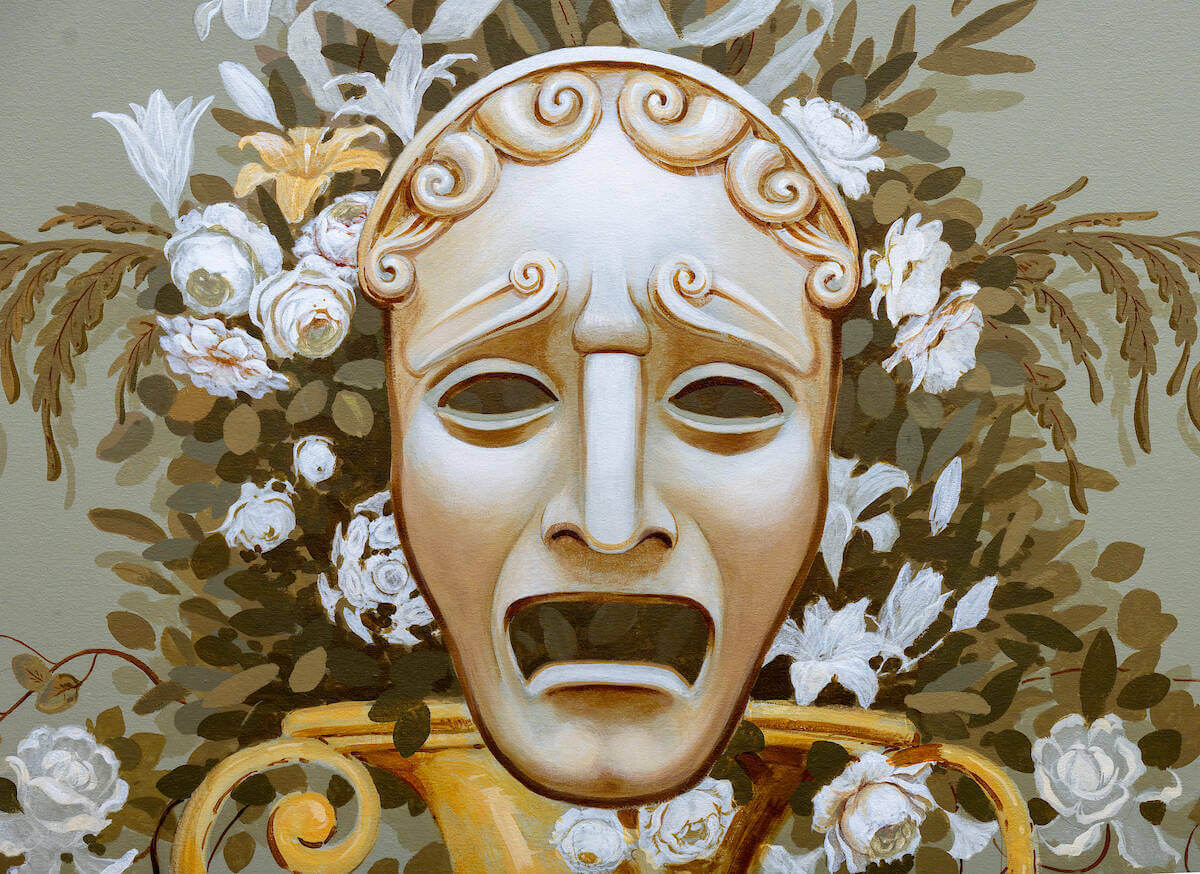
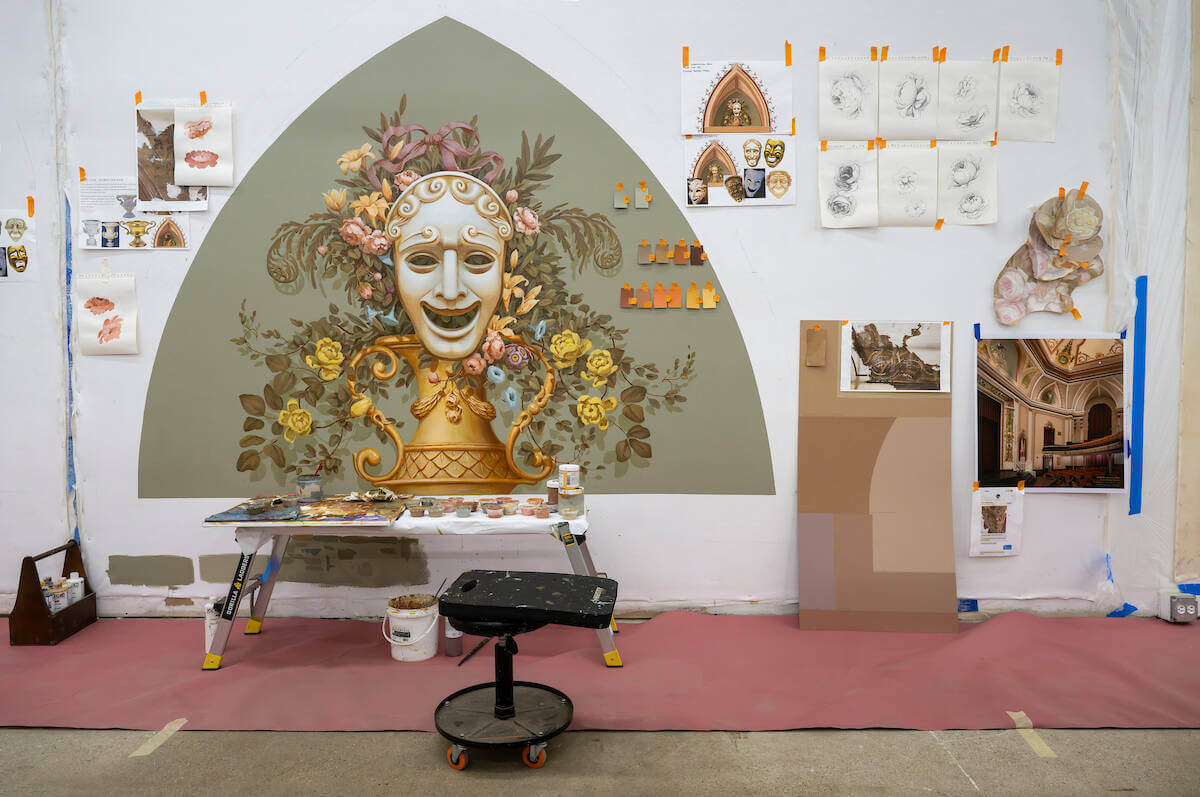
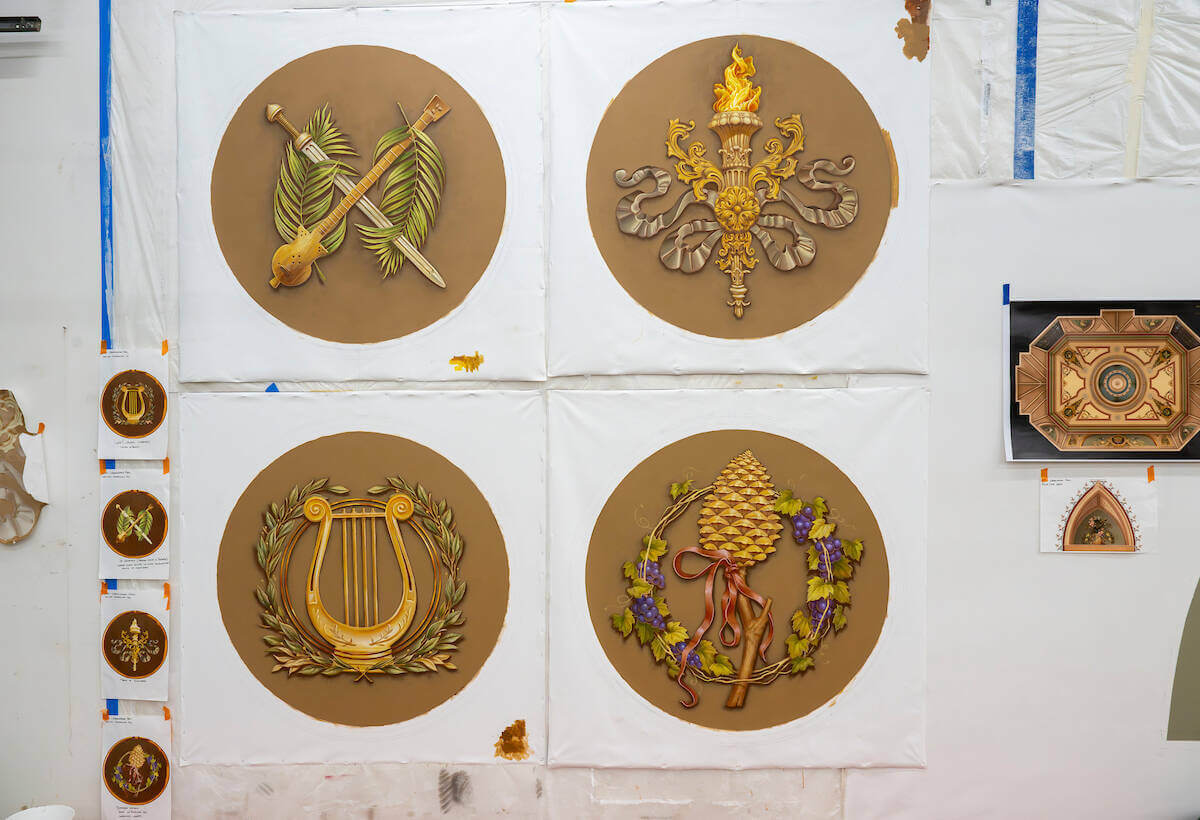
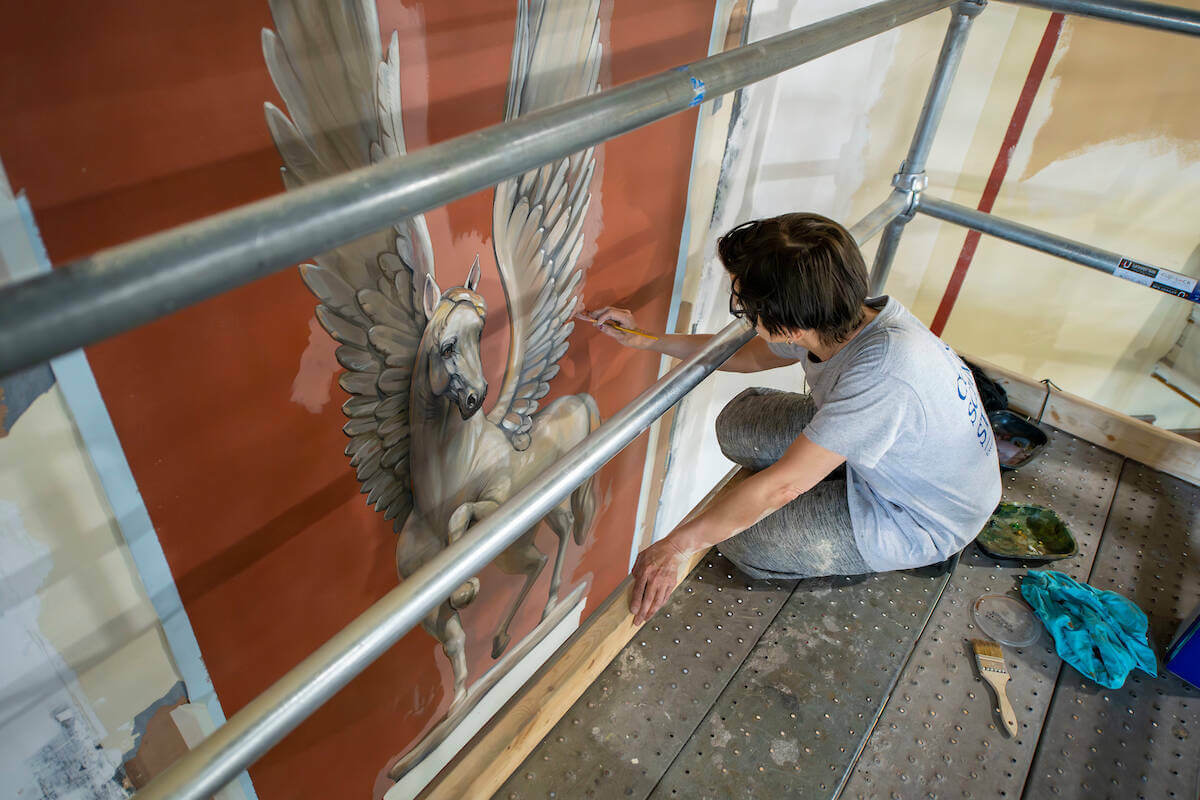
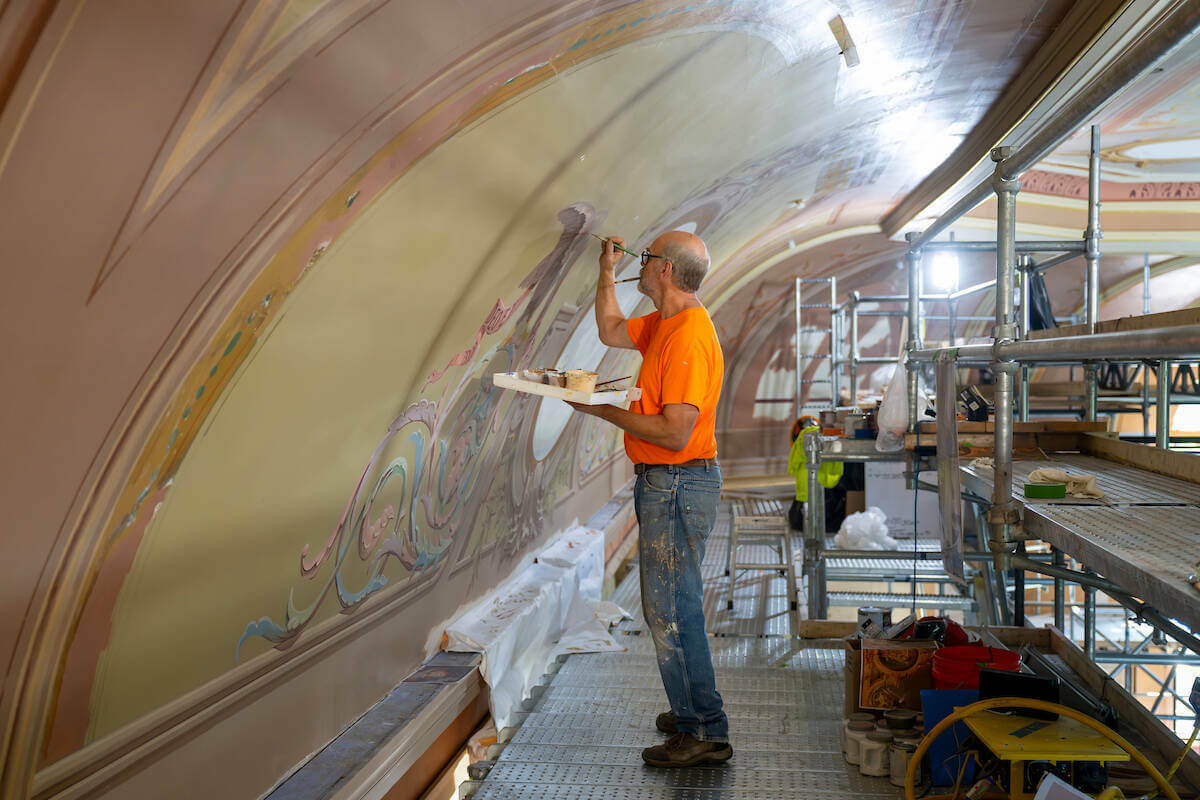
At the Conrad Schmitt headquarters, Alexander “Sasha” Lytvynenko hand-painted on canvas five large murals and smaller ceiling medallions to replace the missing Gregori portraits. A stylized, smiling face mask represents theatrical comedy. Medallions feature the Greek god Dionysus, a torch of knowledge, St. Genesius — patron saint of theater — and a lyre and laurel wreath.
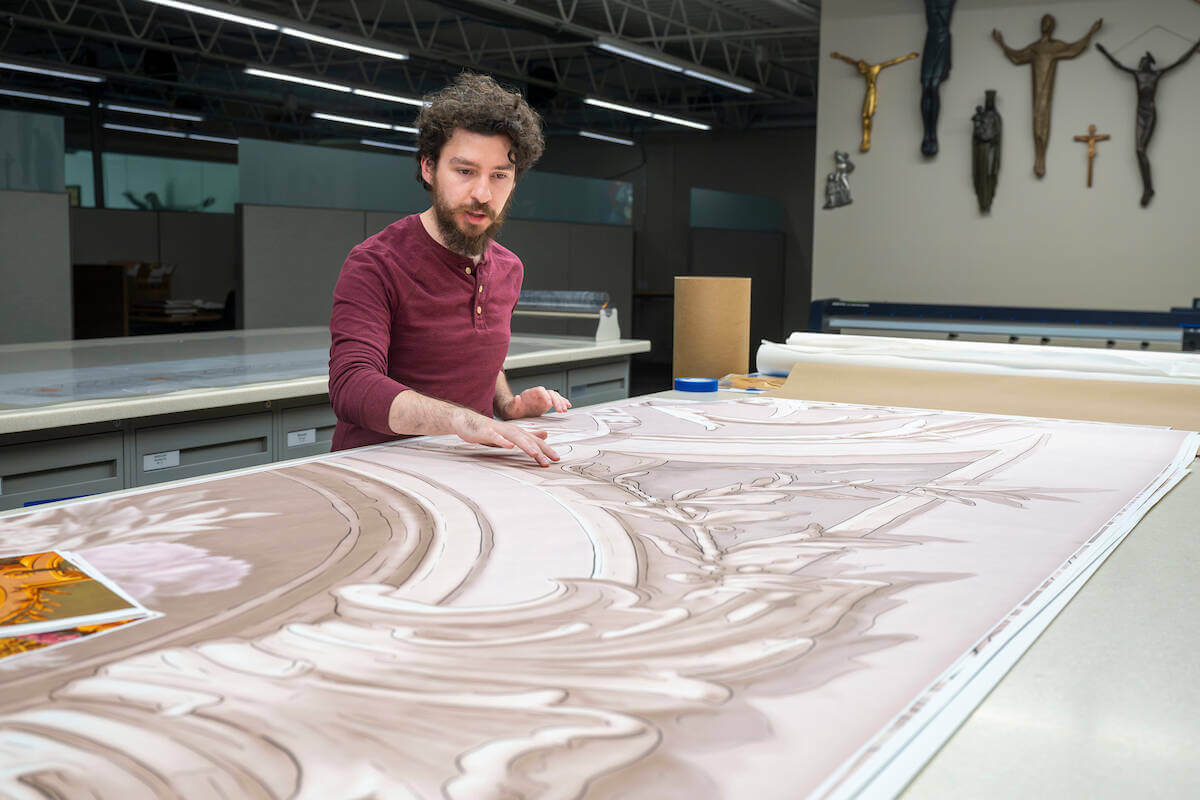
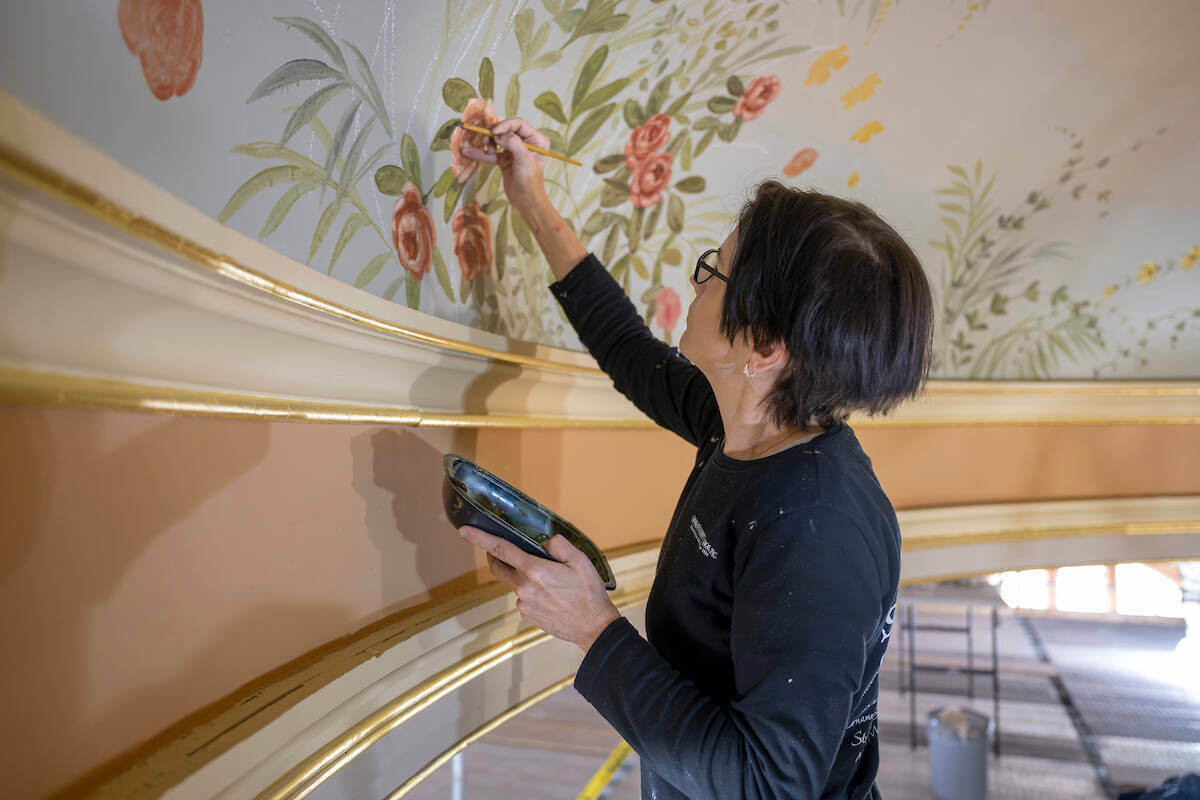
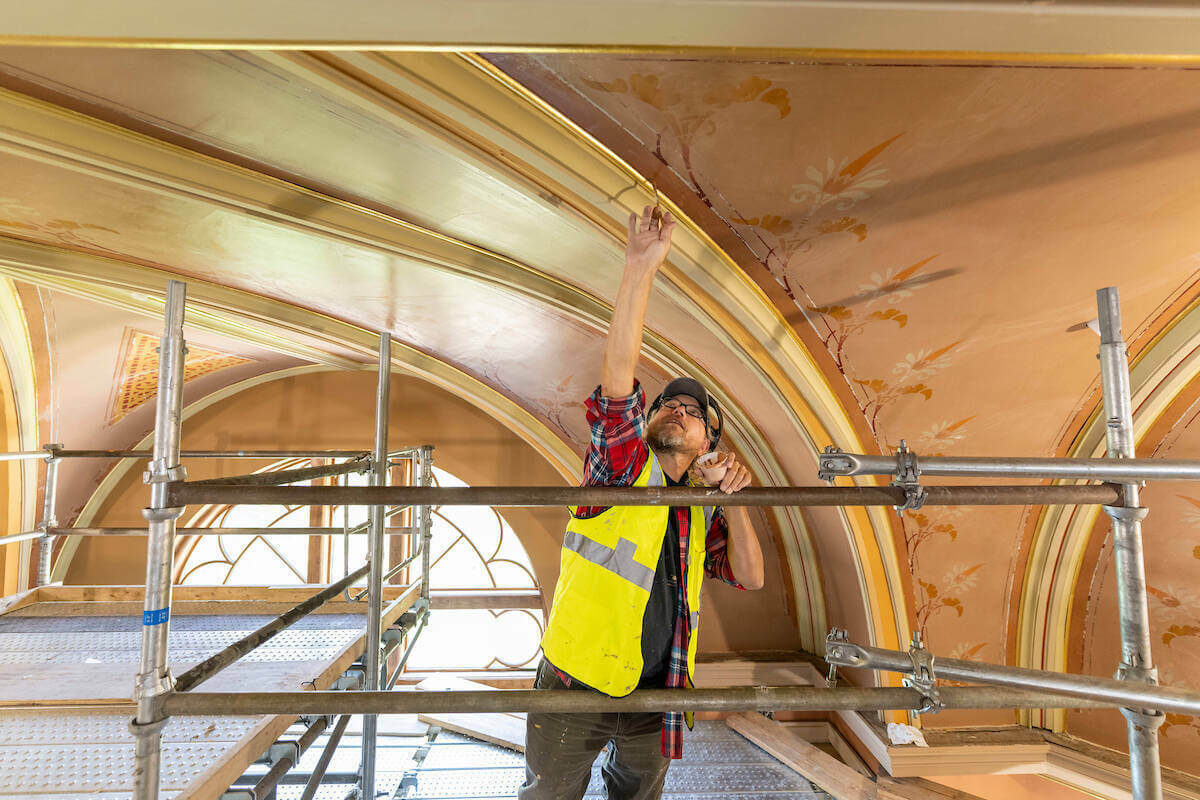
The artists on site created tracings of artwork they uncovered, which their colleagues in Wisconsin used for sizing and designing the new art. A new pastoral scene of flowers and grasses was hand-painted on the ceiling dome by Inga Belozerova, a New Jersey-based artist.
Now, the freshly decorated auditorium is nearly ready for its public debut.
Pilkinton, the professor who wrote the book on Washington Hall, no longer lives in the South Bend area, but he intends to make a trip to see the renovated space. “I look forward to coming back to see it,” he says. “I think it’s going to turn it back into that jewel box.”
Margaret Fosmoe is an associate editor of this magazine. Contact her at mfosmoe@nd.edu.